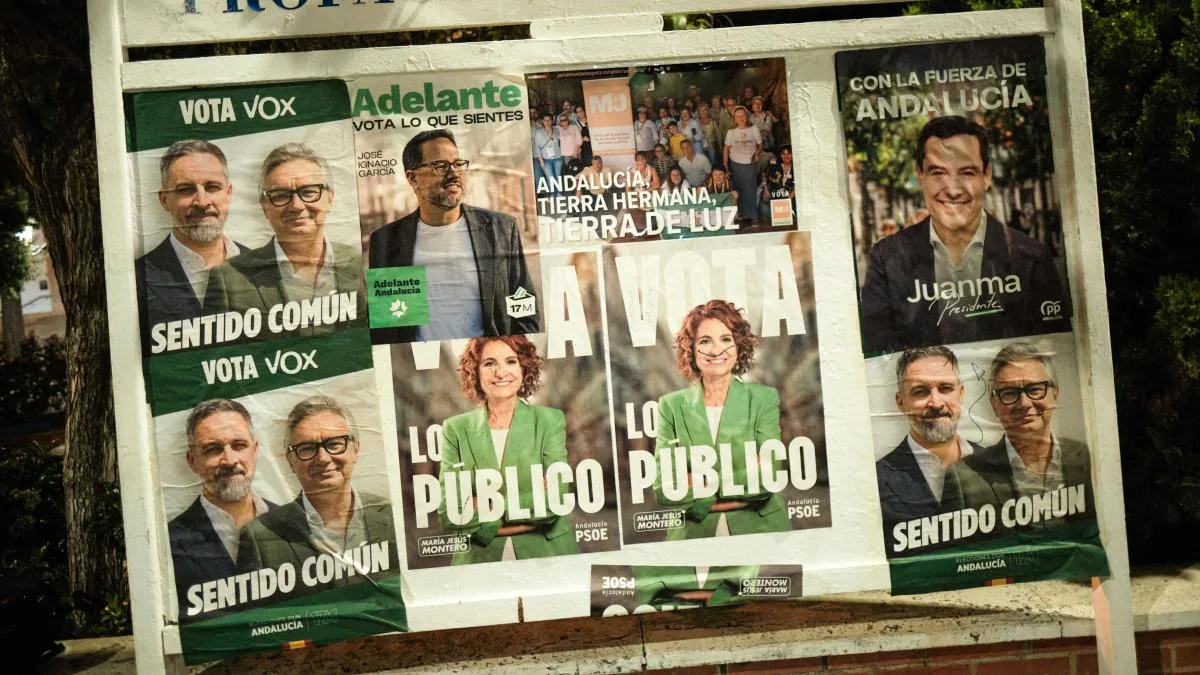
“With the strength of Andalusia” (PP), “Defend the public” (PSOE), “Common sense” (Vox), “The Andalusian left” (Por Andalucía) and “Vote what you feel” (Adelante Andalucía). These are the phrases Andalusians encounter on every corner. Brief, direct, designed to stick. Five attempts to sneak into the minds (and spirits) of an electorate being asked to get involved this 17M.
Read more The Andalusian campaign gets tangled in the ‘petaqueo’
A slogan is, according to the Royal Spanish Academy, “a brief and original formula, used in advertising or political propaganda.” In a campaign, that definition falls short since the motto combines in a few words an identity, a promise, and above all, an emotion capable of activating the vote.
All parties play the same game: to fix an idea in the collective memory. Slogans do not explain programs or develop proposals; they suggest, evoke, and seek to connect, better than the opponent, with the voter’s mood. Because in this campaign, more than ever, the battle is not just for the narrative. It is for the emotion.
Juanma Moreno: the advantage of running as president
In that battle for impact, PP-A has the advantage. “With the strength of Andalusia. Juanma, President” is not just a slogan, it is a statement of position. According to Eduardo Peinado, director of Strategic Words, strategy and political communication consultant, “it is a slogan of continuity and government, presidentialist,” which reinforces the idea of consolidated leadership.
The use of “Juanma,” he explains, “brings closeness and everydayness,” reinforcing a personal brand that “is far above that of the PP itself.” The poster does not only ask for a vote for a party, but for a recognizable figure. But the key lies in the slogan itself. “They want to appeal to the fact that those who vote for the PP are not voting for a party, they are voting for Andalusia.” The word “strength” connects with the narrative of regional growth to which the Populars constantly allude, while the “with” introduces “an idea of accompaniment, of the unity of the candidate and his proposal with the land.” Moreno does not promise to change Andalusia, but to keep walking alongside it.
“The strength of Andalusia continues one of the strong points of the Andalusian PP’s political strategy: to capture that almost orphaned transversal Andalusianist vote,” Peinado points out. A dispute, historically shared with the PSOE, that today is also reflected visually. The posters of all parties are tinged with green and white, a sign that territorial identity has become a central ground of the campaign.
María Jesús Montero: Mobilize, simplify or excite
Against that continuity approach, the PSOE opts for direct mobilization. “Vote the public” introduces an explicit call to action. “This is appropriate for a PSOE that needs to mobilize its electorate,” explains Peinado. The shift is important because the vote is not asked for a party or a candidate, but for a cause. “The vote activator is a cause.” Furthermore, the party multiplies the slogan (“Vote public healthcare,” “Vote public education”) turning it into an extension of the program. “This strategy is smart because the PSOE arrives weak as an autonomous brand and shifts the focus of the slogan to the main concern of Andalusians, healthcare.”
Vox, for its part, opts for simplification at its maximum power. “Common sense” is, in the consultant’s words, “the shortest and most memorable, the one that fits best in any conversation and the one that can win the battle without the need for arguments.” It does not explain, he states. And by doing so, it defines belonging.
Read more Inma Cuesta: “I am resentful; when someone deeply hurts me, I do not forget”
In the alternative left, strategies diverge. Por Andalucía presents itself as “The Andalusian left,” a slogan that “is weaker because it is a simple brand definition.” In contrast, Adelante Andalucía bets on the direct emotion of “Vote what you feel,” which “gives legitimacy to voting with feeling, without needing to do so with reason.”
The result is a clear map: “Juanma appeals to trust; Montero, to protection; Vox, to anger; Maíllo, to ideological authority; and Adelante, to the most emotional vote.” From the consultant’s perspective, the analysis yields a clear conclusion, that “the PP has the best and most transversal slogan, of continuity and government.”
Emotion versus argument
“The slogan duel we see in this Andalusian campaign is not precisely about ideology or change, but about emotion versus argument,” explains Peinado. And slogans no longer seek so much to explain but rather to activate. They function as quick triggers in a context of fragmented attention and increasingly impulsive decisions.
The common goal: combat abstention
All parties share a common interest, and their lives depend on it: that the electorate mobilizes. Andalusia arrives at these elections with a high abstention rate exceeding 40% in the last two autonomous elections (43.44% in 2018 and 41.64% in 2022). Hence the insistence on imperatives and emotional appeal. Because, in practice, the vote is decided less by calculation than by impulse.
To that context is added an element that can compete with politics for citizens’ attention: football. The coincidence on election evening of matches like Sevilla–Madrid or Barcelona–Betis introduces an added factor on a day where every vote counts.
Final stretch
Slogans are brief, but say a lot. Strategies, identities, and ambitions are condensed in them.
And in this Andalusian campaign, more than ever, they reveal a clear logic. It is not enough to convince. You have to excite. Because there, in that immediate reaction a phrase provokes, much of the result is being played.
Read more Clapton, blues of a survivor