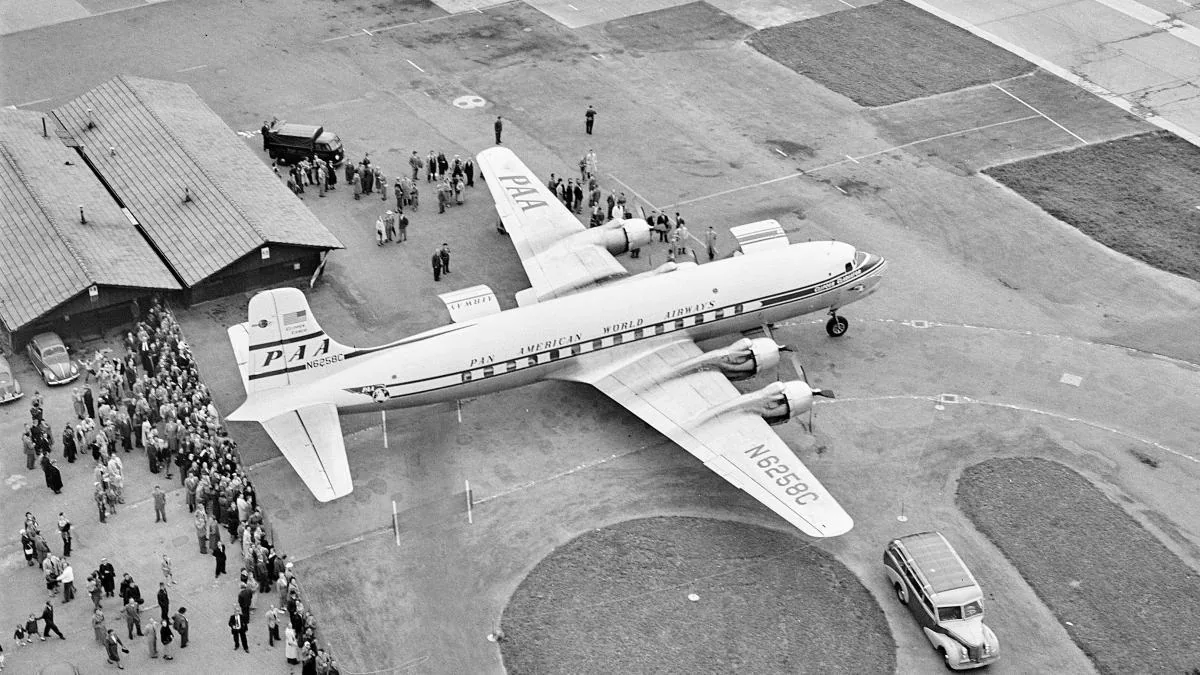
It was a forced ditching 74 years ago. An accident that changed the way air safety was understood and whose mechanical protagonist has finally been found this week near Puerto Rico. The plane, a Douglas DC-4 of Pan Am, a mythical American company that even then covered all imaginable routes. Pan Am was a symbol of a modern world and a planet that was becoming small. Initially called Pan American World Airways, it was the epitome of aerial glamour in its time, and also the involuntary reason why cabin safety on all commercial aircraft radically changed since that plane’s accident.
Read more The CNMC fines influencers Ibai, Jordi Wild and Nachter for violating audiovisual law
The Good Friday Flight
The aircraft was called Clipper Endeavor and covered flight 526A: San Juan, Puerto Rico–New York. It took off from Isla Grande Airport in San Juan on the morning of April 11, 1952, Good Friday. 69 people were on board: 64 passengers and 5 crew members. Shortly after departure, two of its four engines failed. The crew failed to keep the plane in the air and had to ditch in the Atlantic, about 18 kilometers off the coast.
The impact was not the worst part. All occupants survived the crash into the water, although the DC-4 sank in just three minutes, much faster than anyone expected from a plane of that size. In the darkness and without clear instructions on where the life jackets were or how to abandon the aircraft, most passengers failed to get out in time. 52 people died and 17 survived, rescued by boats that came to the area.
Among the survivors who are still alive today, two stories have been recovered these days: a woman who was then a young nurse (now 102 years old), who helped open the plane door so others could escape, and a baby who was found floating on the water’s surface and resuscitated by rescue teams.
From Tragedy to Regulation
The subsequent investigation, carried out by the Civil Aeronautics Board (precursor to the current US FAA), concluded that the lack of pre-takeoff safety instructions had been a determining factor in the number of casualties. The agency then proposed a series of regulatory changes to strengthen safety on flights over water: more accessible life jackets, rafts, and, above all, a mandatory explanation to passengers, before each takeoff, on where the emergency exits are and how to use the flotation equipment.
The ritual we see performed by the cabin crew every time we fly, with the demonstration of the seatbelt, the vest, the emergency exits, and the oxygen masks, largely stems from what happened that morning off Puerto Rico.
Seventy-Four Years Underwater
For decades, the exact location of the Clipper Endeavor was a mystery. A first attempt to locate it with side-scan sonar failed due to bad weather. This year, the Air/Sea Heritage foundation, in collaboration with Deep Sea Vision and the Discovery Channel’s Expedition Unknown program, resumed the search, relying on old court records from a judicial hearing held in Puerto Rico after the accident and on a map drawn by military pilots who witnessed the crash by chance during night training.
With that data, they narrowed down a search area of just ten square nautical miles. An underwater drone equipped with high-resolution sonar located the remains on June 2, at a depth of almost 600 meters, split into two sections: the fuselage and the tail. A subsequent photographic study confirmed the identification by showing the winged Pan American logo still legible on the metal. The discovery was made public on July 21. There are no plans to recover the remains as the expedition leaders have stated that they consider the site a tomb and it will not be disturbed.
The Company That Was Synonymous with Modernity
Pan American World Airways was born in 1927, founded by Juan Trippe, a young entrepreneur with an obsession: to connect the world by air before anyone else. It started with airmail between Florida and Cuba from Key West, and in just a decade, it was already operating the legendary Clipper seaplanes that crossed the Pacific and the Atlantic, turning weeks-long sea voyages into one or two-day flights. For decades, alongside Howard Hughes’ TWA, it was the other great face of American aviation: while TWA dominated much of the domestic routes, Pan Am reserved the international skies and, with it, the almost diplomatic representation of the United States in the world.
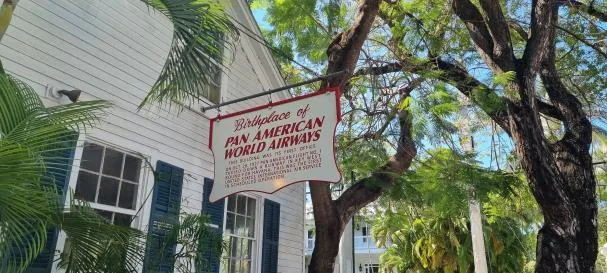
It was Pan Am that spearheaded the era of commercial jets with the Boeing 707 in 1958, and in 1970, it introduced the Boeing 747, the ‘jumbo’ that, in its own way, democratized transatlantic flight. Its flight attendants and commanders were almost cinematic figures, and flying on a Clipper was, for several generations, the ultimate expression of glamour and progress: the promise that the planet had finally become small and accessible.
However, that same world Pan Am helped build eventually left it behind. The deregulation of the sector in the United States in 1978 opened the door to new airlines with lighter structures and broke the model of protected routes on which the company depended. In 1988, the bombing of its Flight 103 over Lockerbie, Scotland, with 270 deaths, was a reputational and economic blow from which it would not recover. Pan Am declared bankruptcy in 1991, the same year, almost symbolically, that commercial aviation began to resemble what we know today: routes open to competition and a mass market very different from what it had invented itself.
Read also
However, its most lasting legacy remains, and it is precisely that which has resurfaced this week off Puerto Rico. Every life jacket explained before takeoff, every emergency exit pointed out, is a direct consequence of that 1952 ditching. And it is no coincidence that, despite the constant increase in air traffic, flying remains, proportionally, the safest means of transport available: that history has been built accident by accident, investigation by investigation.
Finding the remains of the Clipper Endeavor after 74 years is, in that sense, more than an archaeological discovery. It is a reminder of how air safety truly works: not by seeking culprits, but causes. Every thoroughly investigated accident (from that DC-4 sunk in three minutes to the accidents analyzed today) has historically served to close a flaw and prevent it from recurring.
Pan Am no longer exists, although the automatic reflex of listening to safety instructions before each takeoff, that gesture few now pay close attention to, remains, seventy-four years later, its most important legacy, along with nostalgic black and white photos, seaplanes, Boeing 707s, and those first jumbos.
Read more Nighttime heat causes more deaths than high daytime temperatures