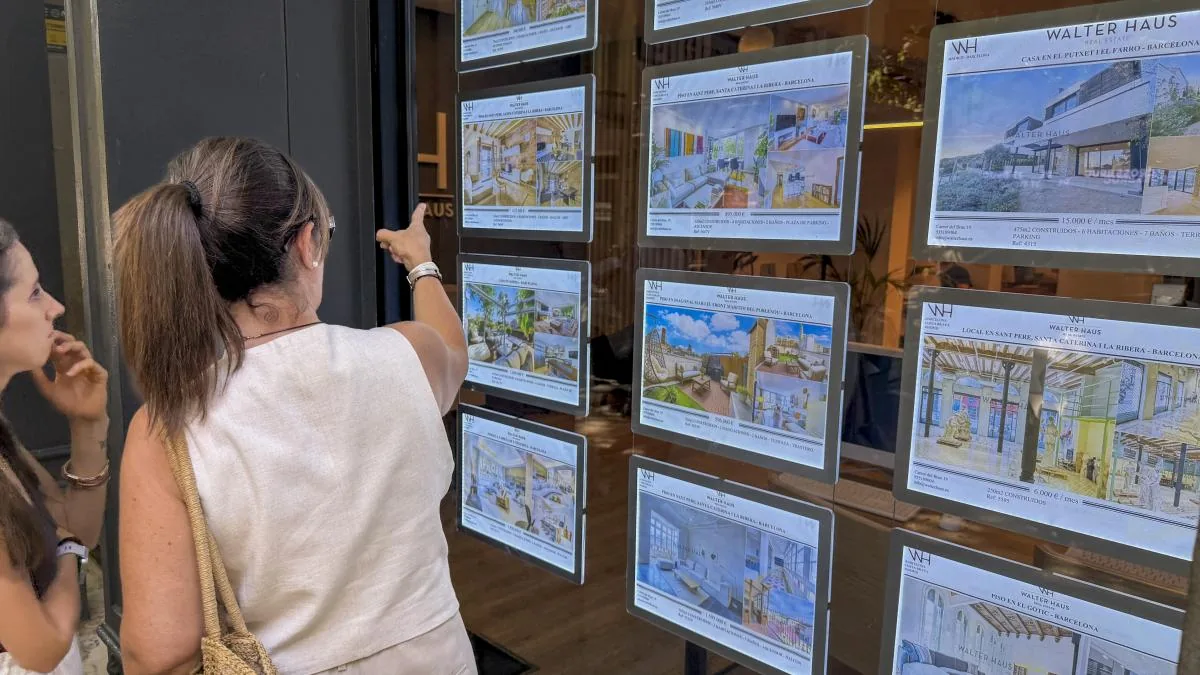
Despite the perception that investment companies dominate the buying and selling of homes in Barcelona, data shows that the vast majority of transactions in the Catalan capital are still carried out by individuals. According to a report prepared by the Cambra de la Propietat Urbana de Barcelona with data from the Notary Statistical Portal, natural persons accounted for 87% of registered sales in 2025, compared to 13% signed by legal entities. Last week, the Parliament gave the green light to urgently process the restriction on buying homes in pressured areas unless it is to live in, for a family member, or to rent it out residentially, aiming to prevent real estate speculation by funds.
Read more A minor dies crushed by a landslide in some pools in Gandesa
That said, although their weight is minor, legal entities had much more presence in certain postal codes in the city center, where pressure on housing access has intensified.
For example, in 08008, located between Dreta de l’Eixample and l’Antiga Esquerra de l’Eixample, legal entities already account for 42.3% of transactions. In 08007, which corresponds to the Paseo de Gràcia and Rambla de Catalunya area, the percentage is 38%; while in 08010, near the Tetuan and Urquinaona squares, sales by legal entities are one third. Another postal code where their presence stands out is 08002, in the Barri Gòtic, where they concentrate 31%. In contrast, in areas like Marina del Port and Marina del Prat Vermell, in the Sants-Montjuïc district, companies make up 4.7% of acquisitions.
The cheapest properties in the capital have increased in price by up to 90% in the last ten years
On the other hand, the report also analyzes the nationalities of people buying properties in Barcelona. 68% are Spanish and foreigners represent 32% of the total. Still, of this percentage, foreigners who already reside in the city are 27%, and only 5% correspond to foreigners who do not live in Barcelona.
The weight of native buyers has been decreasing since 2007, when it exceeded 90%, as the number of people of other nationalities has grown. The authors of the study consider that this evolution reflects demographic changes that have occurred in recent decades, with an increase in the international population established in the city.
Read more Segura Viudas drives the culinary future by opening the doors of its Heredad to emerging chefs
Among foreign buyers, the most common are Italians (6.5%). According to municipal registry data, this is the largest foreign community in Barcelona, with 54,036 people, although this is also explained by dual nationality agreements with countries like Argentina. Italy is followed by France (3.9%), China (2.9%), the United States (1.7%), and Germany (1.7%). However, these origins do not entirely match the most common nationalities among foreign residents in Barcelona, as others like Colombia, Pakistan, Peru, or Morocco have a reduced presence among buyers. The authors of the report suggest as a possible explanation that these groups rely more on renting as a way to access the housing market.
89% of the city’s residential stock is in the hands of owners with fewer than 6 homes
The housing crisis does not affect everyone equally. For people with lower income, the effort to access home ownership is greater, and the price increase in large cities like Barcelona makes it even more difficult. According to the study, the cheapest properties in the Catalan capital are those that have increased the most in price over the last ten years. The first quintile, representing 20% of transactions with the lowest prices, has gone from an average of 100,000 euros in 2015 to 190,000 euros in 2025. This is a 90% increase, almost double, more than any other segment. In contrast, the price rise, although significant, was more limited in the fourth quintile, the most expensive, with 62.6%. In the second and third quintiles, the increase was 77.6% and 74.4%, respectively.
Finally, the report from the Cambra de la Propietat Urbana de Barcelona challenges the idea that many homes are in the hands of large holders. 63.1% of the city’s properties belong to owners with a single home, and 26.3% correspond to owners with between two and five apartments. That is, 89.4% are “small owners” with five homes or fewer. Those who have between six and ten are 3.8%, and those who own more than 100 apartments represent 2.6% of the total residential stock. Considering these data, the authors argue that large holders have a “limited presence” in the overall structure of Barcelona’s housing market.
Read more “You have to have dreams in life, if you don’t create them”