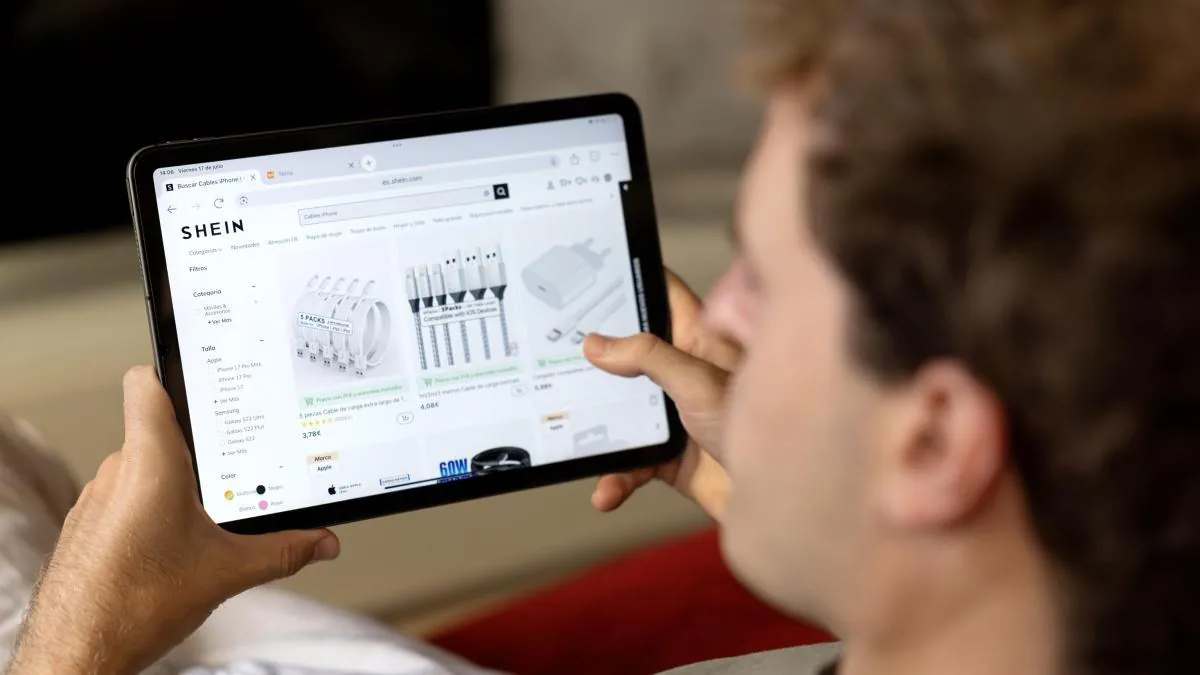
Purchases from Chinese platforms in Spain cause a revenue shortfall of 1.058 billion euros in the trade and distribution sector. Whether Shein, Temu, or Alibaba, behind the cheap purchases there is a greater impact than consumers imagine, blindly guided by price. The truth is that their packages usually pay VAT on less than their real value; social security contributions and personal income tax are lost by avoiding setting up a chain of stores, workers, and local suppliers; and companies do not face corporate tax like local ones, as these are foreign-based brands with minimal presence in Spain.
Read more Mortgage signings slow down and break a nearly two-year upward streak
This is reflected in a study by the National Association of Large Distribution Companies (Anged), which groups the main groups in the country, accessed by La Vanguardia. Every year Spaniards spend about 3.6 billion euros on purchases from Chinese platforms, with one of the highest penetrations in Europe. By spending on digital stores and not locally, always starting from a calculation base linked to employment, the breakdown shows 490 million euros lost in social security contributions and 175 million in personal income tax. The labor side – more than 660 million in total – concentrates the impact. Another 312 million is due to uncollected VAT and the remaining 81 million due to unpaid corporate tax. The figure would be even higher if local taxes or property tax were added and scaled to the entire economic universe, since Anged focuses on eight branches of retail trade and its chain, such as textiles, electronics, transport, or logistics.
Behind low prices there is a “hidden bill” of costs invisible to the consumer
Between consumption, labor, and profit, “the same euro spent on a non-EU direct sales platform passes, in the best case, through only one of these doors, and often only halfway,” it is suggested. VAT, if paid, is in any case reduced by “a systematic undervaluation of low-value shipments” that erodes “a substantial part” of the revenue. As a result, while one euro spent in local distribution generates 38.1 cents in revenue – in personal income tax, VAT, contributions… – the same euro on an Asian platform collects 8.7. Even if the price is the same. That is 27.8 cents lost between margin and repatriation to headquarters. “The revenue drop would not be so great if they were here,” highlights Yolanda Rodríguez, chief economist of Anged, which includes El Corte Inglés, Carrefour, Ikea, Fnac, or Leroy Merlin, among others.
The sector talks about a “fiscal and regulatory asymmetry” due to lack of compliance with regulations. The playing field is the same, but local distribution has more requirements than Asian, there is “unequal treatment.” Although the law obliges equally, the lack of controls unbalances. The problem is the volume of shipments and the inability to analyze the merchandise. It is estimated that 5.9 billion low-value packages (up to 150 euros) arrived in the EU last year. In Spain, there were 220 million. The avalanche causes a lack of control that allows 65% to be declared below their value. Until a few weeks ago, they were exempt from tariffs, something that has been exploited to the maximum, making it a “backbone of a massive direct import model,” something the regulation did not anticipate or prevent.
The 3-euro fee per category that began to be charged this month on low-value shipments does not cover the billion-euro gap and is temporary. As designed, the revenue largely – 75% details the European Commission – goes to finance the European budget, not the countries. “It could only partially alleviate the problem, although it may cause a change in habits, something yet to be seen,” comments Rodríguez.
Read more What do the neighbors of Barcelona eat? There are areas without access to fresh and healthy products
There is seen to be an “asymmetry” in law enforcement and the new 3-euro fee on purchases does not compensate
Another data point from the study is that due to the diversion of spending to Asian platforms, a gross added value of 3.228 billion is not generated in the country and about 56,200 jobs are at risk between distribution and its suppliers. “The product may be the same, but the distribution chain that brings it to the consumer is not, the chain breaks,” the study states. Catalonia is the most affected, with 11,000 jobs at risk. Considering that e-commerce is growing, if the trend continues without reforms, 116,000 jobs are projected for 2030. The European customs system is still pending reform, expected to materialize in 2028, provided deadlines are met. It would move to a more digitalized model that would allow increased control of what enters, something impossible today. Another black spot in regulation is that in China it is easier to access aid.
All this results in a “hidden bill.” “Together, these invisible costs change the nature of what seems like a bargain. The consumer’s savings are, to a large extent, a transfer of risk to themselves, of revenue and control capacity to the Administration, of environmental cost to society, and of activity to compliant commerce,” it summarizes. Rather than banning, enforcement of regulations is urged. As solutions, Anged proposes leveling the playing field, more resources to control customs, or effective VAT collection. There is also a demand for the lack of an entity with sanctioning power, something only repeated in Poland. Parliamentary blockage hinders its implementation.
Economic impact… and social impact
Beyond the economic or labor impact quantified by the study, Anged mentions other effects on the more social side, such as sustainability or product safety. For example, the obligation to resolve calls for problems in less than three minutes or human assistance is avoided, which reduces consumer rights. Likewise, up to 43% of products coming from China are dangerous, according to report figures, although they reach their destination. And bringing the millions of packages arriving in the country by plane also raises questions about sustainability, especially if returns management is added.
Read more Burnham announces “immediate” measures to reduce the cost of living while reforming the Government