The first day on which the extraordinary regularization of immigrants in Spain can be processed is characterized by a low influx of applicants at Post Office branches and authorized points, as confirmed by La Vanguardia. The vast majority of potential beneficiaries are still stuck in preliminary procedures, such as obtaining the historical census record and the vulnerability certificate.
Read more The CIS places the PSOE at its highest point in the legislature, with Vox falling
At the Correos branch on Consell de Cent street in Barcelona, the morning passed with almost total normality. This is one of 50 throughout Catalonia that is authorized to carry out the regularization, and according to the public company, between 800 and 900 people are expected to process it today.
At the office, there was no trace of queues, nor people waiting at the door before opening, nor anything of the sort. By half past ten in the morning, only five people had been attended to for regularization. And for most of them, the process could not be started due to a lack of necessary documentation.
Catalina, an Ecuadorian who has been in Spain for more than three years, was one of the few who achieved her goal this morning. With the relevant prior appointment, and after 45 minutes attended by a postal office employee, she was able to successfully complete the application. Upon leaving – with a big smile and “relieved” – she stated that she had “very clear” what she had to present, but pointed out that the staff still doesn’t have the process down pat: “They need someone to guide them through the system.”
Inside the office, Correos members acknowledged that the process was being “slower than expected” as it was their first time carrying it out.
A family, who had tried to complete the process before Catalina, finished in just five minutes, as they did not have the vulnerability certificate and could not present it.
At the doors of the Correos branches, there is an informative sign indicating the need for a prior appointment to start the regularization process. This deterred many throughout the morning.
CSIF reports computer failures
In any case, the Independent Trade Union and Civil Servants’ Central (CSIF) has reported repeated failures in the computer system for regularization applications, which has even led to the closure of an office in Granada. The most representative union in public administrations specified that these technical problems, which have spread “throughout practically all of Spain,” have caused delays of up to an hour and have resulted in some people having to be rescheduled for Tuesday.
For its part, the CC.OO. union has demanded that Correos increase staff reinforcements by at least 30% of the general workforce to handle the process, as well as 40% in Andalusia, where it coincides with regional elections.
Bottleneck in preliminary steps
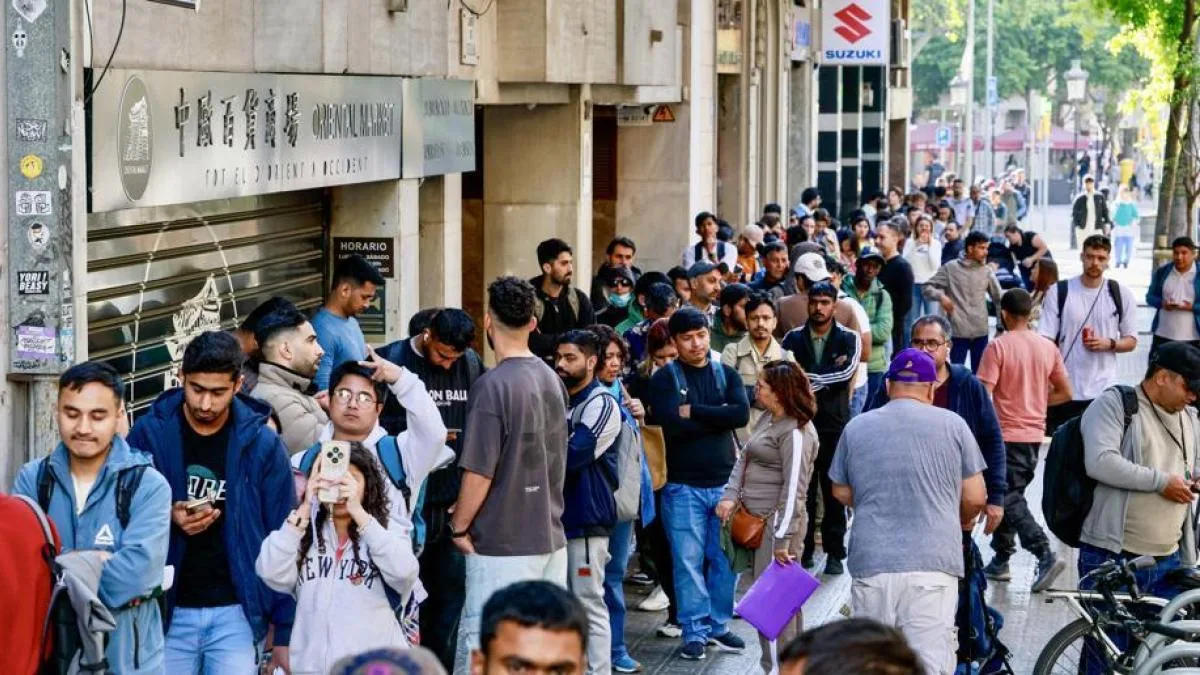
Just two blocks from that postal branch, at Sicília street 216, is the City Council’s Citizen Attention Office (OAC). There, the scene was quite different. From early morning, hundreds of people waited for the office doors to open, hoping to obtain the historical census record and the vulnerability certificate.
Far from it, they had to settle for half the papers. As the first people in line left, they informed others that this delegation did not process the vulnerability document and directed them to “social entities” accredited for this purpose.
Read more What makes Sánchez happy
Despite not having been able to achieve everything they set out to do, many hugged each other upon leaving or greeted each other warmly for having obtained part of the documentation.
The earliest risers started queuing from five in the morning, like Gloria – a woman from Peru who was among the first ten – who got up at four. And those who arrived from seven o’clock – still an hour and a half before the doors opened – already had more than a hundred people in front of them. Those in the queue were mostly accompanied, either by family or friends.
For example, Ayyoub and Otman – two friends – asked other people for help to fill in some details on their documents because they didn’t understand what was being asked of them in Spanish.
Queues and lack of knowledge
The OAC opened punctually at half past eight; only at that moment was there a small moment of tension when some tried to skip the queue and enter the office. Those who had a prior appointment were able to enter first – barely a dozen – and the rest followed without further problem.
Those arriving after opening time looked incredulous and resignedly went to the end of the queue that turned onto Gran Vía and reached halfway down the block. Things got complicated at midday because the computer system also collapsed, which extended the wait, in some cases up to three hours.
Obtaining the census record does not take more than ten minutes if the form is filled out correctly, according to some applicants, but the queue did not diminish due to the constant trickle of people arriving. Upon leaving, many checked that they had all the documentation and scanned a QR code at the entrance to check their next steps.
Another factor is that not everyone in line was clear about what they needed to present. Those who had tried to gather information on their own or through acquaintances were a bit disoriented. In contrast, those who had contacted a lawyer for advice were very confident about the procedures. Like José, who was reciting all the documentation he needed to present for his mother to check.
At the consulates, there was also disparity. While the Ecuadorian consulate had a completely normal day attending to routine procedures, there was more hustle and bustle at the Venezuelan one. The Venezuelan delegation in Barcelona is located in Plaza Urquinaona, where about twenty people were queuing in the street to obtain the certificate proving they have no criminal record.
Almost 42,800 people have submitted online regularization applications until Sunday
A total of 42,790 people have submitted online applications to begin their regularization process in Spain since this procedure started last Thursday and until midnight, according to the Government.
In a press conference from Las Palmas de Gran Canaria, the Minister of Territorial Policy and Democratic Memory, Ángel Víctor Torres, has detailed that on Thursday, the day the processing began, 13,400 applications were received; on Friday, 13,500; on Saturday, up to 8,300; and on Sunday, 7,300 regularization requests throughout the national territory.
The minister also stressed that in the same period, 29,900 people had requested in-person appointments for assistance at one of the offices authorized for this procedure.
Read more U.S. wants to investigate whether the ‘patriotic police’ misled it to close the Andorran bank BPA