On August 12, the first total eclipse visible from the Iberian Peninsula in the last hundred years will take place. For weeks, Sanitat has been emphasizing — through statements, advertising, and press conferences — the importance of protecting the eyes during the observation of this astronomical phenomenon. Although the totality phase of the eclipse in Catalonia will last barely between 28 seconds and 1 minute and 32 seconds, the Government — as well as the different autonomous communities and the Ministry of Health — expect great social anticipation, especially concentrated in the areas where the eclipse can be observed in totality, that is, in areas of Camp de Tarragona and Lleida.
Read more Race to identify homeless minors: Where will they go after crossing the border in Ceuta?
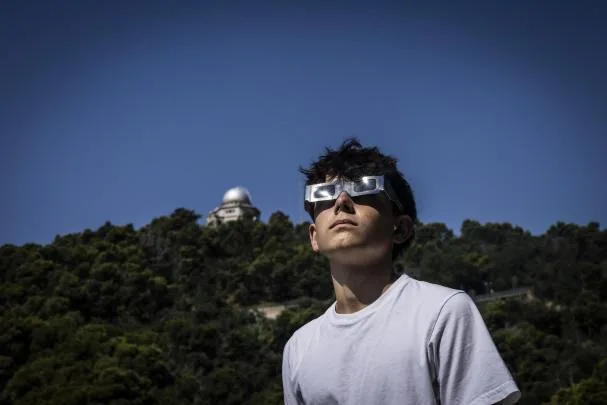
Although the eclipse event is expected to have a festive character, ophthalmologists warn that it also carries a significant risk. Observing the sun without proper protection can cause irreversible damage to the retina. It is enough for a small part of the solar disk to be exposed for electromagnetic radiation and infrared and ultraviolet light to cause severe injuries to the ocular tissue.
Injuries are not immediate and can appear between 24 and 48 hours later
Estefanía Cobos, a retina specialist ophthalmologist at the Bellvitge University Hospital, warns that those who observe the eclipse without proper protection should pay attention mainly to three symptoms. “The most recurrent condition is known as solar retinopathy,” explains Cobos. “When the eye looks directly at the sun, the damage is concentrated in the central area of the retina,” where the light is focused.
Although the symptoms of retinopathy can be very evident – such as the appearance of a black spot (scotoma) in the center of the visual field – one of the main risks is that the retina gives no signal of the damage suffered, as it does not have pain receptors. Cobos warns that the damage also does not manifest instantly. “Once the injury occurs, the photoreceptor cells of the retina progressively die. Symptoms can appear between 24 and 48 hours after exposure,” Cobos states.
Also read
Still, the condition also known as eclipse retinopathy is not the only possible consequence. In other cases, a visual distortion of the image (metamorphopsia) can occur, causing straight lines to appear wavy, partial vision loss, or photophobia, that is, an excessive sensitivity to artificial light.
“Only if the damage to the photoreceptors is not complete could vision be recovered in the future”
Estefanía Cobos
Retina specialist ophthalmologist at Bellvitge University Hospital
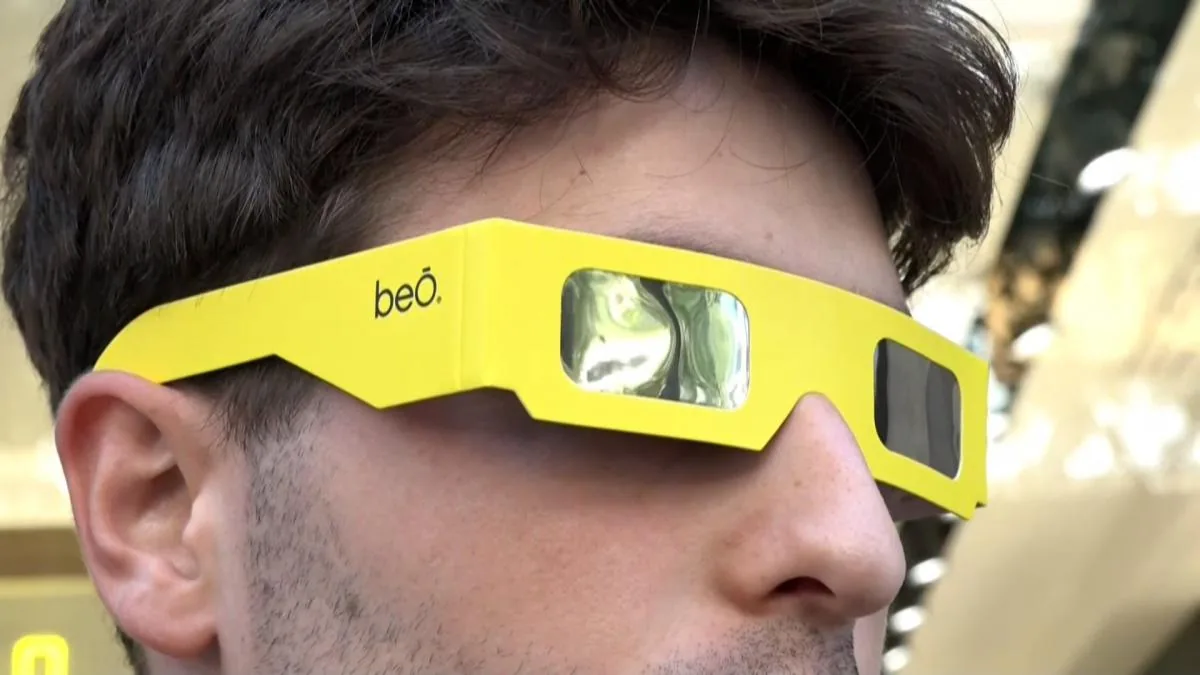
According to Cobos, “the patient may take a few days to detect the impairment.” In the case of metamorphopsia, for example, “they may not perceive the problem until days later, when straining their eyes to read or trying to focus on a specific detail.” Given the risk of irreversible damage, this specialist insists that “the only safe measure is always to use ISO 12312-2 certified glasses.”
Furthermore, she reminds that “anyone who has imprudently looked at the sun without protection should go as soon as possible to an ophthalmological emergency service” for diagnosis. Still, Cobos points out that there is no treatment capable of restoring the affected areas of the eye. “Only if the damage to the photoreceptors is not complete could vision be recovered in the future,” she adds.
Youth and children are the most vulnerable groups to suffer any impairment during a solar eclipse. “The risk is especially among young people and adolescents, who often lack adequate information or do not give much importance to the eclipse.” This specialist recalls that ophthalmology services already recorded an increase in retinopathy cases among young people during the rise in laser pointer use among the youth.
Read more What do we do with the minors of Ceuta?
Keeping protective eyewear on throughout the eclipse is the only safe attitude: “a fraction of a second could be enough”
On the other hand, the only safe way to observe an eclipse is to keep certified protective glasses on throughout the process. You can only look at the sun without protection when the star is completely covered by the moon. Alejandro Filloy, a retina specialist at Joan XXIII University Hospital, warns those who remove their glasses to see the eclipse: “a fraction of a second could be enough.” Filloy recommends informing yourself beforehand about the duration of the total phase of the eclipse and putting the glasses back on 15 or 20 seconds before the Sun reappears. “It is the only safe attitude,” warns this specialist.
Additionally, he assures that, since there has not been a total eclipse in over a century, there are no recent national records on the profile of patients who go to emergency or primary care services for eye injuries related to this phenomenon. However, data from other countries indicate that children are the most vulnerable group due to their lower awareness of the phenomenon and the risk it entails.
However, this specialist warns that “the eye of a young person has a larger pupil and is internally more transparent,” which makes it more susceptible to injuries. In contrast, in older people, the presence of cataracts can act as a filter and prevent solar radiation from passing through, although it does not eliminate the risk in any case.
Catalonia and the Basque Country are the only regions affected by the eclipse that have not yet expanded healthcare attention
So far, Catalonia and the Basque Country are the only regions located in the visibility band of the eclipse that have not yet announced extraordinary measures in health services. Galicia announced reinforcements in health areas with higher visitor influx; Asturias will extend shifts, the Cantabrian government will increase emergency services, and Castilla y León and La Rioja have applied extraordinary measures in anticipation of a possible increase in assistance due to eye injuries.
In this regard, the Generalitat Valenciana issued a statement yesterday announcing that it will implement a special health device with 13 additional ambulances, extended hours in reinforcement care services, and the strengthening of 15 primary care centers. The statement also called for focusing care on children and adolescents, considering them a risk group “due to their curiosity and lower risk perception.”
On the other hand, in the Balearic Islands, the Conselleria de Salut directly recommended that children under six years old not observe the eclipse. Additionally, the Balearic Government plans to increase 160 professionals between primary care and hospitals and is rescheduling surgical interventions to free up beds ahead of the eclipse. The device not only responds to a possible increase in ophthalmology cases but also aims to anticipate possible accidents resulting from the high mobility and concentration of people expected during the day on the island.
Read more Robles, Marlaska, Bolaños and Albares will appear in Congress at the end of August over Ceuta