About new things
The encyclical of Leo XIV on AI is a major text that will shape the social debate
Artificial intelligence (AI) fascinates and repels, frightens and seduces, and is, above all, fundamentally mysterious, the ultimate reason for the fear it inspires in a large majority. It has landed in our lives, and everything indicates that its impact will be decisive in the world…
A specter is haunting the world: the specter of Artificial Intelligence (AI). It will destroy jobs on an unprecedented scale. It will make wars more lethal and efficient (eliminating many more enemies and faster). It can destroy the Earth. And it will place at the pinnacle of power a…
The great obsession of Beniamin Netanyahu for more than two decades hangs by a thread. Israel managed to convince Donald Trump to embark on a war against Iran, which it considers its greatest existential threat, and which could be resolved with an agreement in a matter of days.
He does not only negotiate with Iran. President Donald Trump demands that his allies in the region accept certain conditions or they will not be part of the benefits arising from the negotiations.
“ I ask everyone to stop the construction of yet another Babel.” According to the Pope, humanity is at a crossroads in the face of the technological revolution: to be reduced to an object of a transformation guided by others or to continue being the subject of that change. In his first encyclical, titled Magnifica humanitas, the Pontiff uses a powerful biblical metaphor: the Tower of Babel versus the reconstruction of Jerusalem.
The scene of Minister Itamar Ben Gvir humiliating the international activists of the Global Sumud Flotilla could cost the Israeli government dearly. In the European Union, which is gradually hardening its stance regarding the attitude of Beniamin Netanyahu’s administration, the images of foreign civilians handcuffed and kneeling amid the laughter of the Israeli National Security Minister have caused outrage.
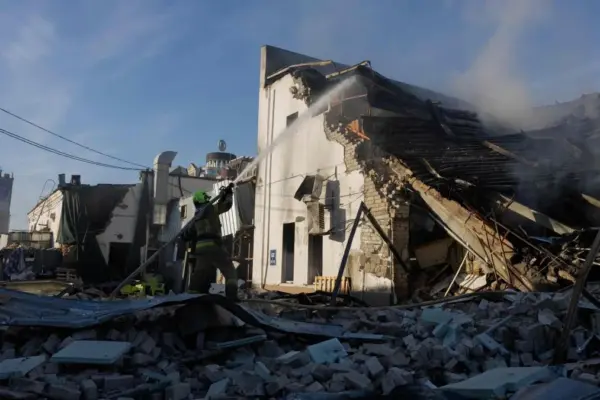
The stray dog that went in and out every so often of the Kontraktova ploshcha metro station, in the central Podil neighborhood, was the perfect thermometer to understand when the attacks launched by Russia in the early hours of Sunday on Kyiv intensified and which is one of the harshest, if not the greatest, of what it has launched against the Ukrainian capital since the beginning of the invasion in February 2022.
It is the third time that Russia presents to the public the star of its arsenal and, as on this occasion, it previously left behind what it was designed for: destruction. The Oréshnik, whose name in Russian means ‘hazelnut’, is a next-generation hypersonic ballistic missile that the Russian army used for the first time on November 21, 2024, during the attack on a weapons factory near the Ukrainian city of Dnipro (southeast). The second attack took place on January 9, 2026, against the Lviv province (west).
The United States and Iran agreed on a principle pact to reduce and continue negotiating the war in the Middle East, and to end the Iranian blockade of the Strait of Hormuz.