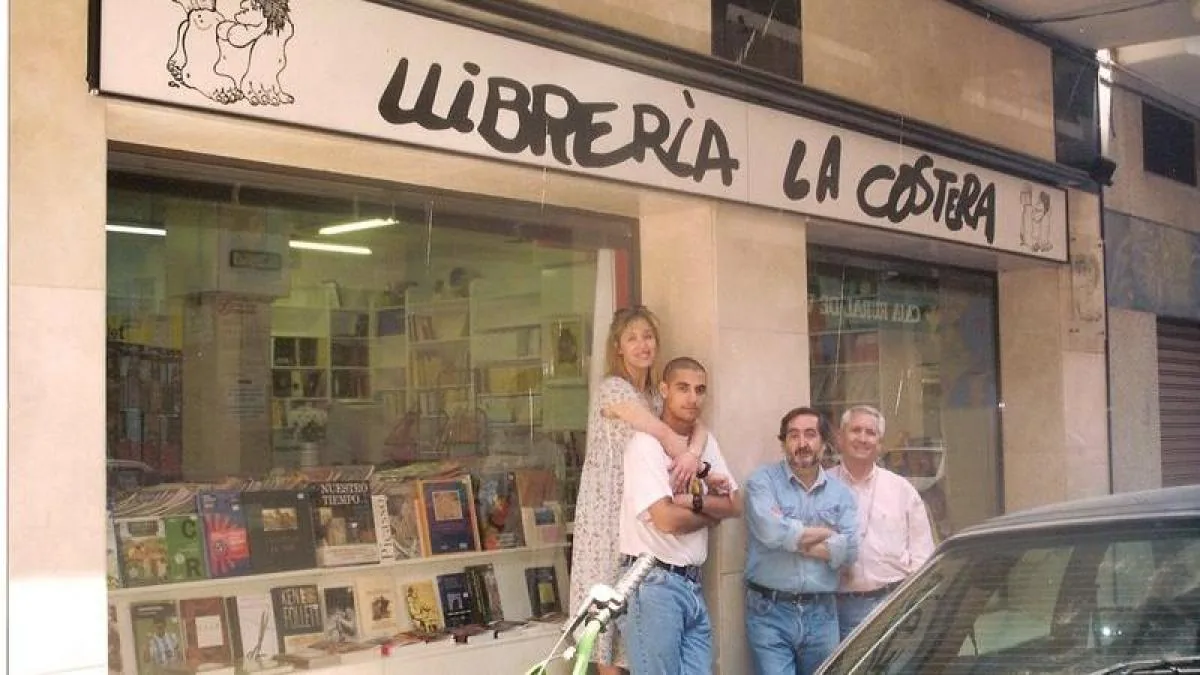
It is not easy in any business to reach half a century, especially in the book sector and with a firm commitment to literature and production in Valencian. An anniversary that Xàtiva will celebrate next weekend as part of the Música i Lletra Festival (MiL) program with a grand tribute event to Llibreria La Costera, a reference for critical and Valencianist thought that has become over the last 50 years a driving force of cultural life beyond the borders of its region.
Read more Couples, marriages… a dangerous game in Barcelona’s theatrical spring
La Costera, founded on May 8, 1976 by Carles Sánchez and Cristina, is one of the Valencianist bookstores featured in the book Aparadors de llibertat by journalist Víctor Maceda, published by the bookstore itself to celebrate its half-century of history.
The first bookstore to bet on books in Valencian in València was Can Boïls, in 1962; it lasted three years
In this book, Maceda narrates that the spark of it all was the Can Boïls bookstore, the first to bet, in 1962, in the midst of the Franco dictatorship, on having most books in Valencian. An experiment that lasted little; it closed after three years, despite having good godfathers like the singer-songwriter Raimon, who presented his first album there. At that time, there were other projects that consolidated over time, and not without difficulties, such as 3i4.
However, the export of this type of establishment that unapologetically defends the native language outside the cap i casal happens with Llibreria Xúquer in Alzira (1968). A reference from which, explains Maceda, La Costera draws inspiration.
“Carles Sánchez, originally from Alcázar de San Juan (Ciudad Real), has lived in Alzira for years […]. In a large-scale police operation, he is arrested and imprisoned in Mislata along with dozens of other activists, some of them from Xàtiva. As a result of conversations with the detainees, they make him see that opening a bookstore like Xúquer in the capital of La Costera would be a good idea. They have nothing like it there. Sánchez not only listens to them but also names it after the region: Llibreria La Costera,” narrates the journalist in Aparadors de llibertat.
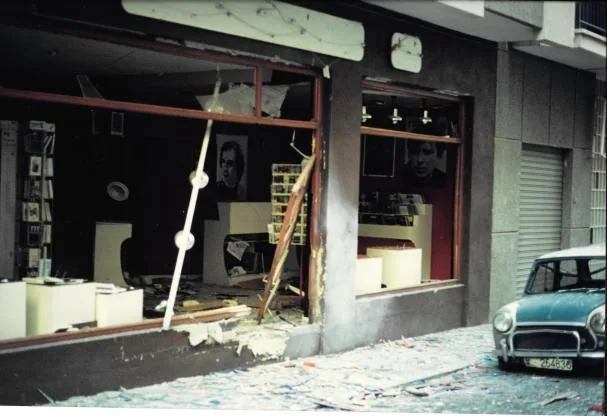
The commitment to the native language at the beginning of the transition was not liked by everyone. Just a few months after opening, on the night of November 25, 1976, a bomb exploded on the bookstore’s facade, causing significant damage inside and to parked cars. This is narrated, fictionally, by Ximo Cerdà in El carrer dels llibres, the other work the bookstore has published to celebrate its half-century of history:
“The facade is open like a wound. The fire breathes. It is not an isolated flame. It is a whole body. An orange animal that moves, that licks the air, that takes oxygen and transforms it into living language. The door is no longer a door.
Read more Junts opts for Rius as candidate in Barcelona but Martí does not give up
It is a void deformed by light.
—Quick!
They get down before the truck finishes stopping.
Hose out. Connection. Pressure. The ritual learned hundreds of times dry becomes urgent in contact with reality. Manel looks up for a second, and the heat hits his face even before approaching. How could it have spread so fast?
Then he understands.
The books.
—Water!”
Everything indicates that the attack was carried out by a group called IV Comando Adolf Hitler Orden Nuevo
An attack whose authorship was not confirmed, but which, Maceda points out, everything seems to indicate was carried out by a group called IV Comando Adolf Hitler Orden Nuevo, since on the same day two similar devices were detonated in bookstores in Zaragoza and Albacete, and investigators attribute it to this small group.
With all loans to return, recovering from the attack was not easy. However, despite the initial fear—the customers kept buying books, but some asked to receive them at home and suppliers demanded discretion—the public ended up supporting the reconstruction and bought aid bonds of 100 and 200 pesetas that provided liquidity at a difficult time.
In 2012, after the retirement of the first owner, Josep Gregori, editor of Bromera, buys the bookstore
Having overcome that first hurdle, the bookstore consolidated as a cultural space for the region and neighboring towns, as explained to La Vanguardia by its current owner, Josep Gregori. The former editor of Bromera took over from the first owners when they retired in 2012 and their children preferred not to continue the business. “We knew each other since I was an editor and they were booksellers, and I thought: ‘before it closes…’” Gregori combined both roles until recently; he is now also part of the Bromera Foundation dedicated to promoting reading, which allows him to have a privileged view of the sector.
Asked if it is easy to keep a bookstore open for 50 years, he clarifies: “One might think not, but that contradicts the fact that new projects have been created.” He points out that “there are young people who venture to open bookstores. The new generations are driven more by ideals and not so much by business. And, if you manage to balance the accounts, it’s fantastic.”
A few months ago, the national bookstore congress was held in València, and there the mood of the sector could be gauged. “It’s not a booming business, mainly due to competition from large platforms that deliver books to your home, but it is maintained.” Also, Gregori emphasizes, there are independent bookstores that fulfill a function in medium-sized towns where large chains are not profitable: “There is a field to play in.”
Read more Souvenir business offensive to take over Gaudí Avenue in Barcelona