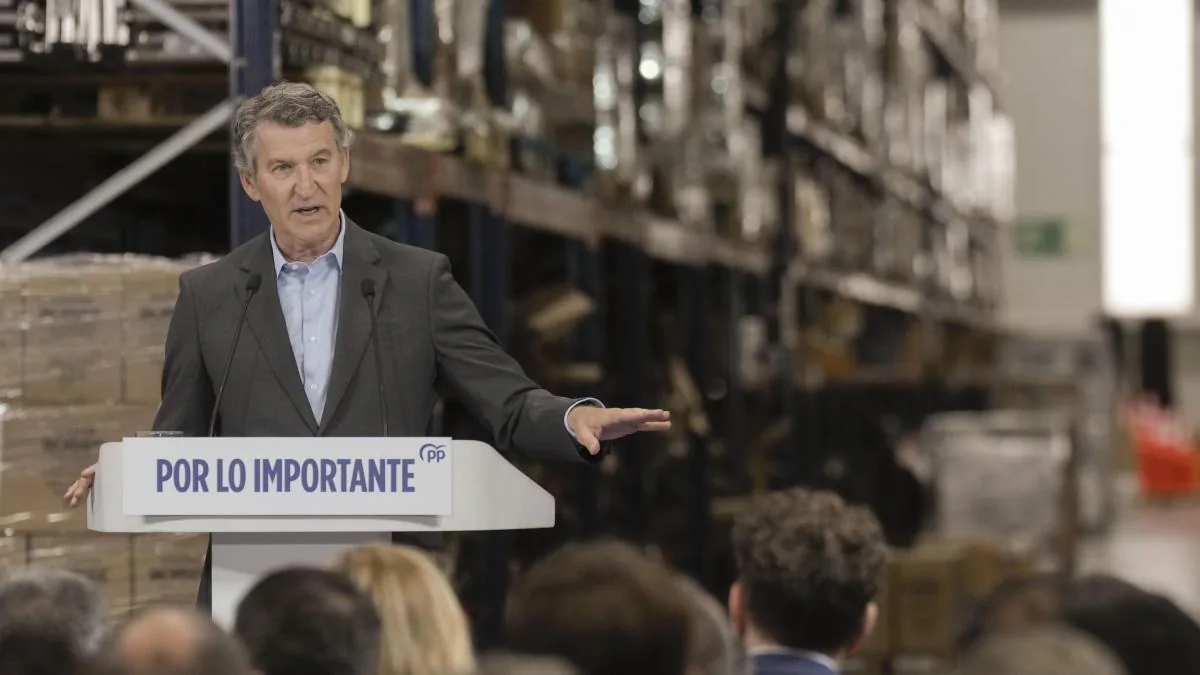
Alberto Núñez Feijóo has attacked Pedro Sánchez’s government this May 1st, as, in his view, economic policy and corruption are discouraging work. “In Spain, it must be worthwhile to work and make an effort again,” states the manifesto published by the PP. Later, through social media, Feijóo himself reproached the high taxes that workers have to pay. “Working should serve to live, not just to pay,” he said.
Read more Sánchez claims “more jobs and rights than ever” despite those who “announce the apocalypse”
Feijóo, who has surrounded himself with an economic team of technicians, led by Juan Bravo and Alberto Nadal, recurrently defends the idea that “it must be worthwhile to work and make an effort.” In fact, this approach is included in the latest political report of the congress held in July 2025.
According to Feijóo, workers suffer “an obstacle course” and he has assured that with his party it will be worthwhile to “work again.” In this regard, the PP emphasizes criticism of the Government’s economic policy, which translates into a loss of purchasing power for workers since, with the increase in inflation in recent years, taxes have not been updated (neither income nor hardly consumption taxes) and that ends up in paying more taxes and, therefore, less disposable income.
Along with this loss of purchasing power, the PP also maintains that work is discouraged because society is being conveyed “that it does not matter whether you make an effort or not, comply or not, work or permanently depend on aid,” referring both to corruption and to the growing public benefits. “Politics cannot be a factory of citizens dependent on the State,” it adds.
In fact, Juan Bravo himself has given figures on Sánchez’s economic balance. Thus, he pointed out that since Sánchez has been in Moncloa, real wages have fallen; the price of the shopping basket has risen by up to 42%; the Government has created a “tax hell” by raising taxes more than 100 times and demanding each Spaniard 3,600 euros more in taxes; youth unemployment rises to 26%, the worst figure in Europe; and the self-employed have suffered a “fiscal suffocation.”
“The contradiction that cannot be hidden: a Spain with record tax collection, but with too many workers who barely make ends meet,” the PP states in the manifesto.
Against all this, the PP defends that an environment must be created so that it “is worthwhile” to train, make an effort, comply with labor obligations, or save.
In this regard, as a first priority, Feijóo’s party points out the need to “restore purchasing power to citizens” so that “working allows making ends meet again”: for this, it sees it “essential to reduce the tax burden borne by labor income and stop using inflation as a silent way to collect more.” As a second priority, Spain “must raise wages” and the way to do this is “to increase productivity.”
To achieve this goal, Feijóo’s PP proposes to boost investment, encourage saving, eliminate bureaucratic obstacles, improve Vocational Training, strengthen the connection between education and business, support the self-employed, and allow companies to grow “without being treated as suspects.” “The Popular Party defends a labor model based on employment, productivity, work-life balance, merit, justice, and freedom,” it adds.
Likewise, the PP manifesto also refers to immigration and the segment of older workers. In this regard, it defends that Spain must have an “orderly, serious migration policy linked to the real needs” of the labor market. “Spain must be an open country, but also responsible,” it states.
Finally, Feijóo defends that “obstacles” cannot be created for those who want to keep working to continue contributing. “The experience of senior workers is an asset that Spain cannot waste,” the PP document states.
The Senate summons Saura and Pardo de Vera over Adamuz
The PP, with an absolute majority in the Senate, will summon former Secretary of State for Transport Pedro Saura to the Investigation Commission on the Adamuz railway accident on May 8 and former Adif president Isabel Pardo de Vera on May 11.
According to the PP spokesperson in the Senate, Alicia García, they are “two key figures as they were the top officials responsible for controlling the state of the infrastructures and for making the necessary investments.”
Read more Director of Puig de les Basses prison resigns amid inmate suicide crisis