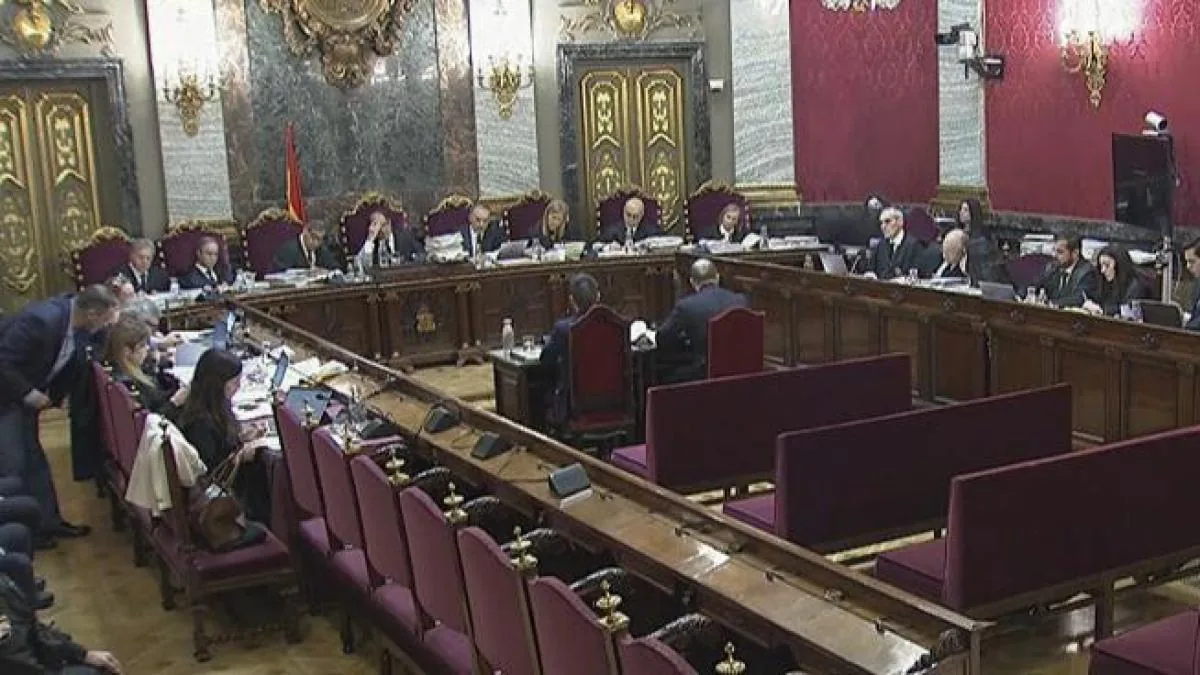
The crucial moment arrives in the trial for the mask case. The three defendants, former minister José Luis Ábalos, his advisor Koldo García, and the commission agent Víctor de Aldama, will testify between today’s and tomorrow’s sessions, which are expected to be long. This Wednesday’s session will begin with the interrogation of the businessman, one of the key figures in this process, which was initiated, among other things, thanks to his agreement with the Prosecutor’s Office. Will Aldama provide new data on the activities of the alleged plot? That is one of the questions hanging over this Wednesday’s session.
Read more The investment consortium founders and further distances ERC and Junts
It is expected that during the interrogation, Aldama will answer all parties involved in the process because his role in this trial has been one of collaboration, acknowledging that he paid Ábalos and his former advisor in exchange for mask contracts and for opening doors to other administrations for him. As explained by the head of the UCO, they helped him access the “highest institutions” of the State, even mediating with the President of the Government, Pedro Sánchez, for his benefit.
The businessman’s defense strategy has been to acknowledge corruption and go further, pointing to other high-ranking officials who are not indicted, at least for now, due to lack of evidence. For this collaboration, the anti-corruption prosecutor requests seven years in prison for him, in contrast to the 24 years requested for Ábalos.
However, the acid test is in his statement. If he does not answer everything the chief anti-corruption prosecutor wants to hear, in the phase of presenting final conclusions, Alejandro Luzón can change his criteria and request an increase in sentence. Therefore, Aldama cannot back down, and today it will be seen how far he is willing to go.
For their part, Ábalos and García will continue to deny the main accusation. Defense sources maintain that both will argue that the contracts for masks with Soluciones de Gestión during the pandemic strictly complied with the current legality for emergency contracting.
Furthermore, they will deny the statements made on Monday by the heads of the Central Operative Unit (UCO) of the Civil Guard, who signed the reports, regarding the amounts that both would have collected from Aldama in exchange for the contracts.
Their thesis is that investigators have decontextualized the conversations held between them and third parties, talking about “chistorras” (a type of sausage) or “lettuce” as if they were banknotes. Both the former Minister of Transport and his former advisor will argue that the cash they handled came from the liquidation of PSOE expenses, which they had previously advanced from their own pockets. If Ábalos used Koldo García or his brother, Joseba, to make certain payments, it was not because his advisor managed black money from corruption – as they are accused – but so that his then-wife would not see certain expenses incurred with his mistress.
One of the unknowns is whether Koldo García will make new revelations, although sources close to him rule out anything striking.
The three are accused of the alleged crimes of bribery, belonging to a criminal organization, influence peddling, and embezzlement of public funds. Throughout this process, which is now coming to an end, almost 80 witnesses have appeared before the Supreme Court, whose statements have supported the accusations against them in relation to various illicit activities.
Masks case
The most important one gives its name to the process: the alleged fraudulent purchase of masks during the coronavirus crisis through the company Soluciones de Gestión in exchange for commissions. Various witnesses have reported that two large purchases of masks were made from this company, contacted by Aldama. Koldo would have organized the purchase and Ábalos would have given authorization thanks to his ministerial powers.
The first acquisition, of eight million masks, was made through Puertos del Estado and was launched urgently on March 19, 2020, circumventing the usual controls existing in public procurement, something exceptionally allowed by the decree declaring the State of Alarm, issued only a few days earlier, on March 12, 2020. The second was made in April through Adif and involved five million masks. Both contracts were awarded to Soluciones de Gestión.
Juan Manuel Gómez, who was undersecretary at the Ministry of Public Works at that time, stated during his testimony that on March 19 he was tasked with purchasing the masks. After studying the needs, he proposed buying four million, calculating that they would last 15 days. Koldo García told him that the awardee would be Soluciones de Gestión, but did not inform him “how the offer had reached him.”
When Ábalos had already signed that purchase, “Koldo said it had to be changed because Soluciones de Gestión had said it was eight million masks or nothing.” A new contract for that volume was made, and Ábalos signed it definitively. Three technical inspectors from the Ministry of Transport, who conducted an audit of the purchases made during the pandemic, supported that version. Their conclusion was unequivocal: the mask order was doubled in just 38 minutes. It went from four to eight million after an email was received from Aldama.
The second order was made through Adif. Its then-president, Isabel Pardo de Vera, stated that Koldo spoke to her about contracting with Soluciones de Gestión “without proposing any other offer.” Another Adif employee, Francisco Toledo, reported that there was “another much more economical offer,” but that, in the end, it was decided to contract the supply of masks with Soluciones de Gestión.
The commissions
The owners of Soluciones de Gestión invoked their right not to testify because they are being investigated in another case for the same facts. Consequently, they did not corroborate the alleged commissions. However, several witnesses have confirmed the existence of cash payments. The investigation suggests that Aldama would have paid 10,000 euros monthly to Koldo, who shared them with Ábalos. Sometimes, Aldama did not have enough cash in Spain and made deliveries in the Dominican Republic.
Read more A no for nothing
Joseba García, Koldo’s brother, stated that he frequently traveled to Santo Domingo (Dominican Republic) to meet his girlfriend and that on one occasion, while in the capital, he was asked to go to Punta Cana to pick up an envelope whose contents he did not look at. A witness, an employee of a company owned by an Aldama partner in the Dominican Republic, specified that she met Joseba at least twice in Punta Cana and handed him two envelopes with 10,000 dollars inside each.
Koldo García’s lawyer took advantage of Joseba’s interrogation to ask him if he had collected envelopes with money at the PSOE headquarters, and Joseba confirmed that he had, on several occasions, but insisted that he did not open them, as that is not his custom. And Koldo’s ex-wife, Patricia Úriz, stated that she had also gone to the socialist headquarters on Ferraz street in Madrid to collect envelopes with money.
Furthermore, Koldo García’s defense questioned the payments made by the PSOE when José Luis Ábalos was the party’s Organization Secretary. The advisor’s lawyer showed nine settlements for various amounts lacking a concept, whose payment was authorized. And Ábalos’s former secretary in Ferraz, Celia Rodríguez, assured that paying expenses in cash was common at the PSOE headquarters.
In contrast, Carmen Pano stated that she had gone to the PSOE headquarters to deliver money at Aldama’s request. Specifically, Pano claimed to have made two deliveries of 45,000 euros each. Her driver corroborated one of the deliveries in which he was present. Pano worked at Villafuel, and that is another story.
Villafuel
Pano and her daughter Leonor González, also employed at Villafuel and Aldama’s ex-girlfriend, stated that the company Villafuel, owned by Claudio Rivas, wanted to obtain a license to operate in the hydrocarbon market but did not meet the requirements to get it. Pano was in charge of introducing Rivas and Aldama, who allegedly used his closeness to Koldo and Ábalos to arrange an appointment for Rivas at the Ministry of Industry. In return, the minister asked for a chalet, and Villafuel rented him a house in La Alcaidesa (Cádiz) with an option to buy through another company, Have got time, which has also been corroborated by the testimony of different witnesses.
The Air Europa case
González Pano also stated that Aldama told her he had collected money at the home of Globalia and Air Europa CEO, Javier Hidalgo, as payment to accelerate the airline’s rescue. From the testimony offered by Pedro Saura, former Secretary of State for Transport, it appears that Koldo García and Víctor de Aldama tried to “expedite” the rescue of Air Europa in the summer of 2020.
For his part, Hidalgo not only defended the legality of the airline’s rescue during the pandemic but also harshly criticized the conditions under which the Government finally agreed to the loan, which he described as the “worst in the history of the world.”
Jessica’s apartment
The house in La Alcaidesa is not the only one that has come up during this trial, which could be prolonged if the defendants’ statements extend beyond today. Jéssica Rodríguez, Ábalos’s ex-girlfriend, explained that the minister rented a luxury apartment for her in Plaza de España in Madrid. An Aldama partner testified that he was in charge of paying the rent “because Aldama asked me to, and he’s like my brother.” The plot covered other payments to Jéssica, such as her cat’s operation, which cost 1,200 euros. Additionally, the girl stated that Ábalos left her cash at home.
Furthermore, Ábalos’s former secretary at the Ministry of Transport, Ana María Aranda, affirmed that Jéssica accompanied the then-minister on 13 official trips “national and abroad.” And she indicated that the minister’s girlfriend’s travel expenses were paid by Koldo.
Jéssica’s jobs have also been extensively discussed in the trial. “José Luis told me it would be good for me to work so I could contribute to social security.” So the plot got her a job in two public companies, first in Ineco and later in Tragsatec. Rodríguez admitted that she never went to work. One of the employees of these companies reported that Koldo complained because Jéssica was not receiving her meal tickets and wanted them despite never showing up for work.
Claudia Montes, former Miss Asturias
Jéssica was not the only alleged “plugged-in” person. Claudia Montes, former Miss Asturias, explained that she met Ábalos at a party rally, they connected, and started writing to each other. Claudia was a single mother and unemployed. She was hired at Logirail as a sales representative for tourist trains. But when she arrived at her workplace, she didn’t like the place and didn’t go to work.
Her superior at the company testified that he opened a file on Montes “because not coming to work is a very serious offense.” Then he received a call from Koldo who stated that if things continued like this, “heads would roll.” The file was not fully processed because Claudia was promoted and, as she said, she spent her workday going to the Oviedo library, albeit to “read books about trains, because she wanted to know everything about the railway world.”
Koldo’s handwriting and voice
During the trial, expert tests have also been carried out. A handwriting expert stated that Koldo’s signature on the documents she examined is “without a doubt” that of Ábalos’s former advisor, despite his defense attempting to sow doubt and raising the possibility that the signature had been stamped with artificial intelligence. UCO experts also confirmed that the voices in the case recordings belong to the accused. Koldo’s defense presented a witness who stated that the origin of these audios cannot be verified.
UCO agents ratify their findings
The UCO agents, led by Lieutenant Colonel Antonio Balas, ratified point by point all the conclusions of their reports in Monday’s session: “there is no doubt that chistorras are 500 euro banknotes”; “Isabel Pardo de Vera, president of ADIF, played a ‘prominent role’ in the hiring of Jéssica Rodríguez”; the apartment in Madrid’s Plaza de España where Rodríguez lived was her “love nest” with Ábalos, paid as “consideration” by Aldama; or that the “ultimate decision to contract” Soluciones de Gestión, Aldama’s company, for the purchase of masks “falls” on Ábalos.
Read more The Government suffers two key defeats at the hands of Junts