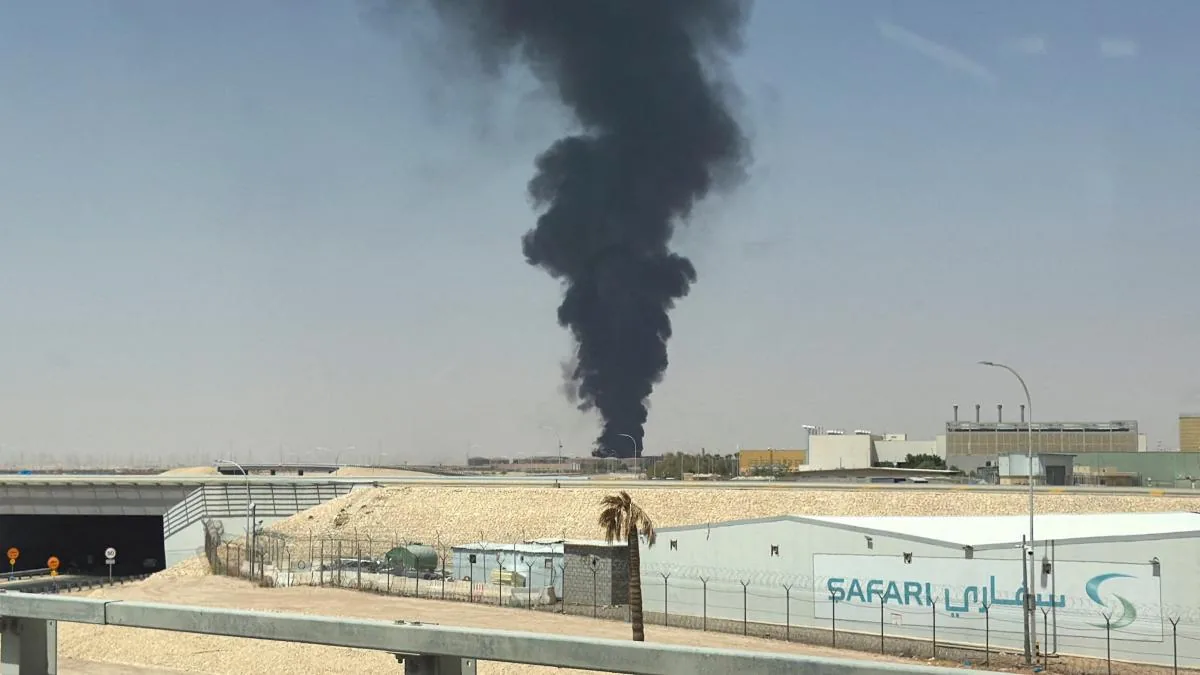
This scorching summer has offered scenes never seen before in Europe. Seaplanes drawing water from the Seine to extinguish the fire in Fontainebleau, in the historic hunting forest of the kings of France. The Rhine and the Danube at their lowest flow levels and almost unfit for navigation. Forest fires in Wales, on the border between Belgium and Germany, on the beaches of Croatia.
Read more The rain overflows the Costa Daurada and the Government defends its forecasts
The climate—first the heat, then the violent storms—has wreaked havoc on a continent that accumulates crises, political and socioeconomic, a Europe in demographic decline but where massive migrations alarm and destabilize, countries that, moreover, are rearming because they feel threatened by Russia.
In this context, drought, forest fires, repeated extreme heat waves, and often the torrential rain that follows have a devastating environmental, economic, and health impact, an additional factor that weakens Europe. Tens of thousands of deaths are attributed to the thermal effect on vulnerable people. Losses are substantial for the agricultural sector. Tourism suffers. Nuclear reactors must be shut down. And the worst part is that it does not seem to be a circumstantial phenomenon but a systemic deterioration.
“This summer reveals a major international crisis, and the most worrying thing is that it is not understood and there is a strategy to hide the reality,” Bernard Badie, emeritus professor of International Relations at Sciences Po in Paris, tells La Vanguardia. In his view, the climate crisis and pandemics are “the first challenge to which all humanity is uniformly exposed.” “The break is total compared to the classical conception of international relations, which knew nothing but the concurrence of national interests,” Badie continues. “It is urgently necessary to replace the reason of State with the reason of the planet, and to equip ourselves with means for true global governance (…) Climate skeptics must also be silenced, from Trump to the European far right.”
One of the zero zones of this infernal summer has been the region west of Bordeaux, where the fire ravaged 42,000 hectares and burned 240 houses. From Lège Cap-Ferret, a summer paradise, its mayor, conservative Philippe de Gonneville, admits to this newspaper that he is “extremely worried” about the future and sees it as urgent to “rethink the forest.” “It is necessary that ecologists do not obstruct us in the essential work to protect property and people, and stop prioritizing an environment that is poorly adapted to climate change.”
–Ecologists? Isn’t that paradoxical?
Heat waves, already a systemic problem, have caused tens of thousands of deaths and great economic damage
–Yes, it is a paradox, but I am in conflict with them because a global vision of things is needed. Taking environmentalism to the extreme goes completely against the protection of fauna and flora. A nature reserve I preside over burned entirely because clearing was not allowed. They had to protect lizards, turtles, insects. Now they have all burned.
De Gonneville insists that laws on forest management must be changed and “end the diktat of the ecologists.” “We have to make certain forest sacrifices, cut some trees to widen firebreaks, even if it bothers the animals, clear the forest, to avoid disasters like this year’s,” he concludes.
More than a thousand kilometers to the north, on the border between Belgium and Germany, another gigantic fire has been ravaging a very green region for a week, where rainfall used to be very high. “In the entire 20th century there were two fires and in recent years (2011, 2023, and 2026) we have already had three; yes, I am worried,” explains from Monschau, in the German state of North Rhine-Westphalia, its mayor, Carmen Krämer, an independent elected with the support of ecologists. This picturesque town of 12,000 inhabitants, with numerous second homes, receives 1.3 million visitors annually. That weekend they had to cancel a popular music festival, ruining business for hotels and restaurants.
“Now it is the fire, but we already saw the symptoms,” adds Krämer, who holds a doctorate in Philosophy. “For five years we have had to buy water from other towns in summer because our reservoir is too low. It does not rain enough. In fact, this summer we kept looking towards southern Europe because everything here was also very dry and we feared the same would happen to us.”
Not only negative conclusions are drawn from the harsh experience of this summer. The European Union, for example, has worked quite well as a community of solidarity. Extinguishing resources have been shared, from firefighters to aircraft. The arrival of seventy Ukrainian firefighters, with about ten modern vehicles, caused an impact in France despite the war.
For Erwan Le Méné, co-founder and CEO of EcoTree, a company dedicated to forest management and designing sustainable climate solutions for businesses, there are various ways to minimize the risk of fires, starting with diversifying tree species—the monoculture is disastrous for containing flames—drastically expanding firebreaks, or a simple measure such as requiring vehicles to carry a fire extinguisher, which would be very useful to prevent small fires from spreading.
French political scientist Bertrand Badie calls for a radical change, moving “from the reason of State to the reason of the planet”
“This summer has opened the eyes of those who thought ecology was not a business issue,” says Le Méné, who wants to be optimistic despite the circumstances. “Companies are beginning to understand that the environment, ecology, is not something external to the value chain, a marginal issue that is only paid attention to occasionally for a tax exemption or pure marketing. In reality, the basis of any business is natural resources. If they run out, if forests burn, if there is no water, if everything is dry, if it is 40 degrees in summer, your company cannot operate.”
The impact of the latest climate emergency on the French presidential elections in the spring is unknown. Marine Le Pen’s party, the far-right National Rally (RN), which is the favorite, is not denialist but has never shown much sensitivity to environmental issues. Its obsession is and will be immigration and insecurity. However, in the medium term, as warned by the president of the Water Economic Institute, Simon Porcher, climate change could become a serious factor of social unrest in a country prone to protest. If water restrictions proliferate, if people suffer in poorly insulated homes without air conditioning, if evacuations due to fires become frequent, responsibilities or something more will be demanded. It will no longer only be about maintaining the standard of living, as during the yellow vests revolt, but something existential.
Read more Assumpta Serna’s thing