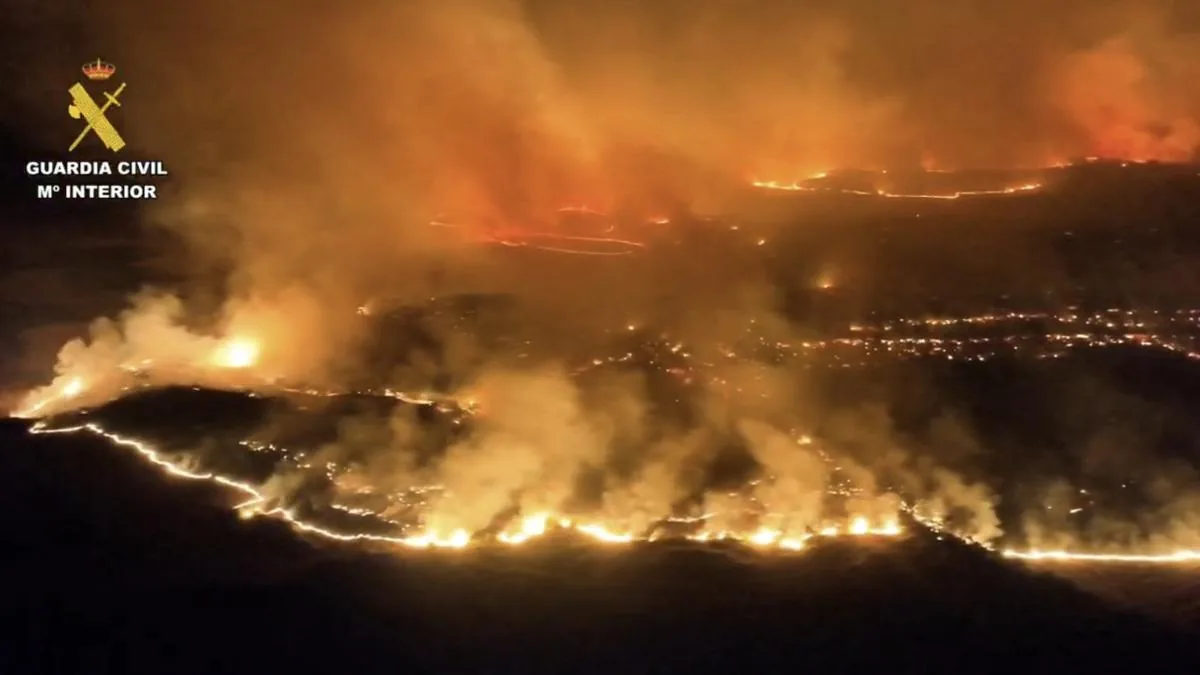
Spain remains immersed in one of the worst summers in terms of forest fires. Three times the area has already burned compared to the same dates last year. If last week the fire took the lives of 13 people and burned 7,000 hectares in Los Gallardos (Almería), these days the worst affected area is Aragón. In Los Gallardos there are still 20 firefighter teams working on extinguishing the fire, while in Orés (Zaragoza) 450 personnel are fighting a fire that, since Wednesday, has already burned 15,400 hectares and 1,000 people have been evacuated.
Read more An unsuccessful marriage proposal ends with a new shooting in Sant Roc
The conditions of the Orés fire, in the Zaragoza region of Cinco Villas, were this Saturday “more favorable” than the previous day, although the fire situation remains “complex,” influenced by the changing wind in the area. In the morning, the wind is a fairly strong, warm, and dry southern component, and in the afternoon it shifts to the north, which caused “some flare-ups” in certain points, especially in the southern part of the perimeter, according to the Aragón Government’s Interior Minister, Roberto Bermúdez de Castro, on Saturday.
In summary, the minister indicated that the fire “is not as bad” and there is not as much concern “as two days ago,” but its evolution “is very slow.”
For her part, the Vice President of the Aragón Government, Mar Vaquero, informed the media about the latest developments of a fire that maintains its perimeter at about 80 kilometers, so “it has not spread.”
Between evacuated and on alert for evacuation if the situation worsens, 16 towns are affected
“We can generally say that conditions at this moment are more favorable than this Saturday at the same time,” said Vaquero, who qualified that the situation “is still complex.”
Regarding this, she recalled that this Saturday four other municipalities were put on alert, in case evacuation or confinement was necessary: Sos del Rey Católico, Navardún, Urriés, and Castiliscar. These join Lobera de Onsella, Isuerre, Longás, Biel, and Fuencalderas, which have been on alert since Friday.
The vice president said that in the coming hours the deployed operation, which gathers about 450 personnel, would continue to depend on wind variations to anticipate, implement appropriate measures, and try to prevent possible fire expansions.
Read more Trump will sell his social media messages to Wall Street investors
Explanations were also offered by the Fire Extinguishing Director, Carlos Cacho, who pointed out that, within the tasks planned by the operation, they managed to defend the evacuated populations of Orés, Asín, Malpica de Arba, Luesia, and Uncastillo, as well as Petilla de Aragón, a town belonging to Navarra. Between those on alert and evacuated, the flames already affect sixteen towns, fifteen in Zaragoza and one in Navarra.
The Fire Extinguishing Director also highlighted “the forcefulness and deployment of resources, which is one of the most powerful we have had so far in a fire in the autonomous community,” as well as some success in extinguishing strategies, considering that the fire is very complex and we have contained the fire around Luesia.” Additionally, in Biota, with more than 900 inhabitants, preventive plowing work was carried out around the town, which may help improve protection in case the fire approaches, according to Bermúdez de Castro on Saturday.
Undoubtedly, good news is that the operation has so far managed to contain the fire so that it does not reach the natural area of the protected landscape of the Sierra de Santo Domingo.
But Zaragoza is not the only Aragonese province that these days is being consumed by fire. The fire declared in Plan (Huesca) remains active and, although the Friday night conditions slowed its spread, the main efforts are on the left flank. Here the presence of greater forest mass and the possible arrival of the fire to a ravine could complicate its evolution, in an area of high environmental value.
Likewise, the fire in Fiscal (Huesca), caused by lightning, is stabilized, although aerial means will be used in the Jánovas area. In the Peña Montañesa fire, in the same province and also caused by lightning, monitoring and follow-up of its evolution continue.