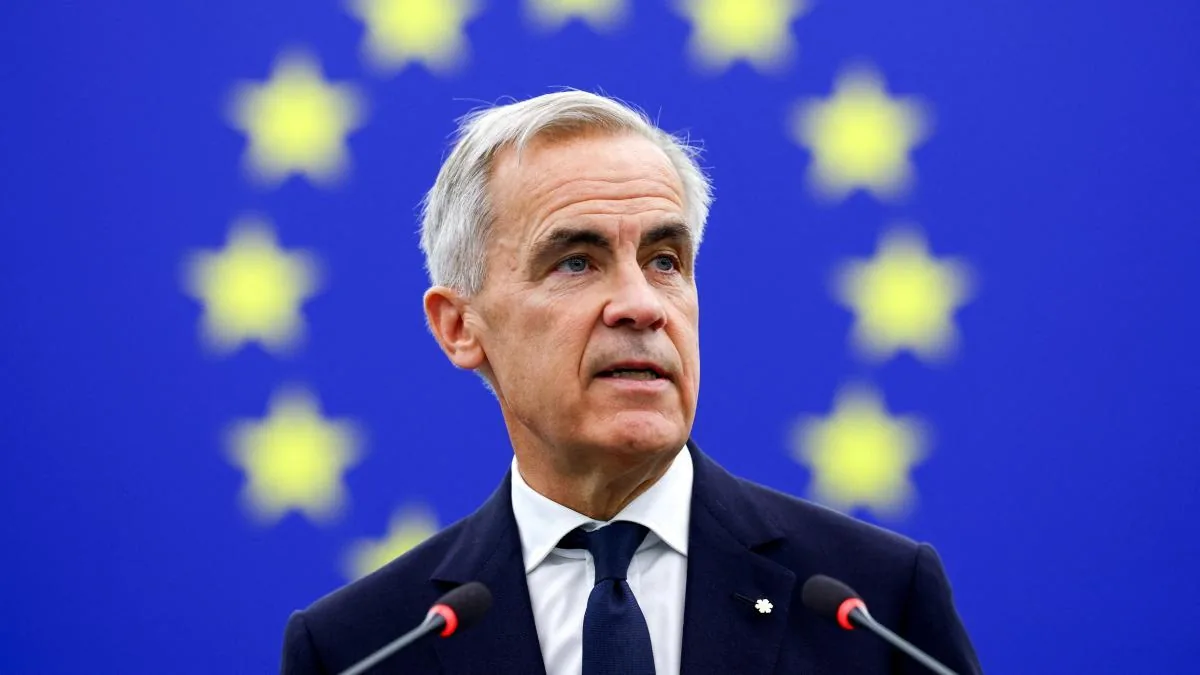
Canadian Prime Minister Mark Carney spoke before the plenary session of the European Parliament in Strasbourg this Thursday and took up the proposal offered to him on Wednesday by the President of the European Commission, Ursula Von der Leyen. “We can create the next world order, one that is fair, stable, and prosperous,” Carney stated, to the applause of the MEPs. The Prime Minister outlined the socioeconomic possibilities that greater collaboration between the European Union and Canada would offer and made it clear that “the majority of Canadians support strengthening ties.”
Read more The EU proposes limiting social media access to one hour a day for minors aged 13 to 15 years
The Commission President opened the door for Canada to become the first “EU associated country.” During her annual State of the Union speech in Strasbourg, the community leader said she wanted to take the relationship with her transatlantic partner “to the highest possible level.” The Prime Minister, who was applauded by European legislators, already responded yesterday that Ottawa is interested in establishing a “unique alliance in security and economy” with Europe, which in no way would imply full membership in the EU bloc.
Also read
Carney expressed himself along the same lines before the plenary. The Canadian Prime Minister insisted that his country’s collaboration with the community bloc is not about “having power to dominate others.” “On the contrary, we seek resilience so that no one can control our open markets, undermine our sovereignty, threaten our territorial integrity, or undermine our freedoms, our democracies, and our rule of law,” he added.
The leader’s words come after the reaction of the President of the United States, Donald Trump, who, drawing on his style manual, threatened to impose “very significant tariffs or stop trading” with the economic bloc of the Old Continent. Von der Leyen also wanted to make clear yesterday that the proposal “is not against anyone,” but Washington sees the building of a stronger alliance between the 27 and Canada as a threat.
The Canadian leader, who avoided explicitly mentioning Trump (although he cited “the use of trade as a weapon”), made it clear that the alliance with the European Union does not intend to rival the current world powers: “I am not proposing a third bloc to become a great rival power,” he stated.
Carney arrived in Strasbourg with an outstretched hand and a list of benefits for Europe. “Canada can provide LNG and hydrogen on a large scale to contribute to Europe’s energy security, among other things through the development and utilization of new port infrastructure in the far north and on our east coast,” he said, just as the EU is trying to diversify its energy sources and shut off the Russian gas tap.
Read more Mark Carney speaks before the European Parliament and appears alongside Roberta Metsola
“Canada has deposits of more than 34 critical minerals, and we are among the top producers of the ten most essential for the global energy transition,” he highlighted. He also offered more collaboration in artificial intelligence, telecommunications, defense, and mobility. “Deepening and expanding our relationship will strengthen our sovereignty and improve affordability, opportunities, and security for Canadian and European citizens, while safeguarding our ability to live our lives as we choose,” he detailed.
In his speech, Carney recalled the ties that bind Canada and the EU, after the President of the European Parliament, Roberta Metsola, thanked Ottawa for its collaboration in “liberating Europe from fascism” during the two World Wars that destroyed the Old Continent.
‘Wahlverwandtschaft’
The Canadian Prime Minister referred to the term Wahlverwandtschaft – elective affinity – used by the German writer Johann Wolfgang von Goethe. He explained that the fact that the EU and Canada share values is a choice. “Canada and Europe are not united by geography, although we share a 3,000 km border in the Arctic. We are united by an affinity — elective, chosen, and renewed — which, for that very reason, is even stronger,” he expressed.
Carney highlighted the challenges societies face: globalization versus sovereignty, the instrumentalization of international trade, hybrid attacks. In this scenario, he insisted that “Europe and Canada are stronger together.”