EU countries already have their box of recommendations from the European Commission to alleviate the energy crisis derived from the closure of the Strait of Hormuz. And it does not include the suggestion of teleworking, as a previous draft stated, but it does include reinforced coordination of energy reserve storage among Member States, one of the few competencies the Community Executive has in the matter. In contrast, Brussels is for the moment shelving the idea of approving a European mechanism to tax the extraordinary profits of energy companies, despite the request from large EU countries such as Spain, Italy, and Germany.
Read more Three ships attacked in Hormuz despite extension of ceasefire with Iran
Brussels’ objective is to avoid repeating the mistakes of summer 2022, when massive and individual purchases by Member States caused prices to rise artificially. For this reason, and given that the energy mix is a national competence, the Commission wants to ensure that gas deposits are filled in a coordinated and gradual manner over the coming months, avoiding market disruptions among EU countries. It also offers to mediate and coordinate, if necessary, any action to release emergency reserves, both gas and oil.
Brussels includes an electrification plan in its strategy before summer and confirms a mechanism to make State aid more flexible for the transport, agricultural, and fishing sectors, the most affected by this crisis, which will be presented later. In addition, it recommends using revenues from emissions trading (the well-known ETS) for industrial decarbonization and electrification projects and asks Member States to use all possible flexibilities to cushion the effects of the crisis. However, it reminds that measures must always be temporary and limited to the most vulnerable sectors. There is some fear in Brussels that a loose hand could have negative long-term effects.
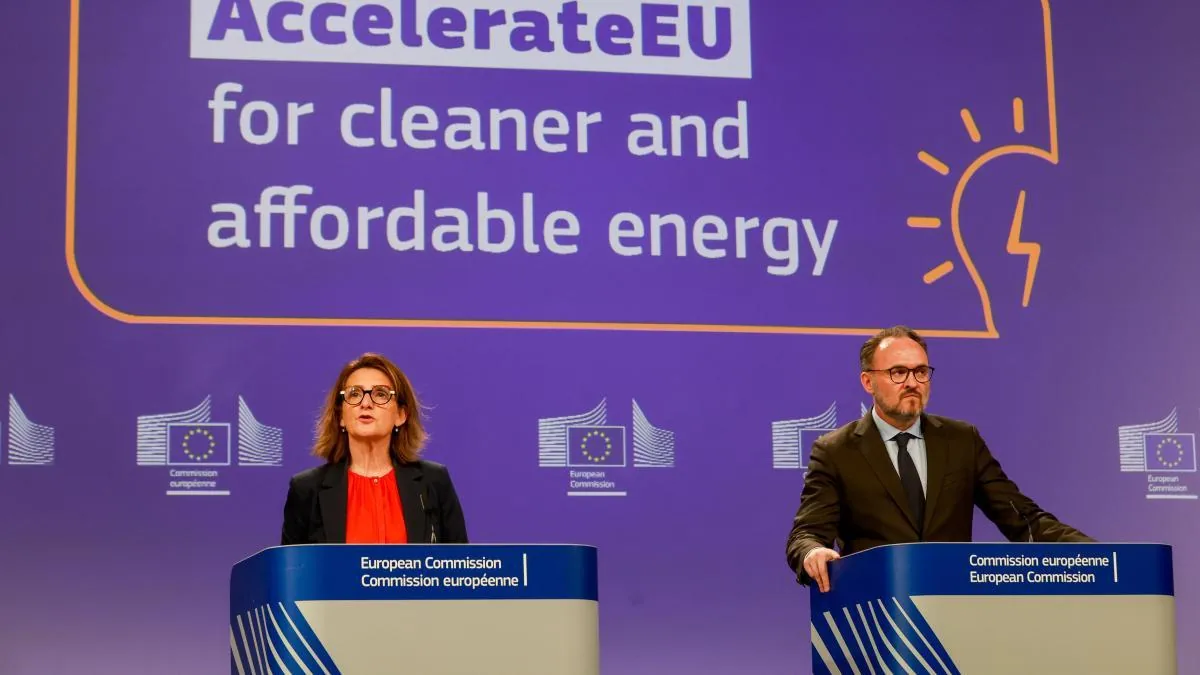
The crisis is seen as an opportunity to accelerate electrification, with the implementation of renewable energy and less dependence on foreign fossil fuels. “Accelerating our energy plans is important for economic and energy security,” said Teresa Ribera, Executive Vice-President of the Commission and Commissioner for Clean, Just and Competitive Transition, when presenting the measures. The Spanish official pointed out that the situation is better than during the energy crisis following the invasion of Ukraine, “but we still need to do more, to develop a shield for those who are suffering.”
The message was shared by Dan Jørgensen, European Commissioner for Energy and Housing, who reiterated that the impact will last for years, especially on gas. Months of uncertainty lie ahead, with an “unpredictable” impact of the war that forces “preparation for everything.” Since the outbreak of the conflict, the bill for fossil energy imports has risen by 24 billion euros. That’s more than 500 million euros daily that citizens and businesses suffer. “We need to act fast and together,” urged Jørgensen. One worrying front is aviation fuel, which is “under the most pressure.”
Read more Mbappé and Vinícius do not falter in a season finale that will be ‘molto longo’
Reviewing the measures deployed by the States, Jørgensen asked “not to burn taxpayers’ money on subsidizing fossil fuels,” something that must be temporary and very specific. For example, instead of subsidizing fuel, he advocates for measures with a more lasting impact, such as aid for changing gas boilers in homes. Lowering electricity taxes is also viewed favorably, as it has an immediate effect on people’s pockets.
Yes to ‘eco-driving’
The final text does not include the teleworking recommendation requested in a draft
In the text of the measures, little else. It does not include the promotion of an EU-level tax to levy the extraordinary profits of energy companies, as Spain, Germany, Italy, Austria, and Portugal had demanded. The Commission for now prefers to leave it in the hands of the Member States, who can apply this measure individually, without the need for a European umbrella. While Ribera acknowledges that circumstances “should not be used for the benefit of a few,” a tax requires unanimity that is currently not achieved and is technically difficult to apply.
The five requesting countries asked to imitate the idea of 2022, in the midst of the energy crisis derived from the invasion of Ukraine. At that time, the EU introduced a temporary solidarity contribution, but the Commission sees technical difficulties in repeating the scheme without the unanimity that would be required in the Council. Nor did it generate particular enthusiasm in the Community Executive then. The argument now is that prices are not as high as four years ago, nor are there risks of imminent scarcity to justify the Commission using the emergency mechanism to approve such measures as it did in the past.
The rest of the measures are pure recommendations to the Member States, and they have already been softened. Faced with leaks from previous drafts, community sources were emphatic in saying that “there is no measure related to teleworking in this plan.” The text does include a series of voluntary actions, which can be followed by both citizens and administrations. Among them, “eco-driving,” driving in a more sustainable way, which the Commission insists is purely a recommendation among ideas to make transport and home heating more efficient.
Read more Israel and the politics of gestures