The air on the seventh floor of number 42 Reina Street in Valencia hadn’t moved since the postwar period. It wasn’t simply that it was stale: it was a dense, almost solid mass that swallowed sounds and exhaled a scent of camphor, old dampness, and rancid sweat accumulated over ninety-three years of entrenched life. In that three-room mausoleum, time did not pass: it rotted. And at the center of the rot reigned Amparo, seated on her throne with earrests upholstered in burgundy skay, a tiny and terrible matriarch whose power did not need to move from the armchair to reach the last corner, the last atom of oxygen in the apartment.
Her children, Pascual and Vicente, were seventy years old and were her perfect vassals. Identical twins, withered in the same way, like two apples forgotten at the bottom of a drawer until they became unrecognizable. They wore tergal shirts of the same beige tone, identical pleated trousers, and an identical expression of servile panic that no longer distinguished fear from love. Their existence was a litany of obedience, chamber music whose only chorus was “Yes, mom,” repeated to nausea, until the words lost their meaning and only the reflex remained.
—Pascual, the fruit is wilting. Go to the kitchen and turn it. Yes, mom.
—Vicente, you left a fluff in the hallway. I see it from here. Go get it. Yes, mom.
—You will not go out today. The sun rots the skin and the people on the street have the devil in their eyes. Yes, mom.
They had never known another woman. They had never had a job outside those walls. The umbilical cord that bound them to Amparo was a steel cable forged in seven decades of domestic tyranny, a cage they had learned to love themselves. They were two elderly larvae in a cocoon of silence and obedience, and outside that cocoon, they did not know how to breathe.
One August morning, the Valencian sun that roasted the street awnings failed to penetrate Amparo’s bedroom. They found her rigid in her bed, mouth open in a grimace of surprise, as if death had caught her mid-order. Her lips, still tense, seemed about to say something. But there was nothing.
The silence that followed was louder than any of her screams. Pascual and Vicente looked at each other. For the first time in seventy years, there was no voice telling them what to do. Panic was an icy wave that paralyzed them. Calling a doctor meant strangers, questions, the end of their encapsulated world. Outside there was sun, noise, life. And they no longer knew how to be alive without permission.
—What do we do, Pascual? —whimpered Vicente, twisting his translucent-skinned hands.
Pascual, who always processed his mother’s orders first, had his gaze lost at the laundry room door. There, next to the ceramic sink, hummed the chest freezer they bought in 1982 to store market bargains. It hummed just as it had for forty years, just as it would always hum.
—We can’t lose mom —said Pascual, and his voice sounded as natural as if he were repeating a memorized lesson—. Mom has to stay.
What followed was a pathetic and clumsy butchery. Using a ham knife and a metal saw belonging to their father—two weak and trembling elderly men barely holding the tools—they desecrated their creator’s body. There was no cruelty, only an animal need, the same that leads a child to cover their eyes so the darkness disappears. The wet sound of the cuts made them gag, but the imaginary voice of Amparo in their heads whipped them: “Useless. You can’t even do this right.” At dawn, Amparo—or what was left of her—rested in plastic bags under a layer of peas and frozen hake sticks. The freezer’s hum became the new heartbeat of the home.
Days later, there was a knock at the door. The sound was a violation. They opened with the chain on. A young woman, fresh-faced and with her hair tied in a ponytail, smiled at them.
—Hello, I’m Clara, the new neighbor in B. Sorry to bother you, could you help me for a moment to push a wardrobe? I can’t do it alone.
Pascual and Vicente looked at her as if she were an apparition. The outside world. A young woman. A woman who was not their mother. Something in their atrophied brains tried to process the information and failed.
—We are very old —cawed Pascual—. Our bones hurt.
And they closed the door.
But the seed of a monstrous idea had been planted. That night, in the darkness, without Amparo’s snoring in the background, they realized a truth their minds had rejected until then. It was not mom they missed. It was having a mom. Any mom. The void was not of love, but of function.
The next night it was they who knocked on Clara’s door. When she opened, she found the two elderly men standing very close together, with the same pleading look, but now there was something more: a kind of dull hunger in their watery eyes.
—Yes? —she said, surprised.
—We want you to be our new mom —said Pascual, without preamble, as if asking for a glass of water.
Clara blinked. A joke. A symptom of senile dementia. But their faces were deadly serious, and the word “mom” coming from two gray-haired elderly men sounded obscene, like a joke told at a wake.
—Sorry, I don’t understand…
—Yes —added Vicente, in a whisper—. We need a mom.
Fear, cold and reptilian, slid down Clara’s back. She couldn’t explain why, but at that moment she knew she was not facing two harmless old men. She stepped back and slammed the door. She heard Pascual’s voice through the wood:
—We will pay you! We will pay you very well! Mom left us many apartments! We are rich! But we don’t know how to live without a mom!
Clara, with her heart racing, shouted for them to go away.
Life, however, has a methodical cruelty. Two weeks later, the marketing company where Clara worked made staff cuts. She found herself on the street, with three months of rent ahead and savings melting like an ice cube on August asphalt. She searched for work to exhaustion, but the market was a desert. Desperation began to gnaw at her foundations, and at night, in bed, she remembered Pascual’s voice: “We will pay you very well.” And she hated herself for remembering it.
Meanwhile, in seventh A, the brothers had made a discovery. They were running out of food, and the idea of going out to buy was an odyssey that terrified them. One night, Pascual opened the chest freezer, looked at the bags, and had a revelation. Mom had always fed them. Perhaps, in some way, she could keep doing so. They started little by little. A broth that tasted strangely sweet, with a metallic aftertaste they attributed to the freezer’s years. A steak of pale, fibrous meat that melted in the mouth with a new texture. It was their perverse communion: they kept mom alive inside them.
Desperate, with the eviction notice on the table, Clara knocked again on the elderly men’s door.
Read more Castellón Airport seeks its direct connection with Madrid: “It is an essential route”
—I accept —she said, unable to look them in the eyes.
The joy on their faces was grotesque, childish. Vicente clapped twice, like a child receiving a gift.
—What exactly does the job consist of? —asked Clara, the word stuck in her throat.
—It’s very easy —explained Pascual, and in his voice was a viscous tenderness—. You have to wake us up in the morning with a kiss on the forehead. Prepare our ColaCao with muffins. Make our beds. Iron the handkerchiefs in our pockets. And at night, you must tuck us in and stay until we fall asleep.
—And what else? —whispered Clara.
—You must call us “my children,” “darlings,” “treasures”… Nice things. Like mothers say.
The offer was insane, but the 4,000 euros a month they put on the table was the only lifeline in her shipwreck. She signed a paper they had typed, with spelling mistakes, where she was named “substitute mom.” She put it in her bag and never looked at it again.
The first day was an immersion in a feverish dream. She woke two seventy-year-old men with a kiss on their cold, wrinkled foreheads. Their skin smelled of naphthalene and something else, something she did not want to identify. She served them breakfast while they looked at her with dog-like devotion, unblinking, as if they feared she would disappear. She made their beds, which smelled of closed spaces and old age, with sheets that recalled Amparo’s scent. At night, she read them a story from a children’s book with yellowed pages—Little Red Riding Hood, the old version, the one with the wolf devouring the grandmother. When she tucked them in, Vicente grabbed her hand with a strength that did not seem to belong to his paper-thin fingers.
—Don’t go yet, mom. I’m afraid of the dark.
Clara sat on a chair between the two beds, in that room frozen in 1965, until their breathing synchronized. Then she cried silently, covering her mouth with her free hand, wondering into what abyss she had fallen and why she couldn’t get out.
Weeks passed. Clara became an automaton, dissociating her mind from her body to survive. She forced herself not to think, to limit herself to comply: wake, kiss, cook, clean, tuck in. But the strangeness grew, oozed through the walls, seeped into the cracks. One day, Vicente had a nightmare and got into her bed, trembling like a five-year-old child. Pascual demanded she cut his toenails because “mom didn’t like them long.” They spoke of their mother in the present tense, as if she were in the next room, as if she had never left. And Clara began to notice that she herself sometimes could almost feel her.
The ultimate terror came on a Tuesday, while she was cleaning the laundry room. They asked her to organize the chest freezer because “mom’s things are messy.” With rubber gloves and a knotted stomach, she began moving opaque, heavy plastic bags. One was poorly closed. When she picked it up, something small and hard fell to the floor with a metallic clink. It was a bone. Small, curved, with a texture the gloves could not cushion. A human phalanx. And on one end, a gold ring Clara remembered seeing worn in an old photo: the mother, Amparo, with her hands on her lap.
The air solidified in her lungs. The freezer’s hum was no longer a heartbeat. It was a roar. She understood everything then: the sweet smell of some stews, the brothers’ aversion to buying meat at the supermarket, their way of sucking the bones clean. She was living with two matricidal cannibals. She had been eating from their same soup.
Panic set her legs on fire. She had to get out of there. No longer for the money, but for her life. She dropped the bag, turned, and ran toward the exit door. But the hallway floor, the one she had mopped an hour earlier with bleach and care, was still wet. Too wet. As if someone had deliberately wet it again.
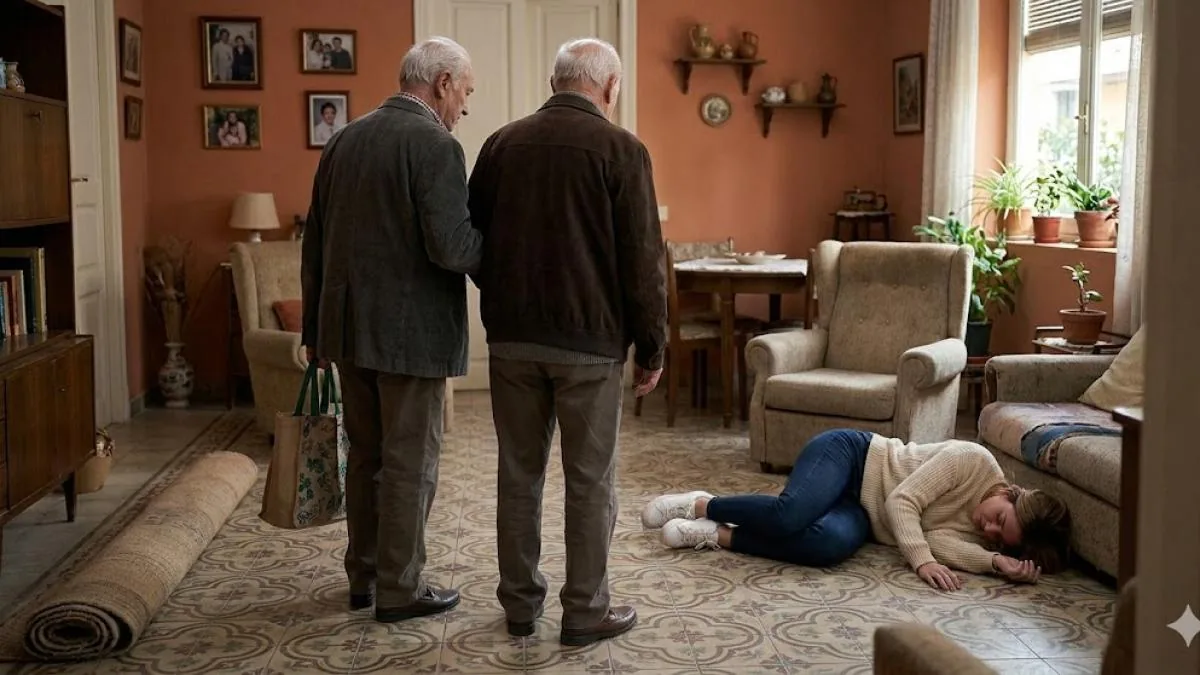
Her foot slipped. The world spun in a moment of weightlessness. She saw the ceiling, the chandelier with a burnt-out bulb, and then the sharp edge of the dining table. Her head hit the wood with a hollow, terrible sound, a dry crack that echoed in the apartment’s silence and slowly faded, like a stone falling into a very deep well. And then, nothing.
Pascual and Vicente peeked from the kitchen. They saw Clara’s body, motionless on the floor, in a pool of blood slowly spreading over the black and white tiles. Her hair loose, eyes open. She looked younger that way, Vicente thought. Like a broken doll.
They looked at each other. The same panic. The same paralysis they felt when they found their mother. Vicente opened his mouth to cry, but no sound came out.
—Pascual… —he finally whimpered—. The new mom is broken.
Pascual looked at the body, then toward the laundry room—where the chest freezer kept humming, patient, eternal—and then at his brother. A cold calm settled in his eyes. They already knew what to do. They already had practice.
A month later, seventh A was spotless. It smelled of bleach and dried flowers. Pascual and Vicente sat at the table, dining in silence. A stew of pale, tender meat, with potatoes and carrots. The dining room lamp’s light flickered slightly, as if something had just happened.
—The house is cleaner than ever —said Vicente, chewing slowly, savoring each bite.
Pascual nodded, sipping the sauce from the plate with a piece of bread.
—Clara cooked well —he said, and his voice was neutral, almost absent—, but not as well as you.
Vicente looked up. An empty smile, one that didn’t reach the eyes, spread across his old face.
—Yes, mom —he said, and the word fell in the dining room like a slab—. You’re right, mom.
The freezer’s hum, in the background, was still there. As always. As always. As always.
Read more Half a century of a Valencianist bookstore of reference that even survived an attack