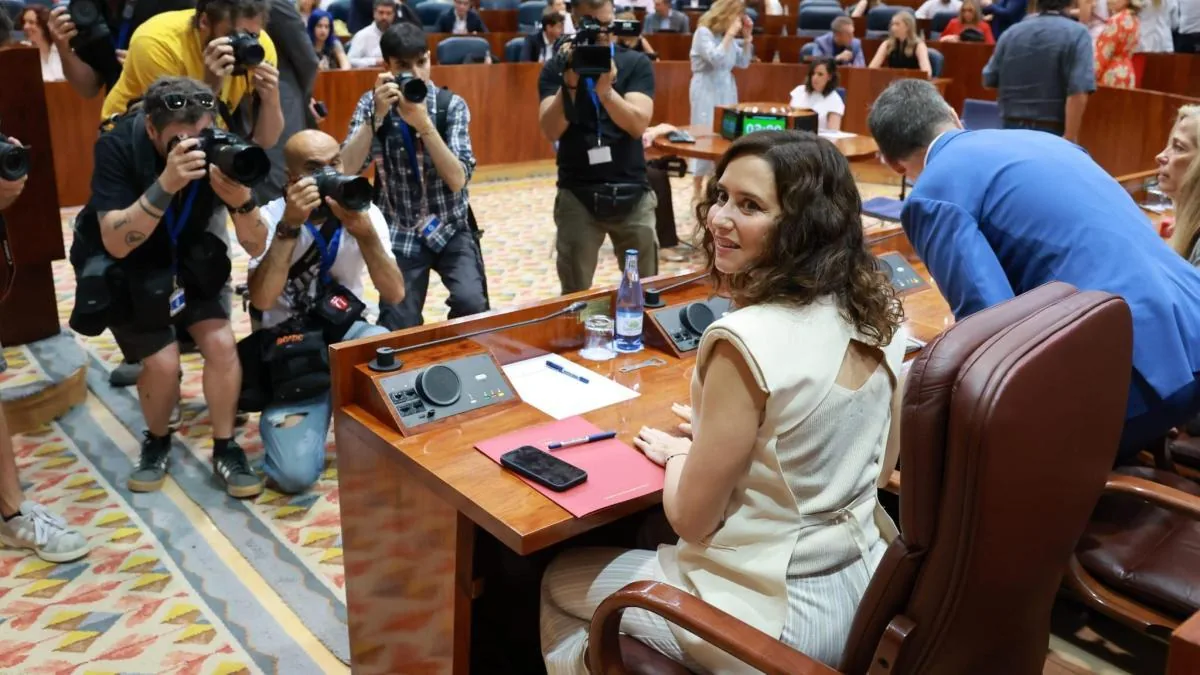
Isabel Díaz Ayuso has once again drawn her own political perimeter. And bypassing the board set by the national Popular Party for regional negotiations, the president of the Community of Madrid has not hesitated for a moment to place herself at the antipodes of Vox’s migratory discourse, accusing Santiago Abascal’s party of using arguments with a “racist tint.”
Read more United States leads the ranking of foreign tourists in Valencia even without a direct flight
The clash would be nothing more than a usual incident in the Madrid Parliament were it not for the shockwave it generates in the national strategy. For months, Alberto Núñez Feijóo has maintained a pragmatic balancing act with Vox in different autonomous communities, where both parties share or have shared power quotas, and where the Popular Party depends on the far-right to form majorities against the PSOE.
Read also
On that board, the forcefulness shown this Thursday by Ayuso in the Madrid Assembly introduces an element of internal friction. While Genoa opts for a measured confrontation and avoids a frontal ideological clash, the Madrid baroness has decided to raise the bar to defend the region’s migratory openness model against the “national priority” accepted by Mañueco (Castilla y León), Guardiola (Extremadura) and Azcón (Aragón). And for this reason, she has accused Vox of orchestrating a narrative based on social alarm, latent xenophobia, and the collapse of public services.
“Pedro Sánchez and Vox need each other every day, and they always show it,” Ayuso verbalized as soon as the control session for the government she presides over began. An equalization – that of the extremes that feed each other – with which the president seeks to shake off the pressure. Because, although she has discharged the responsibility for migratory management to the Moncloa Palace, the bulk of her reply has been aimed at disarming Vox’s discursive framework.

Previously, the far-right spokesperson in Madrid, Isabel Pérez Moñino, had criticized the demographic model of Puerta del Sol, accusing the regional executive of promoting uncontrolled population growth that “harms” Spanish citizens. A common rhetorical framework based on “demographic pressure” and insecurity.
Read more All open fronts in the indefinite strike of Valencian public education
Ayuso, however, has transformed the ethical debate into economic pragmatism. Defending the weight of immigration in Madrid’s GDP, especially in construction, where she estimates foreign labor at 25%. “Thanks to immigrants, we will be able to build homes,” she argued.
Beyond the direct confrontation, the episode reveals the asymmetry that coexists within the Spanish right. While the national PP tries to cohabit parliamentarily with Vox without mimicking its language, Ayuso displays herself free of ties thanks to her absolute majority.
Direct attack on the PSOE
The president of the Community of Madrid, Isabel Díaz Ayuso, has also not held back in her accusations against the PSOE, whose spokesperson, Mar Espinar, she accused of being “a representative of corruption” in the regional chamber and of speaking “on behalf of the sewer.”
In a particularly tense control session, Ayuso responded to an intervention by Espinar with a highly political speech in which she linked the PSOE to various judicial cases and controversies affecting the central government’s environment. “Your increasingly low-level words cannot hide the fact that you are the representative of corruption in this Assembly,” affirmed the Madrid president. In this context, she warned of what she called “the sewer” and accused the PSOE of trying to fabricate cases against her political circle.
The Madrid president went further by asserting that the PSOE “set up a corrupt plot to defend the ‘One’ at the cost of destroying democracy,” referring to the head of the Executive, and reproached the socialists for alleged smear campaigns against political adversaries.
Read more Negotiation resumes: Education will convene unions this Friday for a new meeting