





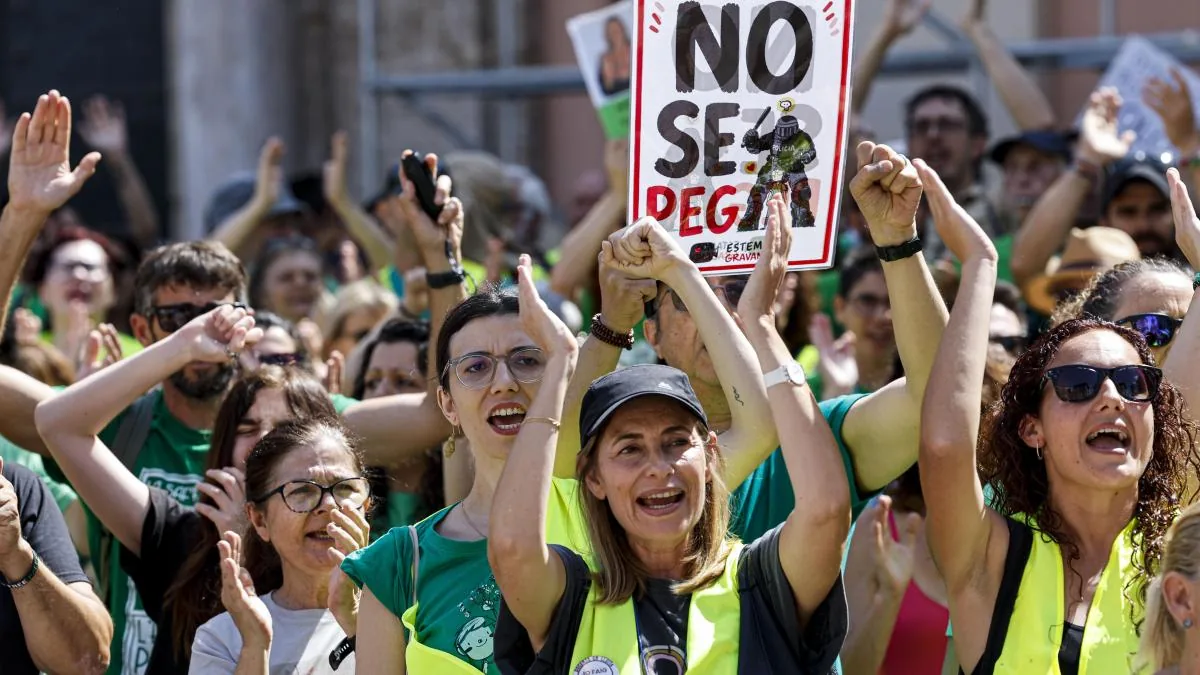
How are Valencian teachers doing? Will there be any progress? When will the strike end? Questions pile up at rallies, protests, at school gates, among families… The indefinite education strike that has been shaking public education in the Valencian Community since May 11 – yesterday with a 5.29% turnout, according to Education – permeates everything, dyes everything green but, for now, with no solution in sight.
Read more Negotiation resumes: Education will convene unions this Friday for a new meeting
To the questions, few answers: some teachers are encouraged, others disillusioned, others exhausted, “on an emotional roller coaster,” they explain. For now, no progress is visible either. The Ministry of Education, Culture, and Universities closed the last two pending meetings yesterday, on educational infrastructure and vocational training, but in no case were they sectoral tables due to the absence of the other three unions, STEPV, CCOO-PV, and UGT-PV. These insist on demanding real, in-person negotiation, but since Sunday, Minister Carmen Ortí has established the telematic modality.
And when will the strike end? For now, it remains indefinite. The unions maintaining the call have proposed changing the strategy, redefining actions… but keeping a protest like this going has its costs.
Three-way negotiation stalled
The President of the Generalitat, Juanfran Pérez Llorca, asked all Education unions this Wednesday to “sit down, not abandon the negotiation chairs” and “focus on what is important, which is Education.” “If we leave aside political issues that some try to exploit and union electoral strategies, an understanding will be reached quite naturally,” he argued.
Monday, Tuesday, and Wednesday, the Ministry of Education held telematic meetings to address all points of the negotiation table, except salary, which it considers closed with the agreement signed on May 25 with CSIF and ANPE. In these meetings, attended only by these two unions – with the exception of the participation of CCOO-PV and UGT-PV in one of them last Tuesday – no major specifics were reached, and no agreements were closed.
ANPE, for its part, criticizes that the non-participation of the other unions prevents these from being considered sectoral tables and has presented a legal report to Education “that supports that the convened meetings have the character of a sectoral table and, therefore, can be negotiated in them.” And, to spice up the conflict between unions, CSIF yesterday filed a complaint with the Prosecutor’s Office to investigate whether “attempts at coercion and intimidation” against its delegates, when they could not leave the Ministry last Sunday due to the initial lockdown, constitute a crime. The background is the confrontation between unions over a salary agreement closed with the latter two, which STEPV, CCOO-PV, and UGT-PV consider was negotiated in bad faith.
Evaluations at a hot end of the school year
The strike began on May 11, in the middle of the end of the school year for those who finished the PAU yesterday, and about to close the third term for the rest of the educational community. Regarding the circumstance, Education sent specific instructions to schools to guarantee student evaluation, despite the protests because, as Minister Ortí has always defended, “the search for labor improvements among adults cannot become a detriment to children.” These instructions state, whenever another teacher cannot be assigned, or the management team evaluates them, or the grades from the first and second evaluations and the work from the third are taken into account, that the student should pass.
Read more Six weeks of summer closure on Barcelona Metro Line 1 between Florida and Plaça de Sants
Education has also given instructions regarding heat in classrooms, one of the teachers’ complaints to which the Ministry responds by proposing a Thermal Comfort Plan. Meanwhile, it proposes precautionary measures in classrooms – such as checking the temperature or ventilating during less hot hours; making schedules flexible in June and September; or communicating the situation to the competent civil protection authority.
Educational camp in the center of Valencia
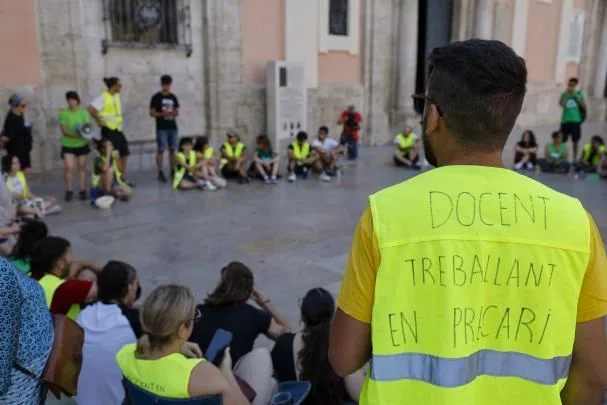
The educational camp forged among a group of indignant teachers is another derivative of the conflict that most clearly visualizes the labor conflict in the city. Occupying the Plaza de la Virgen in Valencia is the latest action they have proposed and the one having the most media impact, with many facets: the camp does not have permission, and in its possible eviction, the Government and the City Council of Valencia clash, whose highest representatives in the Valencian Community cannot quite find the formula.
Read also
Delegate Pilar Bernabé believes that “whoever has to dialogue, should dialogue” and Mayor María José Catalá accuses the former of being “cowardly.” Apart from the discomfort that the camp may cause its detractors, there was one more ‘but’ that was resolved last night: this Thursday, the Corpus Christi celebrations begin in Valencia. And the historic center, where the teachers are camping, was being decorated for it, so yesterday, the campers decided to “temporarily relocate” to a less central area of the square to “facilitate the proper development of the festivity.” They argued that they believe “constructive dialogue is the best tool to avoid a confrontation that takes our demands out of focus.”
And now, also, strikes in subsidized private schools
In addition, subsidized private education yesterday held the first of three days of partial strikes – with a 2.52% turnout of teaching staff, according to Education – called by unions “in protest at the lack of progress in negotiations with the Ministry.” These mobilizations will be followed by new days on June 10 and 17.
The strikes are for periods of at least one hour between 8 and 10:30 am. FSIE-CV, the majority union in this network, USOCV, CCOO-PV, UGT Servicios Públicos, and STEPV call these mobilizations “due to the absence of agreements on labor and educational matters contemplated in the December negotiation calendar and still pending: partial retirement, the improvement of Dual Vocational Training, the adequacy of staff in special education and Vocational Training centers, or the modification of the delegated payment order.” The cooperative subsidized schools, grouped in AKOE, do not join these, and are still studying pressure measures in a situation they also want to denounce.
Read more Barcelona eliminates private company shared bicycles