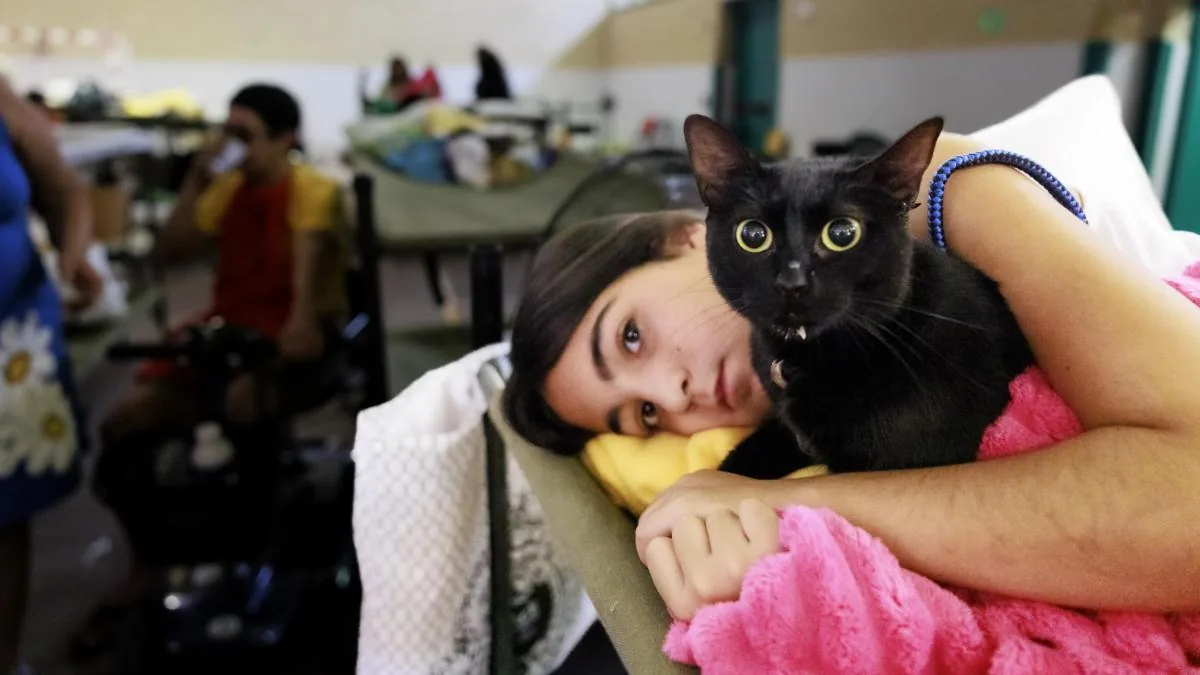
The fire has driven tens of thousands of people from their homes in the western mountains of Madrid and the Ávila valleys of Tiétar and Iruelas (around 90,000 between evacuated and confined). The vast majority have gone to their primary residences or to relatives’ homes, but many have been housed in more than a dozen sports centers distributed throughout the region (except in Madrid city, which houses no one).
Read more National emergency due to a fire considered “inextinguishable”
One would expect to find citizens angry about the terrible situation they are suffering, but that is not the majority. The reality is that people are calm, after the initial nerves, although uneasy about what might be happening to their towns. And above all, patience stands out.
“The summer season is over for us, and I fear, so are the following seasons”
“Girl, it is what it is. We are alive and that, in truth, is the most important thing. We have a bed, food, and they treat us well… Of course, we are very uneasy about what we will find when we return, but the first thing is to put out the fire,” say María and Eugenia, two charming ladies who are already over 65 and have spent two nights sleeping in bunk beds at the Villamanta sports center. The first night, they didn’t sleep a wink, they assure. The second, better (“human beings adapt to everything,” they say in unison).
Will there be more nights? Yes, they know there are more days left, as most do. The dense smoke and the smell of barbecue leave no doubt, and even less so the capricious wind, which for a while stays still and the next moment pushes strongly, sometimes to the right and other times, the opposite. “It’s out of control,” assure the agents who keep the M-507 road closed. They are clear that they will not let anyone pass (except for residents of Aleda del Fresno who are going for medicine), “because we don’t want to be responsible for anyone’s death,” they say. Fear prevails over any argument.
Read also
Patience, gratitude, and uncertainty are the predominant feelings, but there is also indignation. There are those who cannot help but show their pain for a fire that threatens natural spaces that give them life in every sense. “I came to the mountains fleeing Madrid. Here I formed my family and found my livelihood, a farm that gives me happiness. And all of that is about to disappear if it hasn’t already,” says Laura, evacuated from Chapinería.
Rage pours from her mouth against those who deny climate change, who prevent adequate measures from being taken to curb these fires, and against the “politicians” who, when autumn arrives, dismiss the crews that care for the forest. Her words are shared by some of those in Pepe’s bar, which, along with La Muni’s, has become a meeting point for the evacuees. One of them recounts that the farmers of the northern park of Guadalajara, where more than 32,000 hectares have burned and whose smoke has joined that of Madrid and Ávila, are going to gather again in support of the mayor who, allegedly, caused the fire with a harvester. The news again raises indignation.
“I came to the mountains fleeing Madrid. Here I found my livelihood. And all of that is about to disappear”
Because many feel that their future is over. Even if the houses are not affected, nor the towns, the landscape that so attracted tourists, that urbanites so sought after, is. “The summer season is over for us, and I fear the following seasons,” says a resident of the beautiful Ávila town of Navaluenga, who works at a children’s camp.
Read more The climate crisis rules
In Villamanta, a father with his disabled son walk around the sports hall. They have just arrived. They say they have been in another sports center, but they came to this one thinking that colleagues from the AMAM center for people with intellectual disabilities were there. They are no longer there; they have been transferred to a residence or with family members.
More than 1,300 elderly people, people with disabilities, and minors from a total of 19 residences (14 for the elderly, 3 for minors, and 2 for people with disabilities), people in social emergency, and young people from the municipalities affected by the fires in the region.
In Villamanta, pets are not allowed inside. Therefore, some sleep in their cars with them. This is not the case for Libertad, 11 years old, who has put her cat Tití under the blanket. With her, she patiently awaits the moment to return home, something her bunkmates do not see very clearly at the moment.
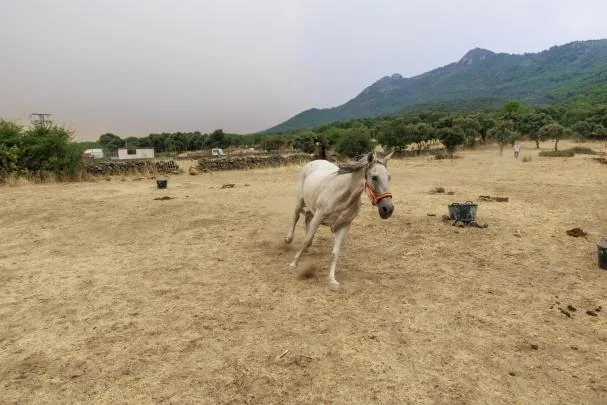
It’s lunchtime and the relocated residents in Villamanta return to the sports center and stand in front of an open van, which gives off an appetizing smell. It belongs to the NGO World Central Kitchen, by Spanish chef José Andrés, which offers breakfasts, lunches, and dinners for the relocated. Three young people are in charge of a setup that is replicated in other sports centers.
In neighboring Navalcarnero, the Spanish chef’s NGO is not present. The twenty families housed in the sports center are attended by social services. Tranquility prevails in this center, although suddenly everything escalates. Cenicientos, where the command post coordinating the fight against this immense fire was located, has been evacuated due to a sudden change in wind. Now, the command post is in Navalcarnero.
Read more Minister Puente clashes with Díaz Ayuso: «If there’s a buffoon in Spain, it’s you»