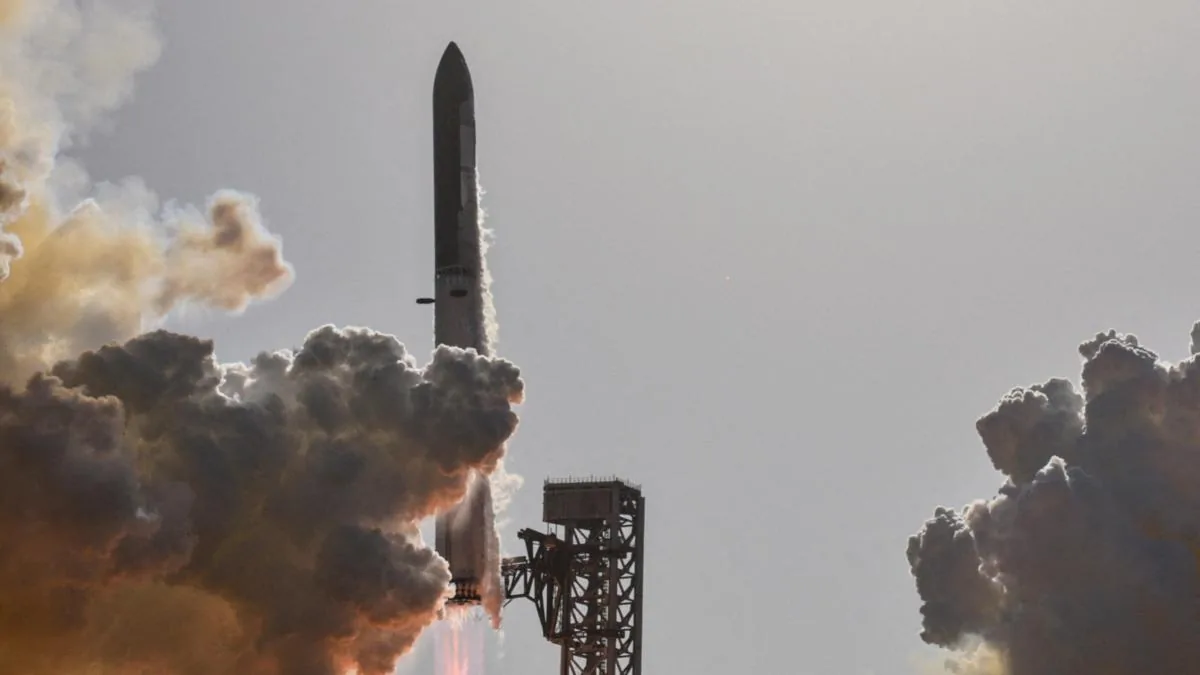
A fragment of a SpaceX rocket that had been floating in space since last year crashed into the Moon on Wednesday, adding to the list of meteoroids, spacecraft, and other space debris that have been bombarding the lunar surface for a very long time, astronomers said.
Read more The sale of apartments has now seen two consecutive quarters of decline
The object, the size of a school bus, is the second stage of a SpaceX Falcon 9 rocket that had launched a Firefly Aerospace lunar lander module toward the Moon in January 2025. Its collision with the Moon became a spectacle for astronomers and space enthusiasts eager to see how it would unfold.
The debris was traveling at a speed of 8,690 kilometers per hour
Weighing 4 metric tons (4,000 kilos), the rocket body crashed into the Moon around 0635 GMT, traveling at a speed of 8,690 kilometers per hour. None of the few spacecraft orbiting the Moon were in position to capture close-up images of the impact.
However, at the Paranal Observatory in Chile, the Very Large Telescope of the European Southern Observatory (ESO) detected flashes of light associated with the impact.
“We can confirm that the telescope detected spectral lines of gaseous sodium and lithium in the impact plume, which lasted between 5 and 10 minutes after the impact,” an ESO spokesperson told Reuters.
The rocket impacted near the lunar terminator line, that is, the shadow boundary separating the sunlit face from the dark side.
As with other objects that have impacted the Moon in the past, the rocket stage raised a cloud of lunar dust that was briefly illuminated by sunlight, although it was difficult to observe with the naked eye from Earth.
The way the impact plume interacted with sunlight allowed astronomers to gain clues about its composition.
The sodium gas detected in the spectra is believed to have come from the lunar soil, while traces of lithium could have originated from the rocket stage itself, Carl Schmidt, the lead astronomer in charge of the impact observations, explained to Reuters.
Read more A woman dies stabbed allegedly by her partner in Murcia
“This is a very preliminary analysis, but I wanted to share something quickly; over time we will be able to provide more details about these results,” Schmidt said via email.
The impact was unintentional
The impact was unintentional, according to SpaceX. The rocket fragment was expected to impact near the Einstein crater, on the Moon’s western limb, an area often difficult to see from Earth.
Normally, these stages re-enter Earth’s atmosphere and disintegrate, or fall into the ocean after propelling the rocket’s payload to a precise point in orbit.
However, since the January lunar lander mission required more thrust than missions closer to Earth, the rocket’s second stage remained in space, drifting among thousands of other pieces of space debris that active satellites must avoid.
It was not until earlier this year that astronomers determined that the rocket stage, which had dumped its remaining fuel and could not be controlled, was on an orbital trajectory ending at the Moon.
Space debris impacts on the Moon are rare. A Chinese rocket stage crashed into the Moon in March 2022 after completing a lunar test mission.
In 2009, NASA intentionally crashed a rocket stage into the Moon to study the cloud of lunar material raised by the impact, leading to a key discovery: that lunar soil contains traces of water ice.
Read more The King receives Vivas, president of Ceuta, this Thursday at Marivent