The most forgotten war in the world fits into a small alley of a historic souk in Dubai. Far from the vertical ostentation of skyscrapers in other neighborhoods of the Emirati city, the wooden pergola-covered passages of the Deira Gold Souk, in northern Dubai, house a different kind of more discreet display: more than 300 shops buying and selling jewelry and gold. The Dubai souk is a bustling hive of luxury and vibrant peace.
Wrapped in the bustle of loud bargaining, visitors stroll leisurely past the dazzling shop windows and cool off the heat with fizzy drinks in nearby cafes. At first glance, nothing seems to connect these scenes of calm with one of the worst conflicts in the world unfolding 2600 kilometers away, but the connection exists: the multimillion-dollar trade in gold and gum arabic, an edible resin used in soft drinks like Coca-Cola, sweets, paint, or cosmetic and pharmaceutical products, lies at the root of the Sudan war, the most forgotten conflict in the world according to the annual list of the Norwegian Refugee Council (NRC), which has caused a humanitarian crisis of biblical proportions with 150,000 dead and 14 million displaced.
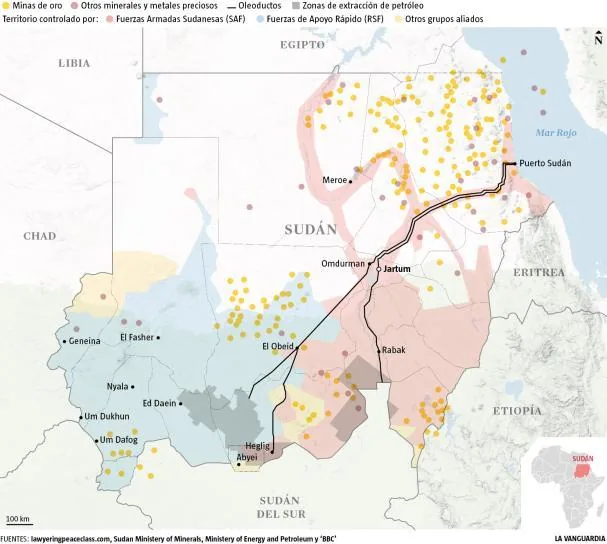
For Sudanese journalist Zeina Salih, the local power struggle that began in 2023 between Mohammed Hamdan Dagalo, aka Hemedti, leader of the fearsome paramilitary Rapid Support Forces (RSF), and Abdelfattah Burhan, head of the army, has turned into a predatory economy involving dozens of countries that mercilessly fuels the conflict. And in this bloody business, the golden metal is central. “Gold plays a key role in the war. Sudan has the third largest gold reserves in Africa and both sides trade this wealth to buy weapons and support. Gold from the rebel RSF areas travels to the Emirates, and Egyptian companies lead the gold mines controlled by government forces,” she points out.
The Emirati government denies it
The Rapid Support Forces rebels, perpetrators of massacres, receive weapons clandestinely from the United Arab Emirates in exchange for gold from their mines
Despite the devastation ravaging the African country, which has left thousands of schools and hospitals destroyed or roads impassable and pushed 41% of the population into hunger, the gold business is healthier than ever. In the report Gold and War in Sudan , Suliman Baldo, founder of the Sudan Transparency and Policy Observatory, denounces that the gold sector – including mining, production, distribution, and smuggling – defines the Sudanese civil conflict. “The gold trade, valued in billions of dollars, constitutes the most important source of income for the two main parties in conflict and feeds a cross-border network of associated actors including other armed groups, producers, traders, smugglers, and foreign governments.”
The gum trade, used in soft drinks or cosmetics, reaches record figures and is used to buy weapons
If the production from mines controlled by the army is exported, both legally and through smuggling, to Egypt; in rebel territory, where artisanal mining is the norm, gold has become a currency to buy the weapons that their main allies, the Emirates and Russia, smuggle through the porous borders of Libya or Chad. The lack of control is almost total. The report Tracking Africa’s Gold by Swissaid estimates that up to 70% of gold production in Sudan is smuggled to neighboring countries, from where it enters international channels. The trafficking began even before the sound of bullets: according to the organization, at least half of the 400 tons of gold clandestinely extracted from Sudanese soil between 2012 and 2024 were destined for Dubai and, to a lesser extent, Moscow.
The Sudan war has not caused a bloody fight for gold. It is the other way around. The ruthless race for Sudanese gold has led to a war without quarter. And it is not the only treasure both sides and their international allies dispute. Besides fertile lands and livestock, which interest Saudi Arabia and Egypt, there is another wealth of Sudan that places the United States and Europe at the center of the conflict: gum arabic. Its importance has always been crucial. In the 1990s, when the U.S. banned exports from the African country by labeling it a “state sponsoring terrorism,” it expressly excluded this resin extracted from acacias with emulsifying properties, present in hundreds of supermarket products. The ban would have been fatal: Sudan provides 80% of the world’s supply of gum arabic.
The war has taken advantage of that great demand. Smuggling of gum arabic from both sides, a traditionally opaque trade, has skyrocketed: despite the most demanded variety, hashab, multiplying its price sixfold due to the war, in 2024 Europe imported almost 20,000 tons of Sudanese gum arabic, 62% more than the previous year, with Germany and France as the main destinations. Moreover, smuggling is practiced without mercy, as neighboring countries like Egypt, Eritrea, or Chad have become new exporters with more than 4,000 tons in total.
“Gold constitutes the largest source of income for both sides,” says expert Suliman Baldo
Although large pharmaceutical companies or multinational beverage and cosmetic firms claim to monitor the origin of their purchases, Esther Bijl, co-author of the report How the Gum Arabic Trade Fuels the Conflict in Sudan denounces indifference. “Every day, millions of European consumers visit their stores unaware that many of the products they buy contain gum from Sudan, where armed militias are committing large-scale atrocities. Our research indicates a high probability that these groups benefit from the gum arabic trade.”
Sudanese activist Gurashi Mirghani, who was part of the popular resistance committees that overthrew dictator Omar al-Bashir in 2019, sums up in one sentence the predatory war with which both national and international actors have brought his beloved Sudan to disaster. “Our riches have once again been our curse.”