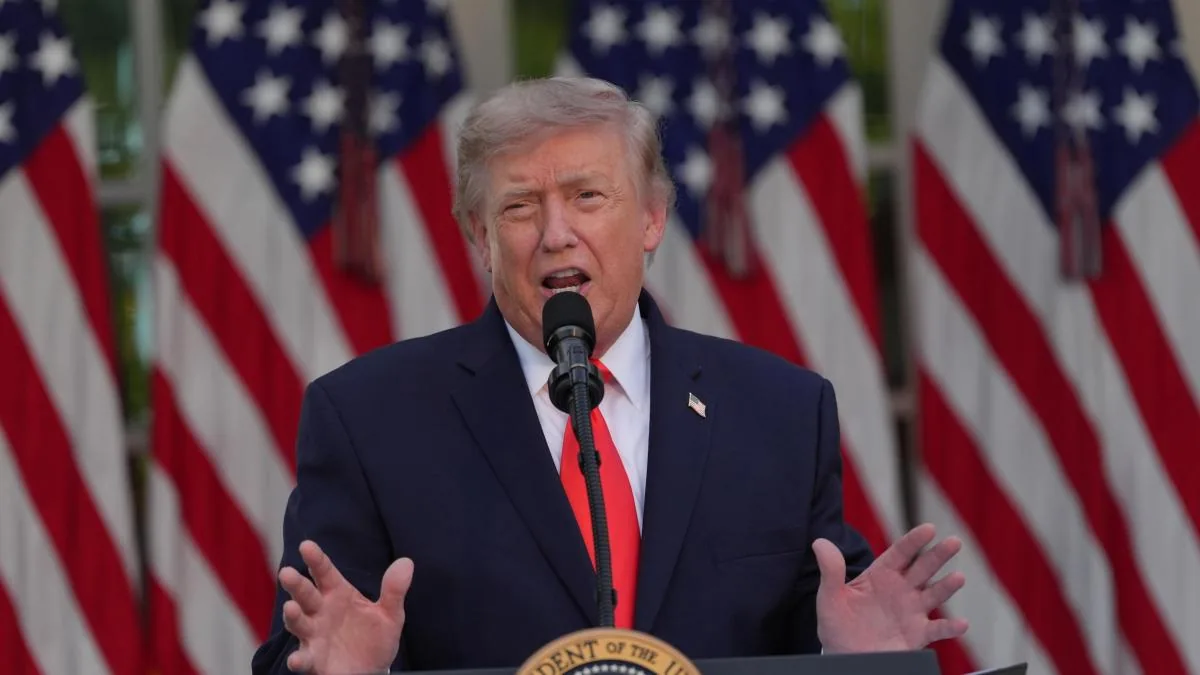
Donald Trump had promised it without too many detours. “We are going to end all diversity, equity, and inclusion programs throughout the federal Government,” declared the President of the United States. Since returning to the White House, his Administration has applied this offensive to education, public contracting, artificial intelligence, and numerous federal agencies. Now he wants to permanently incorporate it into the system that funds much of American science.
The White House Office of Management and Budget (the powerful OMB) has presented a proposal of more than 400 pages that would modify the rules under which federal grants are awarded and managed. The change affects dozens of agencies, including NASA, the National Science Foundation, the National Institutes of Health, and the Departments of Education, Energy, Transportation, Housing, and Health.
Together, these institutions manage nearly a trillion dollars annually in public aid. Around 150 billion are allocated to science and technology. The reform would require discretionary grants to demonstrate that they contribute to the “president’s policy priorities” and would give politically appointed senior officials greater capacity to review awards and cancel projects already underway.
The Administration maintains that the current system lacks transparency and has allowed ideological programs to be funded. “Together, these policies wasted an enormous amount of taxpayer resources and caused great damage to public trust in the Government,” the proposal states.
According to the OMB, the reform is necessary to ensure greater accountability. But for a large part of the American scientific community, what is at stake is not simply spending efficiency. It is who decides which research deserves to exist.
Trump decides everything
The absolute control of scientific research
The U.S. federal system is not completely isolated from politics. Congress and the White House have always been able to decide that certain areas receive more resources: cancer, Alzheimer’s, defense, nuclear energy, or space exploration, for example.
The difference is that, until now, the specific selection of scientific projects has mainly depended on specialized agencies, officials with technical experience, and peer review processes. Independent experts evaluate the methodology, relevance, feasibility, and potential impact of each proposal.
These policies wasted an enormous amount of taxpayer resources and caused great damage to public trust in the Government
U.S. Government
The new model would reduce the weight of those evaluations. Scientific reviewers could continue issuing recommendations, but policymakers would have more leeway to ignore them when a project did not align with the presidential agenda.
Donald Trump had already set this direction in an executive order from August 2025. The document required that discretionary aid “demonstrably promote the president’s policy priorities” and rejected funding initiatives that foster what the White House calls “anti-American values.”
That concept is not precisely defined, just as there is no stable delimitation of what research can be considered woke. The proposal explicitly mentions diversity, equity, and inclusion programs, the so-called “gender ideology,” and certain forms of international cooperation.
The White House itself has turned the term woke into an extremely broad political category. In one of its official videos, it even summarized its position with a phrase: “DEI, eliminated. Woke? For losers. Common sense is back.”
Trump has also used this language when talking about artificial intelligence. At the end of 2025, he accused some states of trying to introduce “DEI ideology” into models and producing a “woke AI.” His Government later ordered that systems acquired by federal agencies be, in their own terms, “ideologically neutral.”
The problem is that applying that logic to science allows labeling as ideological issues that are also legitimate objects of research: health inequalities, discrimination, the health of transgender people, the effects of racism, climate change, or epidemiological differences among population groups.
Everything is ‘woke,’ according to Trump
What is researched is also a political decision
Science aims to produce knowledge through testable methods, but it does not exist in a vacuum. The decision to fund one disease and not another, prioritize military research over public health, or study how a policy affects certain groups has social consequences.
Jeremy Berg, former editor-in-chief of Science magazine, recalls the start of the AIDS crisis as one of the clearest examples. “It’s not something abstract,” he explains. “President Reagan said nothing for four years and there was no coordinated effort to address it.” The absence of a political response did not alter the biology of the virus, but it did condition the resources available to study and combat it.
The idea was that science should be isolated so that the best ideas would be funded. Period
Donna Riley
former program director at the National Science Foundation
But that does not mean scientists should decide a country’s priorities alone. Governments have legitimacy to set major goals. The question is whether politics should be able to discard specific research because of its vocabulary, the populations it studies, or because its conclusions might be uncomfortable.
Donna Riley, former program director at the National Science Foundation, explains in The Verge that the principle of the system was precisely to protect scientific evaluation from those pressures: “The idea was that science should be isolated so that the best ideas would be funded. Period.”
Nancy Krieger’s experience shows what can happen when that separation disappears. This Harvard social epidemiologist led a study funded by the National Institutes of Health on the effects of discrimination on health. Her grant, close to a million dollars, was canceled when about a year of work still remained.
It was an absolute shock and dismay
Nancy Krieger
Harvard social epidemiologist
“I thought: what? What does this mean? I don’t understand,” she recounts. She then had to reorganize the research, handle the litigation, and manage the impact on professionals whose jobs depended on those funds. “It was an absolute shock and dismay.”
The case was not isolated. During Trump’s second term, various agencies have withdrawn or suspended aid related to gender, diversity, trans health, discrimination, and climate change. The OMB reform would transform many of those decisions, made so far through scattered orders and guidelines, into a regulatory structure applicable to almost the entire federal Government.
Beyond Trump
A threat that does not end in the United States
Although the rule would only have direct authority within the United States, its consequences could far exceed its borders. Modern science depends on international networks. Clinical studies are conducted in several countries; observatories share data; laboratories exchange samples; large space, climate, or biomedical research projects require teams distributed worldwide.
The United States occupies a central position within those networks. Its National Institutes of Health constitute the largest public funder of biomedical and planetary behavior research. And its universities, agencies, and laboratories participate in thousands of international projects.
Thus, when a U.S. grant disappears, the consequences are not limited to the researcher who received it: they can affect associated centers, databases, contracts, technical staff, and experiments spread across several countries.
The proposal also encourages agencies to monitor applicants’ links with foreign organizations and allows assessing whether those relationships could harm national security. There are legitimate reasons to control the transfer of sensitive technologies or conflicts of interest, especially in relation to China. However, critics fear that broad wording will end up generating legal uncertainty and discourage scientific collaborations that pose no threat.
This proposal aims to undermine virtually all industries and public services supported by federal funding
Rob Bonta
Attorney General of California
The proposal, in fact, has sparked an unusual mobilization. The public consultation period ended on July 13, 2026, after receiving nearly half a million comments. Various analyses estimate that around 95% opposed the reform. Twenty-two state attorneys general have also expressed their rejection and are preparing to challenge it in court if it finally comes into effect.
“This proposal aims to undermine virtually all industries and public services supported by federal funding,” says Rob Bonta, Attorney General of California. Democratic Senator Tammy Baldwin accused Trump and OMB Director Russell Vought of endangering “the health and safety of Americans.”
Also read
“Citizens expect their tax money to be allocated to research with the best chances of making a breakthrough or curing a disease,” Baldwin adds, “not to be used as a club to punish perceived enemies of the president and gain political advantage.”
The Administration rejects these criticisms. Vought has described them as a “left panic attack,” while a White House task force assured that American taxpayers will no longer be forced to fund “woke NGOs with partisan agendas.”
The battle, therefore, is not between neutral science and politics trying to contaminate it for the first time. Scientific funding has always responded, to some extent, to national priorities. The change proposed by Trump is deeper: allowing affinity with the presidential program to weigh as much or more than the scientific quality of each project.
Read more Lost inside a closet to assemble