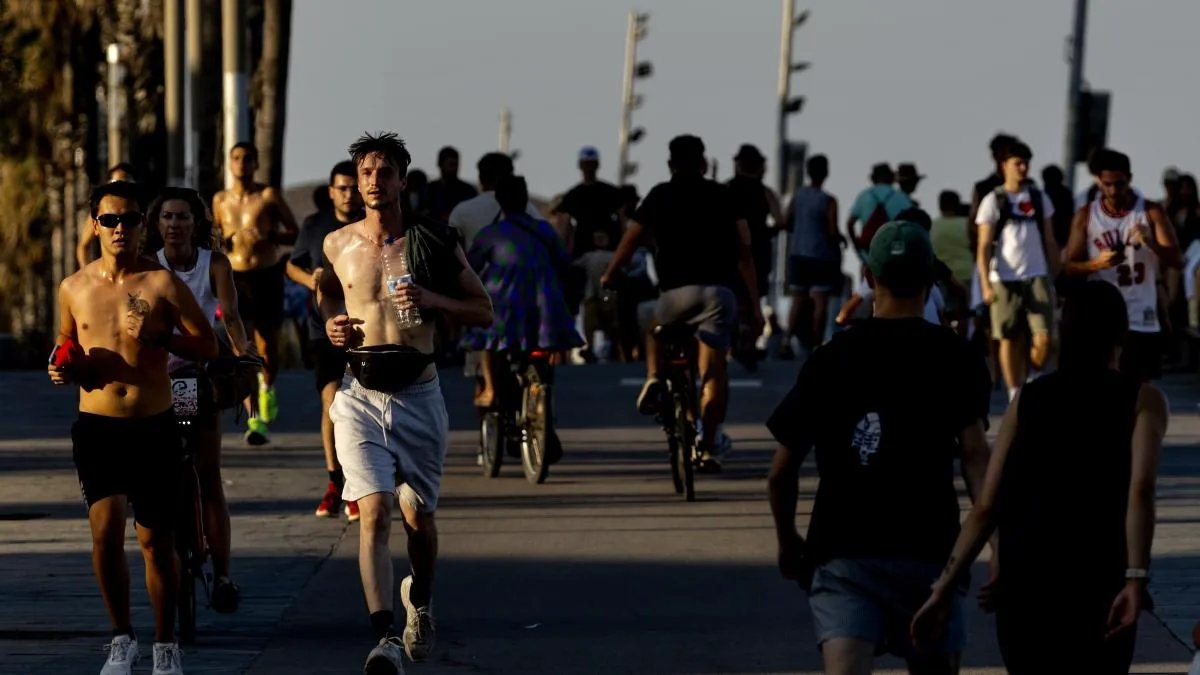
Heat is beginning to change social habits. Faced with rising temperatures, which seem to lead us to a cyclical situation of heat waves, many people are starting to change their routines as a form of self-regulation, consciously or unconsciously. Going out at 1 p.m. to shop or going for a run early in the afternoon are unthinkable activities during the hours of greatest sun exposure. Especially in the streets of cities that, at best, have some trees that prevent the asphalt from radiating temperatures of 40 degrees to pedestrians.
Read more Cold war PSOE-PP in the face of the climate crisis
Gradually, the start of many activities and routines is moved forward – to early morning –, delayed – until the sun sets – or simply stopped because people avoid going outside. High temperatures empty avenues, parks, and squares for much of the day. In the morning, the elderly have stopped gathering on benches in avenues or parks; and in the afternoon, children no longer play in parks and runners no longer run along promenades in their sportswear. It is a self-imposed curfew that lengthens year after year as extreme heat reduces the habitable hours of the day.
This is demonstrated by a study published in the journal PNAS Nexus, linked to the U.S. National Academy of Sciences, after collecting mobility data from 13 million people in Spain. The report indicates that on the hottest days, the country’s total mobility decreases by up to 10%, and during the hours of maximum temperature, early in the afternoon, it is up to 20% lower.
Josefa Padilla (78), a resident of the Eixample in Barcelona, is one of many Barcelona residents who has reorganized her daily life because of the heat. She does her shopping at 8 or 9 a.m. at the latest and tries to combine it, whenever possible, with a swim in the municipal pool. “The pool is the only thing we have left.” “I used to go out to eat with friends, but now we meet in the morning when we leave the pool to have a coffee.” Padilla admits she is lucky to have air conditioning at home because otherwise, “I would do nothing but sweat all day.”
Some afternoons she has to leave at 4:15 p.m. to pick up her granddaughter at the summer camp. If the parents can do it some days, she does not leave her house until 7 p.m. “When I pick her up, sometimes she wants to go to the park, but I can’t handle this heat.” And she sums up this inability with a phrase: “We live in a permanent heat wave.”
Parks and squares, ghost spaces
On the other hand, for years cities have invested in designing parks and public spaces to encourage outdoor life. However, many of these playgrounds and squares become useless for children in summer.
Raquel Alcoceba (47), a resident of the Gràcia neighborhood in Barcelona, takes her two children, aged 4 and 6, to the summer camp at a local school. This mother states that many activities that used to be held in nearby squares have now moved inside educational centers. However, the children leave at 4:30 p.m., during “the hottest hour.” “When the camp ends, we no longer go to the park. There isn’t one in the area with awnings or trees to protect from the sun,” she adds. Faced with this situation, the family also uses the pool as a climate refuge.
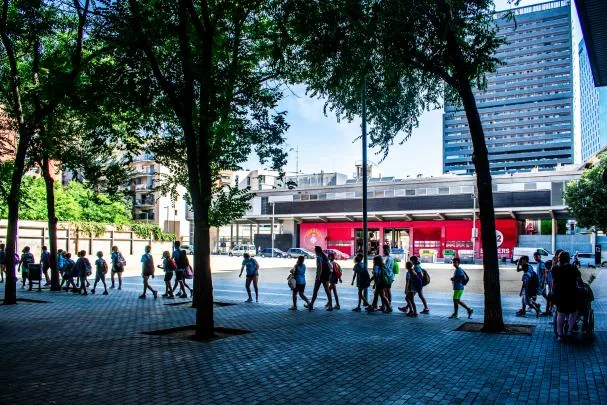
Although activities try to adapt to heat schedules, Sara Soro, a monitor at the Ítaca school summer camp in the Les Corts neighborhood of Barcelona, explains that they only do one activity outside the school per week, when they go to the pool.
“It’s nice in the water, but if you’re changing the children or watching outside, it’s very hard.” They go from 10:30 a.m. to 12 p.m., walking, in a ten-minute trip, “always with caps and protection.” According to Soro, these schedules would be difficult to change, even if the camp company wanted to, because they depend on the availability and hours of the pool.
“Get up early or wait for the sun to go down”
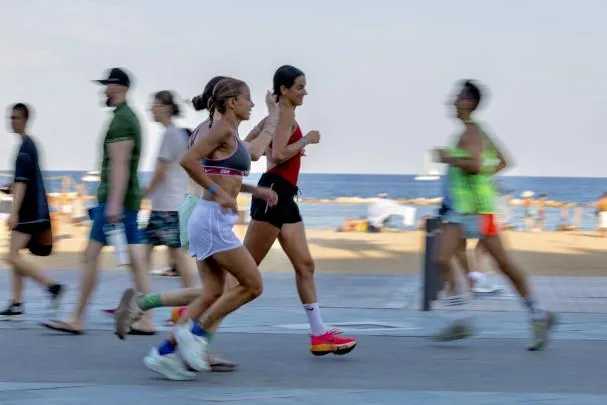
Alex Krieger (30) tries to run regularly along Barcelona’s seafront promenade. He has also chosen to adapt his schedule due to the high temperatures. “I used to run around 7 p.m., but now some days I don’t go out until 9 p.m.” Others prefer to get up early. “I have friends who go at 6:30 or 7 a.m. at the latest,” he explains.
On the other hand, residents of the seaside neighborhoods have also adapted their exercise schedules because of the heat, despite living just meters from the beach. Pere Llaurador (67), a resident of the Barceloneta neighborhood, usually walks the seafront promenade to Poblenou. “In the mornings I swim at the breakwater. During these months I always try to go out at 6 or 7 a.m.”
Read more The song of the summer: it grows only due to immigration and productivity stagnates
Summer used to be a time of freedom and leisure; now people fear sunstrokes or heat strokes”
Isabelle Anguelovski
Researcher at the Institute of Environmental Science and Technology (ICTA-UAB)
Isabelle Anguelovski, researcher at the Institute of Environmental Science and Technology (ICTA-UAB), points out that gradually, “we will return to an imaginary from forty or fifty years ago”: afternoons locked inside homes, with shutters down and in darkness. “Like our grandparents.” This researcher states that there is already a “critical time window” – from 11 a.m. to 6 p.m. – during which the population should not go outside for health reasons. Almost a full workday, locked in and unable to go out in public.
“Summer used to be a time of freedom and leisure; now people fear sunstrokes or heat strokes.” Anguelovski warns that children and the elderly are the main affected groups. “This situation may promote greater social isolation among the elderly and lead to a vicious circle of mental and physical health.”
Exceeding an average of 27.8 degrees increases worldwide sedentarism by 1.5%
The Spanish Society of Rehabilitation and Physical Medicine (SERMEF) confirms what is observed on the streets. During the last heat wave, the entity warned that episodes of extreme heat are causing part of the population to reduce or abandon physical exercise.
According to the study Effects of climate change on physical inactivity, published in The Lancet Global Health, which collects data from 156 countries during the period 2020-2022, exceeding an average temperature of 27.8 is associated with an increase of 1.5 percentage points in worldwide sedentarism. A phenomenon that affects low- and middle-income countries more, where it reaches 1.85 points.
Changes in habits can become dangerous because they individualize a response that should be structural”
Amaranta Herrero
Professor of Environmental Sociology at the University of Barcelona (UB)
Amaranta Herrero, professor of Environmental Sociology at the University of Barcelona, points out that “changes in habits can become dangerous because they individualize a response that should be structural.” According to Herrero, there is an impact on the community fabric. “The danger of a practice as everyday as meeting your friends in the square has increased, and this leads to a reduction in social encounters that impacts the community structure.”
This is the case of Olga González (20), Abril Esberri (23), and Ivet Romero (24), three friends who usually met after lunch in Castelldefels. “Now we don’t go out until 7 p.m. You can’t be outside before then,” they say. If they don’t have to work, they try to go to the pool or the beach in the morning. And if they stay home, they don’t leave the air conditioning. “I have it on 24 hours a day,” says Romero. Despite the heat, there are habits they don’t want to give up. They always meet on a bar terrace to smoke. In this case, tobacco addiction wins over the heat.
Scorching nights mark a turning point: heat ceases to be an exclusively daytime problem
In Barcelona, the start of summer is marked, among other events, by the end of the Grec Festival. Xavier Marcé, councilor for Culture and Creative Industries of the Barcelona City Council, warned that both professionals and the public have noticed the consequences of suffocating nights. “We will have to reflect on the heat,” he said.
The fact is that scorching nights, the main cause of heat-related deaths in Barcelona, transfer the problem that was until now associated with the day to the night. If this scenario becomes normalized, neither the night will be synonymous with milder temperatures, nor will moving activities to nighttime be an alternative solution to escape the heat.
“There is a lack of climate planning for public spaces”
Amaranta Herrero
Professor of Environmental Sociology at the University of Barcelona (UB)
For now, the only solution seems to be self-regulation of schedules. “There is a lack of climate planning for public spaces,” adds Herrero. This environmental sociologist believes that “almost revolutionary changes at the urban level” must be promoted. That is, promoting green spaces throughout public areas, installing vertical gardens, or ensuring a dense tree network, one of the few measures capable of reducing street temperatures by several degrees.
Furthermore, if cities and work schedules are not reconfigured, “only a privileged few will be able to adapt”: those who can flex their workday or afford access to air-conditioned spaces or a pool.
Read more In the background of the migration crisis, the 2030 World Cup final