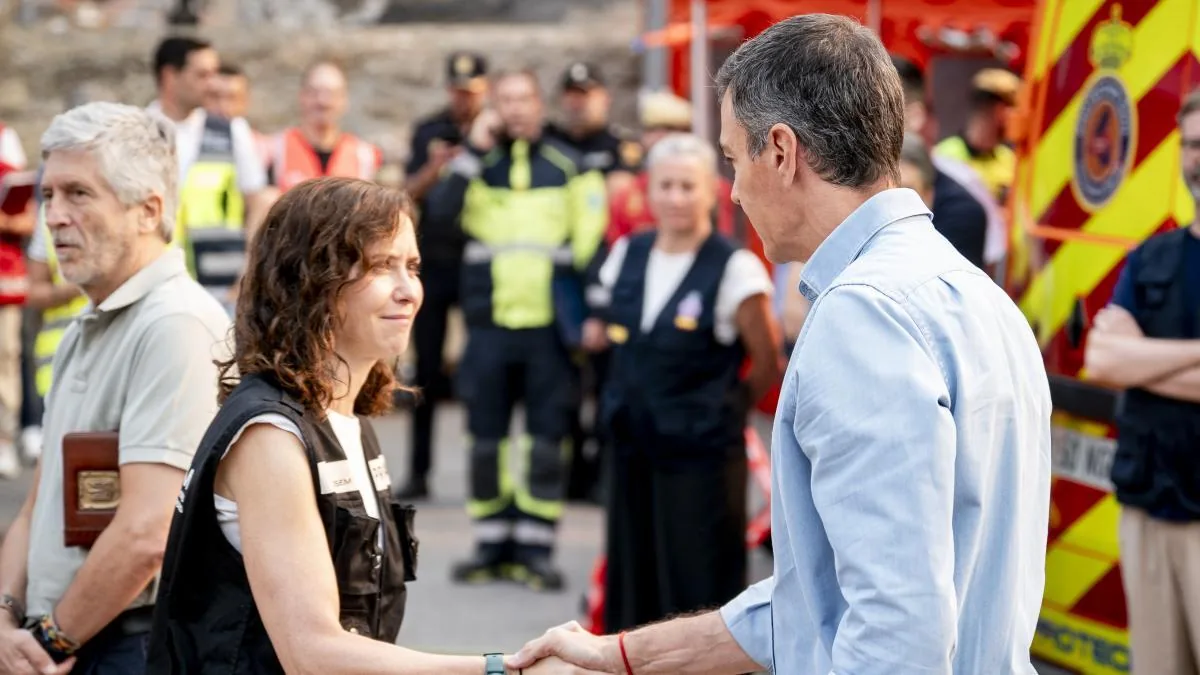
The proposal repeatedly launched by the Prime Minister, Pedro Sánchez, to reach a State pact for the climate emergency has received outright rejection from the Popular Party. Despite the outcry from experts and the unanimous demand of social organizations, the chances of an agreement are clouded, largely because the parliamentary term is coming to an end.
Read more The song of the summer: it grows only due to immigration and productivity stagnates
A large part of the disagreements between PSOE and PP have to do with the diagnosis and approach that each side gives to its discourse on action against fires.
The PSOE emphasizes prevention and stresses that fires are another consequence of climate change, whose effects are worsened by Spain’s demographic, territorial, and ecological imbalances that complicate action.
The reference to climate change makes the PP uncomfortable, to the same extent that it strengthens the PSOE, by placing on the public debate agenda an issue unrelated to the “deadly” corruption cases that have surrounded it.
For the PP, on the other hand, the invoked pact is a “smokescreen” and, in its role as opposition, it launches a battery of 50 measures very focused on fire extinguishing means and on greasing emergency coordination, while emphasizing the responsibilities of the central Administration, but sidestepping that prevention is also a transferred function to the autonomous communities, many of which it currently governs (with Vox).
PSOE did not bring its proposal to the Congress plenary to avoid a parliamentary defeat
The first pact proposal was presented last year by Sánchez after the August fires in Castilla y León. The issue was quietly introduced in the Congress of Deputies at the end of the year, since the socialist group preferred to keep the debate in the commission for Ecological Transition, as raising this issue to the plenary would have meant a political defeat, due to the opposition of PP and Vox, and the reluctance of Junts, who also viewed the idea of a “national” pact on this matter unfavorably.
The arguments given by the PP spokespeople were along the lines of considering that it was not possible to trust a government surrounded by “corruption” and with “little time left to live.”
The parliamentary commission for Ecological Transition hosted at the end of the year, in various debate sessions, two dozen prominent experts in territorial policies and climate action, and representatives of social institutions (unions, environmentalists, Red Cross…).
All shaped a catalog of solutions to prevent fires with proposals for rural and agroforestry development, among many others.
After this summer’s fires, the PSOE-PP relationship has worsened even more. Political scientist Cristina Monge holds that reaching a climate pact is very complicated, since “the PP is in an uncomfortable situation due to Vox’s influence” in government pacts in several territories and, on the other hand, it is entrenched “in all means against the Government.” That radicalism places the PP in such an extreme confrontational position that it fuels accusations of denialism.
However, “the PP is not a denialist party; at least not yet,” says the sociologist, who recalls that the Popular Party and the President of the European Commission, Ursula von der Leyen, supported the Green Deal.
PP is not a denialist party, but there is a risk of regression
Cristina Monge
Political Scientist
The ghost of PP denialism appeared 20 years ago, when Rajoy, citing a physicist cousin, wanted to undermine the credibility of scientists warning about the effects of warming. And that heavy shadow reappeared this week, when PP spokesperson Ester Muñoz, to reject the pact, reverted to one of the oldest screens of denialism: “Climate change has always existed,” she stated, which sounded like a slap to the robust science of climate change.
Read more In the background of the migration crisis, the 2030 World Cup final
PP has evolved since Rajoy’s cousin. It created the first Ministry of Environment and supported the Kyoto Protocol against warming (the first commitment to reduce gases from rich countries). “But at this moment it risks suffering a regression in this matter,” warns Cristina Monge.
The conservative or liberal position has evolved to accept that climate change exists, that it is man-made, and that its consequences are very dangerous, but prefers to delay action invoking variable circumstances (“it is not possible to make quick changes,” “there are other priorities (pandemics, wars…)”). This is called delayism.
Cristina Narbona fears that PP’s discourse will merge with Vox’s, and sees the rejection of the proposal as mere “electoral calculation”
The PSOE president, Cristina Narbona, convinced that “the PP is very tied to Vox, they are not free,” expresses her fear that the discourses of these two parties “will merge” into one, and considers that the popular stance is the result of an “electoral calculation” to deny the Government bread and water.
Furthermore, she sees the PP immersed “in a global dynamic” manifested in the regression of environmental and climate policies of the European Commission and the European Parliament and “the advance of the interests of the most Atlanticist fossil fuels,” spurred on by Trump.
It is also revealing that when Alberto Núñez Feijóo launches his 50 measures against fires he does not use the expression “climate change” but talks about “natural disasters.” This is not trivial, it must please Vox, as when it attacks “ideological laws” that do not allow “cleaning the forest.”
Also read
No matter how much we decarbonize, we cannot do without water bombers
Alberto Nadal
Deputy Secretary of Economy and Sustainable Development of the PP,
Alberto Nadal, Deputy Secretary of Economy and Sustainable Development of the PP, corrects Ester Muñoz’s harsh tone to emphasize that “climate change is a fact” and align with science: “There is a relationship between human activity, CO2 emissions, and temperature rise. That temperature rise – he adds – has consequences. And one of them, which we are seeing, is that forest fires are more severe.”
But for this PP leader, the crux of the matter is that “the Prime Minister is saying that decarbonization policies in Spain are what will solve the fire problem,” “when Spain only contributes 0.6% of global emissions and the EU, 6%.”
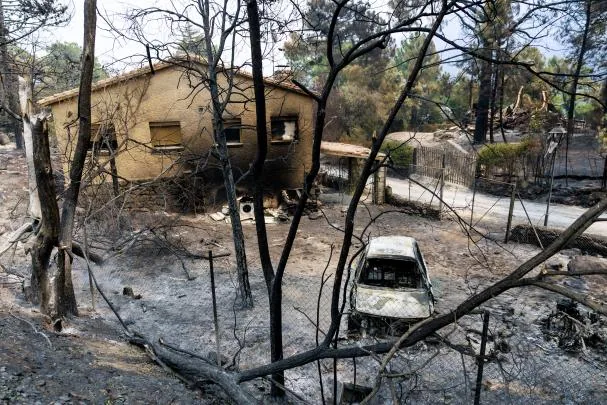
And, therefore, “even if Spain had zero emissions tomorrow, which is impossible, the fire threat would be exactly the same.” “No matter how much we decarbonize, we cannot do without water bombers,” says Nadal.
The disagreements are also fueled by the battle for rural votes, with the risk of creating a rift with the urban population. Hence the accusations against the Government of “ideological extremism” and “ignoring the rural world.”
A cold observer might even see that the proposals of PSOE and PP are complementary. But for that, the flamethrower would have to be put aside.
Read more Sánchez raises the issue before the EU and defends his migration policy