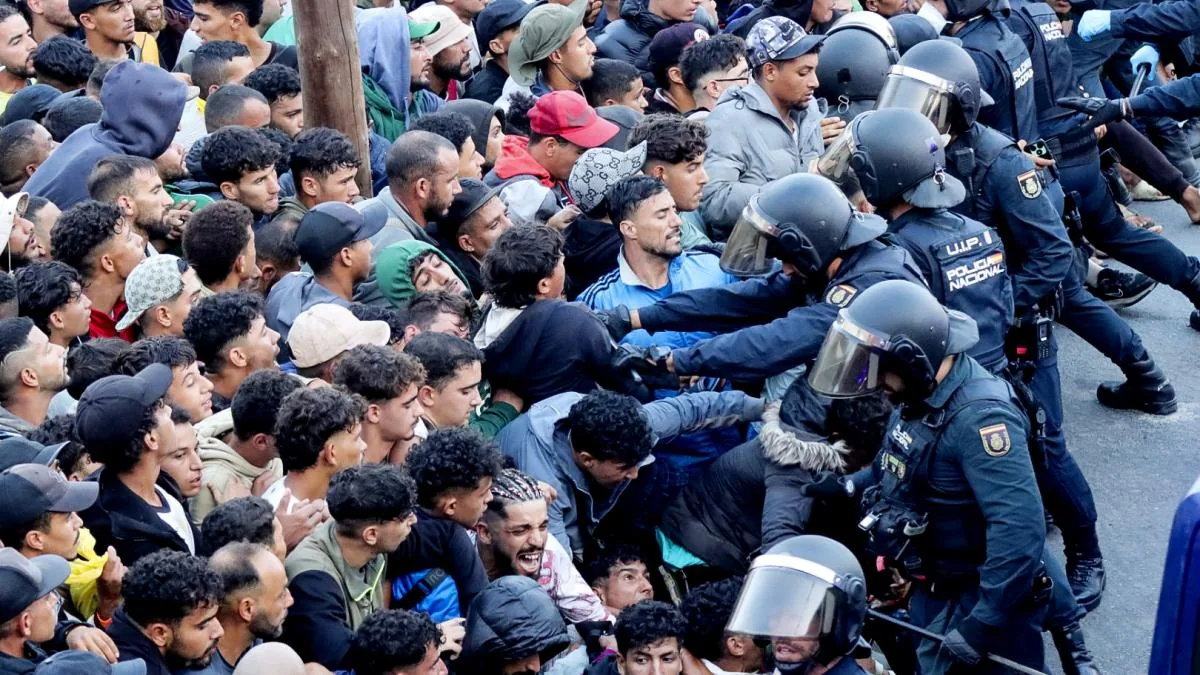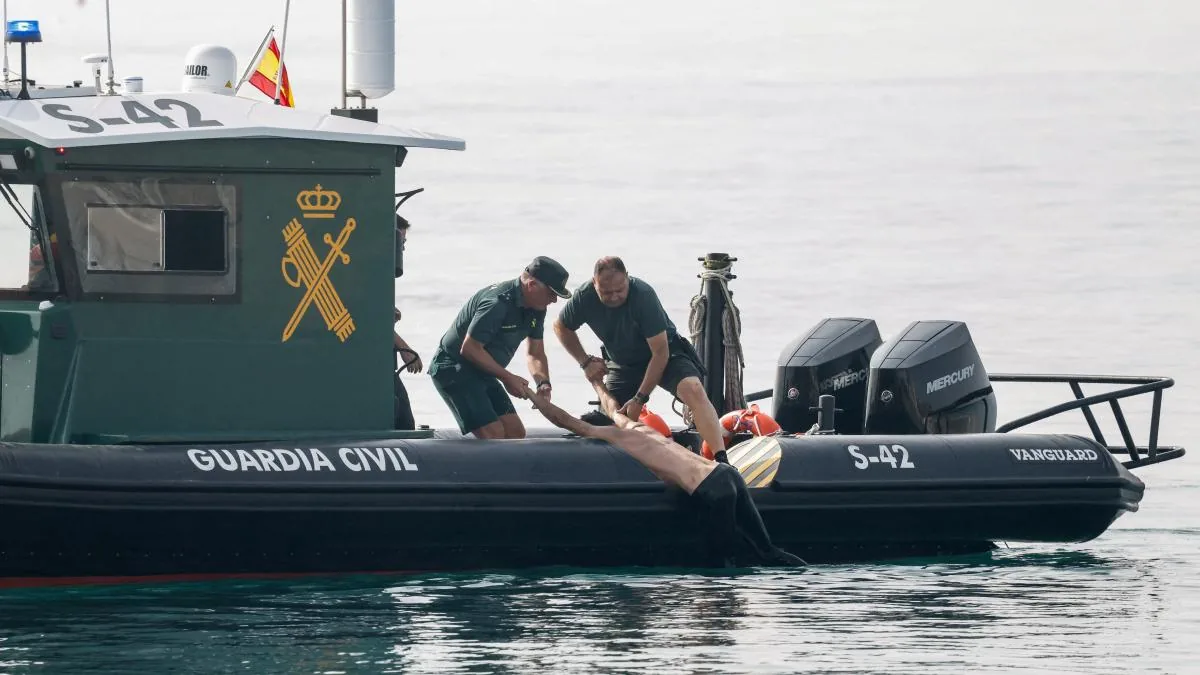
The Prime Minister, Pedro Sánchez, sent a letter yesterday to the President of the European Commission, Ursula von der Leyen, urging the Irish presidency, which holds the rotating presidency this semester, to convene an emergency meeting due to the reaction he described as “selfish, polarizing, and illegal” from countries like Italy in response to the crisis triggered this week in Ceuta by the irregular crossing of the border.
Read more The trail of corpses turns the Ceuta crisis into the deadliest at the border
Sánchez defends his migration policy in the letter and expresses “deep concern” over the reaction of some European governments, while highlighting the situation in Ceuta “at the external border of the European Union.”
The Prime Minister denounces “prejudices, false news, ignorance, or political interests” generated in the response to this crisis which, he argues, “is contrary to European law, humanitarian law, and the principles of solidarity that unite us and to the long-term interests of Europe and the most basic common sense, because Ceuta is not part of the Schengen area, because there are practically no irregular migrants left to be returned, and because Spain is, according to Frontex, one of the least permeable external borders of the European Union.”
Sánchez emphasizes that the number of irregular entries into Spain is half of that recorded, for example, in Italy in recent years (2021-2026). “In the current international context, the EU cannot afford this type of selfish, polarizing, and illegal reaction,” he adds.
To analyze this situation and coordinate a collective response, the EU interior ministers will meet by videoconference on Tuesday, responding to Spain’s request, which was immediately accepted by the Irish presidency. The Ceuta crisis is proving to be an ideal scenario for the spread of anti-immigration theses by the far right, which is gaining increasing influence in the European Union.
Italy leads a coalition of 22 European countries that reproach the regularization
Thus, a group of 22 EU countries led by Italy also sent a letter yesterday to the Presidents of the European Council, António Costa, and the European Commission, Von der Leyen, and to the Prime Minister of Ireland, Micheál Martin, as the rotating president, in which they also demand an urgent videoconference of the interior ministers. Additionally, they warn that they are willing to “strengthen or reintroduce temporary controls” at internal borders to address the risk of secondary movements, even though no unauthorized movement from the autonomous city to the rest of Europe has yet been detected.
Read more If you want it without AI, you will have to pay more
In fact, Italy began yesterday to apply random checks on travelers coming from Spain at airports and seaports, following the decision by Giorgia Meloni’s government announced on Friday to temporarily suspend the Schengen free movement agreement.
Alongside Italy, the aforementioned letter was signed by Germany, Austria, Belgium, Bulgaria, Croatia, Cyprus, Denmark, Slovakia, Slovenia, Estonia, Finland, Greece, Hungary, Latvia, Lithuania, Malta, the Netherlands, Poland, the Czech Republic, Romania, and Sweden. All of them consider that the immigrant regularization process promoted by the Spanish government is the cause of the catastrophic crossing of more than fifty thousand Moroccans at the Ceuta border. A crossing that has so far cost the lives of 67 people, according to the latest official figure from yesterday.
Anyone who has traveled on the ferry connecting Ceuta with Tarifa knows that it is relatively easy to reach the autonomous city from the Cádiz coast, but the controls, both on entry and return, are not easy to bypass. They are the same that any citizen from outside the Schengen area must undergo to set foot on European Union territory.
But these details seem irrelevant at this political moment. The EU’s conservative majority considers Sánchez guilty by omission in his task of safeguarding the border that materially separates (ethics being another matter that does not count in this political quarrel) Europe from Africa.
On Tuesday, European interior ministers meet to analyze the situation and coordinate the response
However, in this context, it seems evident that the Ceuta crisis—and the more violent but minority attempt to storm the Melilla border that has occurred at least two nights in a row—could not have happened without the Moroccan government tolerating it. In 2021, the Sahara was the cause of the border crisis. Now it is more difficult to identify the Moroccan government’s objective, which counts among its best allies Netanyahu’s government in Israel and Donald Trump in the United States.
Read more Gianni Infantino, defender of the faith?