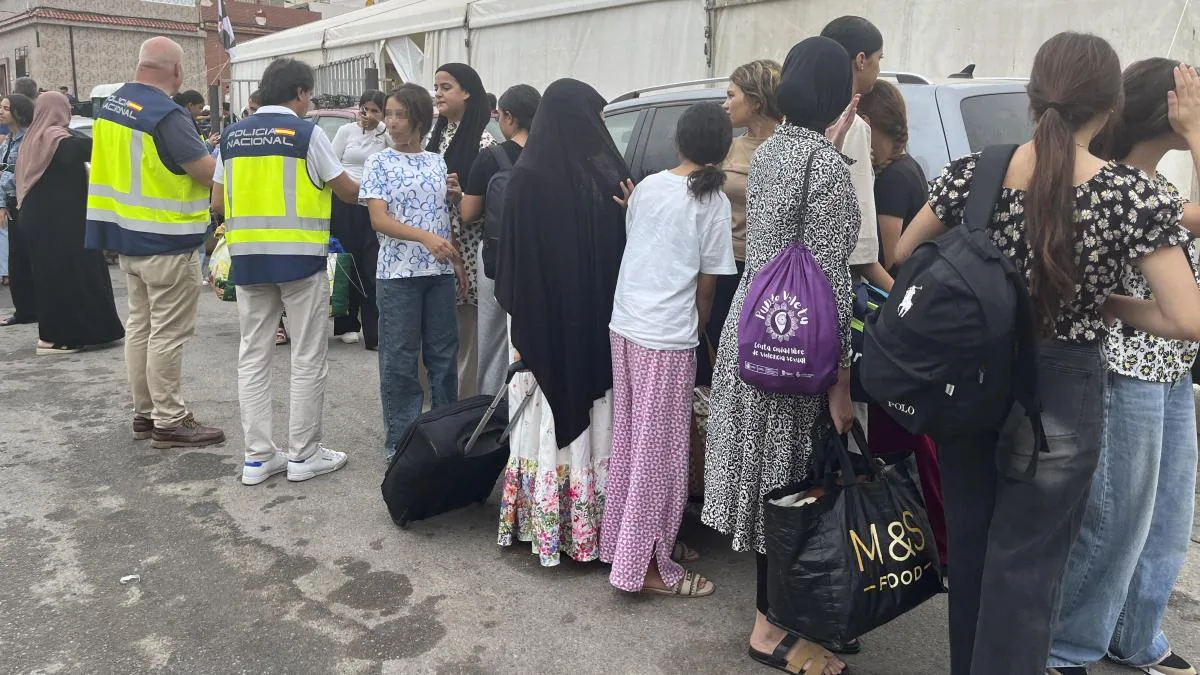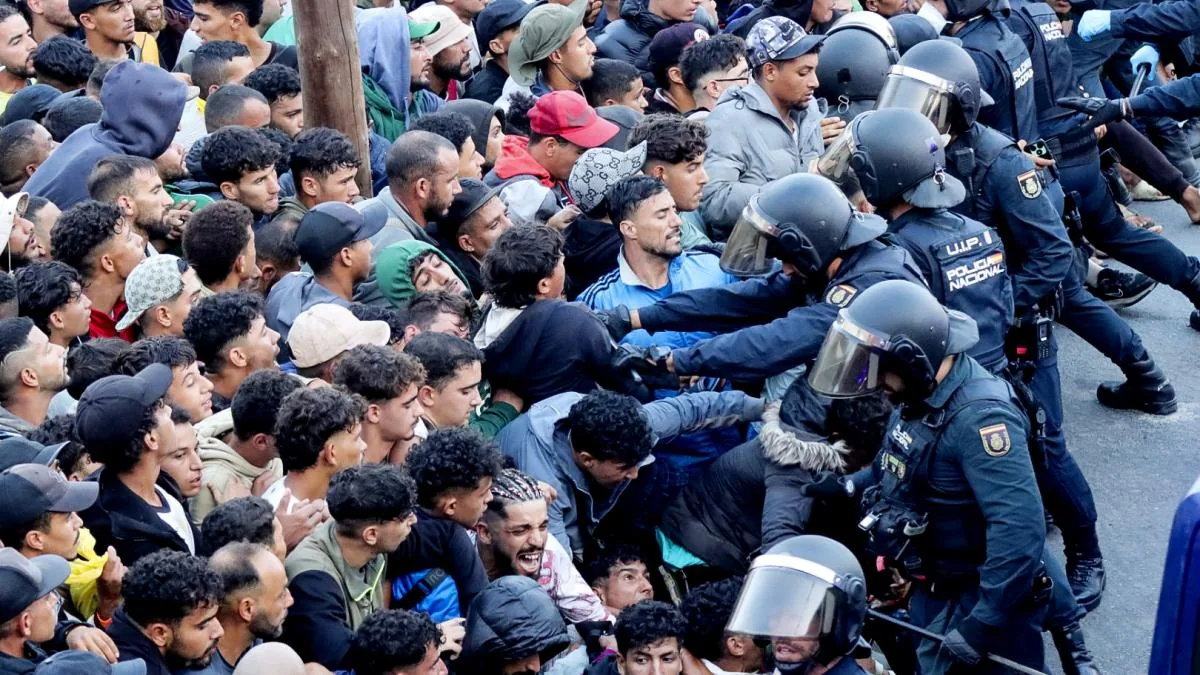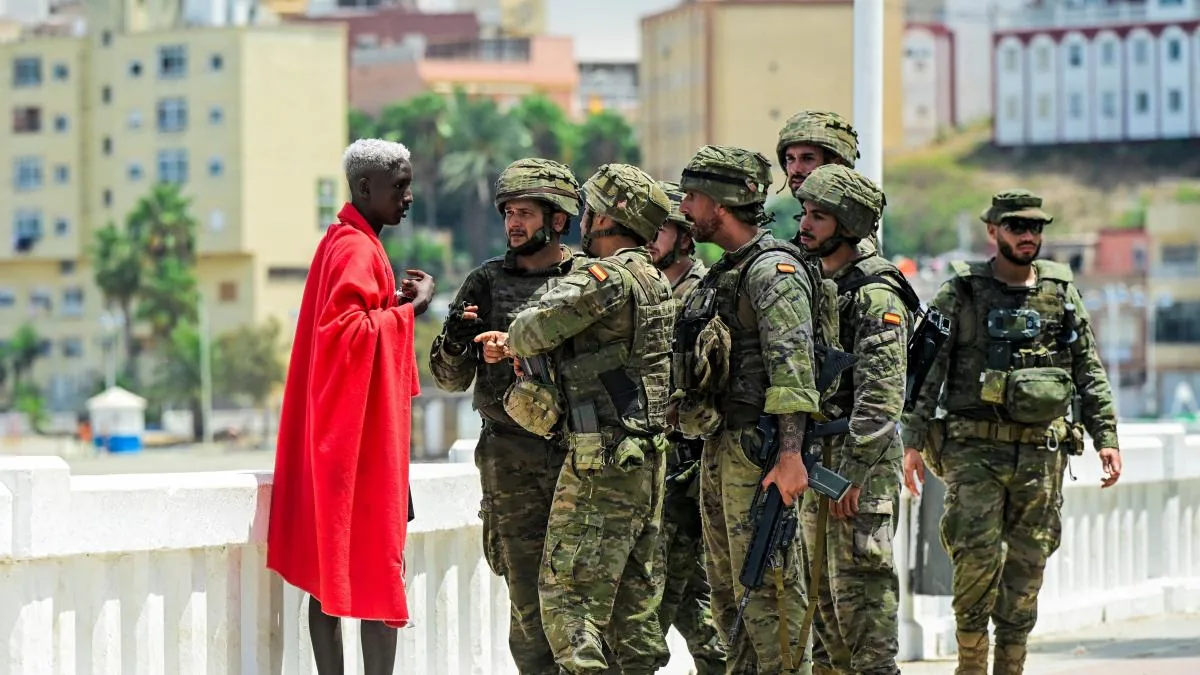
The first curve of Martínez Catena Avenue, the road that runs along the southern coastal area of Ceuta, serves to quite accurately predict whether it will be a day of migratory pressure in the autonomous city. From there, in the background, you can glimpse Tarajal beach. Unless the dense fog that usually appears during many summer days prevents seeing the border with Morocco. That white curtain, besides announcing stifling heat, helps immigrants trying to swim to the Spanish coast avoid being detected. Foggy night, early morning of irregular arrivals.
Read more If you want it without AI, you will have to pay more
The city, returning to normal, has set up a tent to identify the bodies to be repatriated
However, what this meteorological phenomenon made difficult to see yesterday was the most tragic face of Ceuta’s migratory crisis: how the Civil Guard boats were busy combing the seabed in a continuous drip of corpse rescues. The figure, 67 deceased, which is not definitive, makes the mass crossing the deadliest event at a Spanish border. All of them drowned around the border breakwater that Morocco stopped monitoring.
A diver from the Civil Guard’s Special Group of Underwater Activities (GEAS) explains, at the doors of the hotel where he sleeps with other reinforcements sent, that the rescues will serve to gauge the magnitude of the tragedy, perhaps overshadowed by the stratospheric figures of the avalanche, which the Ministry of the Interior raised to 60,000 people yesterday. Bodies with injuries compatible with being crushed against the rocks of the deadly breakwater, which piled up while being stepped on by their next compatriots fleeing to Spain. The constant increase in recovered bodies – at midnight on Thursday there were 18, by Friday afternoon it rose to 57, and yesterday it reached 67 – has forced the setup of a space in the port of Ceuta to house the bodies. Police sources denounced yesterday that the tent does not have enough refrigerators, so some bodies are wrapped outdoors.
Ceuta has begged for extraordinary means such as forensic experts to perform autopsies as quickly as possible and specialized agents to identify the maximum number of bodies. Authorities know they will have to assume the burial of immigrants who cannot be named, so they seek to expedite repatriations. They do not even want to hear about having to open, again, another trench in the cemetery to bury the deceased migrants. It would not be the first time because at the same tragic border point, on February 6, 2014, 14 migrants out of the 200 to 300 trying to swim across drowned after Spanish agents used riot control elements such as rubber bullets or smoke grenades. Almost all were sub-Saharan.
Read more Gianni Infantino, defender of the faith?
The other event marked in black on the calendar of the migratory phenomenon in Spain is the massive jump over the Melilla fence on June 24, 2022, in which at least 23 people lost their lives after the violence used by Moroccan gendarmes to repel them. Amnesty International raised the death toll to 37. Again, almost all the deceased were sub-Saharan. Now, from the Ceuta crisis emerges a trail of Moroccan victims: young people deceived with false promises of opportunities in Spain who threw themselves into the sea – or the breakwater – while their police looked the other way. The Alaouite kingdom officially continues not to recognize deaths from the mass crossing, although some Moroccan newspapers placed nearly twenty bodies in the forensic institute. Police sources doubt those figures, due to the difference it would imply between those rescued on the Spanish and Moroccan sides. To be more precise, Morocco continues to maintain total silence about the country’s biggest migratory crisis.
Human rights organizations estimate that 100,000 people moved toward the border
Despite this scenario, the Minister of the Interior, Fernando Grande-Marlaska, yesterday again highlighted, without deviating an inch from the government’s public discourse, Rabat’s collaboration during the crisis. He even raised the praise a notch, calling Morocco a “truly reliable partner.” Although the reality on the ground, with testimonies from migrants who found the border wide open, calls his argument into question. Moroccan human rights organizations have estimated that about 100,000 people moved in the days before the jump to the northern border with the intention of crossing it. It is at this point that questions arise posed by a police commander: “If Morocco is such a reliable partner, why did it not share with Spain the information that tens of thousands of compatriots were approaching the border post?”
Marlaska assures that the secret services did not warn about the tide of immigrants heading to Spain
Furthermore, the Interior Minister revealed that the Spanish secret services did not warn that this tide of immigrants was heading to the border. According to his version, no “report” from the National Intelligence Center (CNI), dependent on Defense, arrived at his ministerial office alerting about the situation. There were, according to ministerial sources, reports warning of a rise in swimming migrants due to the Supreme Court ruling that determined that hot returns of immigrants intercepted at sea are not allowed. But with the whole team focused on the fires on the Peninsula, the matter was treated as a usual migratory spike every summer… until Morocco opened the tap at noon on Thursday.
Read more Sánchez’s challenge to the EU