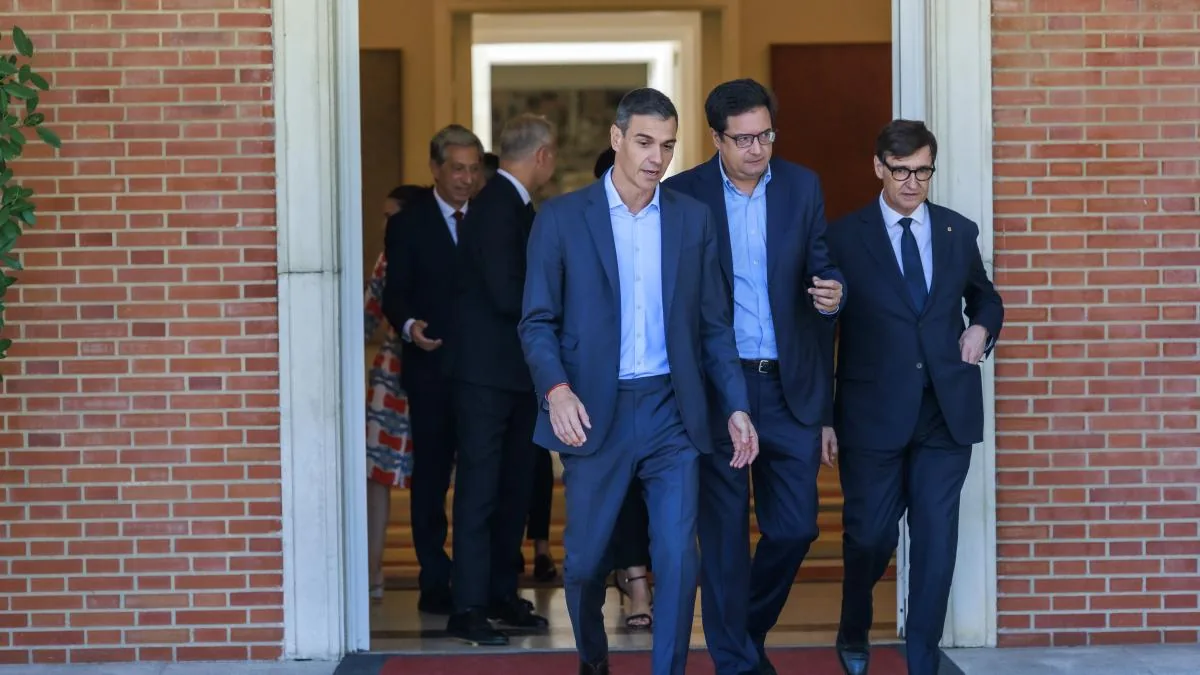
In his end-of-political-course review, Pedro Sánchez celebrated last Tuesday the recent endorsement by the Court of Justice of the European Union (CJEU) of the Amnesty law: “It has confirmed that we acted in accordance with the law to promote reconciliation.” “It was a brave but necessary decision that allows us to look to the future together again,” he emphasized. He even stressed that “a success of the Amnesty law is that the PP and Junts have reunited, nothing more and nothing less.” However, the President of the Government said nothing in his appearance about the fact that the Council of Ministers had just approved, in its last meeting before the August break, granting a partial pardon to Laura Borràs, which will prevent the former president of the Parliament of Catalonia from going to prison, as later revealed by the Ministry of Justice.
Read more Begoña Gómez changes lawyer ahead of the jury trial
The news, known late Tuesday afternoon, was again hard to swallow for the PSOE sectors that have always expressed their disagreements with the Government’s measures to redirect the political conflict in Catalonia, such as pardons and amnesty for the leaders of the procés, as demonstrated again this Wednesday by the president of Castilla-La Mancha, Emiliano García-Page, who in an interview on Ser attributed this pardon to Borràs to a “blackmail by far-right separatists,” referring to Junts. “Really now, with all the corruption issues we are facing, do we gain credibility by pardoning people who have been convicted of corruption?” Page asked.
“Both the Amnesty law and the pardon policy have been useful,” defended, however, this Wednesday, the Minister for Digital Transition and Public Function, Óscar López, in an interview on TVE, when asked about this pardon to Borràs and whether it is an outstretched hand to try to recover communication channels with Junts and be able to complete the legislature, as the President of the Government reiterated the day before.
“Where are now all the speeches against the Amnesty law?” Óscar López asked. “Because for years Spain was falling apart, Feijóo said the European court would declare it unlawful, or that the Constitutional Court would declare it unconstitutional. And now we have seen that both the Amnesty law and the pardon policy have been useful,” he argued, recalling that in 2017 the procés independence movement made headlines and news reports worldwide. At that time, the minister assured, “coexistence had broken down and we experienced the greatest institutional crisis in the history of our country,” following the unilateral declaration of independence of Catalonia.
Read more Ayuso justifies the purchase of a luxury penthouse in Chamberí to use it as a temporary office
Óscar López highlighted that “what this Government and President Sánchez have done is normalize the political situation in Catalonia, rescue coexistence, and return to politics what should never have left politics.” This, in fact, he assured, is “one of the greatest achievements” of this Executive. “And for all those who always tear their clothes and are worried morning, noon, and night because this country is breaking apart, let them remember that when this country broke was under the PP government, which was when the independence of Catalonia was declared and the greatest coexistence crisis in our country occurred,” emphasized the leader of the Madrid socialists as well. “This effort is very worthwhile, it has been very worthwhile despite all the atrocities we have had to hear,” he concluded.
Borràs was convicted in 2023, being the successor of Carles Puigdemont as president of Junts, for the crimes of administrative prevarication and document falsification, for splitting contracts in awards during her term leading the Institució de les Lletres Catalanes until 2018. Although the later president of the Parliament always defended that the case against her was a product of lawfare and presented herself as a “political victim” of the procés independence movement. The Ministry of Justice argued on Tuesday that the partial pardon – the fine and disqualification penalty remain, but the prison sentence of four and a half years is commuted to two years, which will prevent her from entering prison – has been granted “under the terms proposed by the High Court of Justice of Catalonia itself, which was the one that convicted her, and which in the sentence stated that the prison sentence was disproportionate and excessive.”