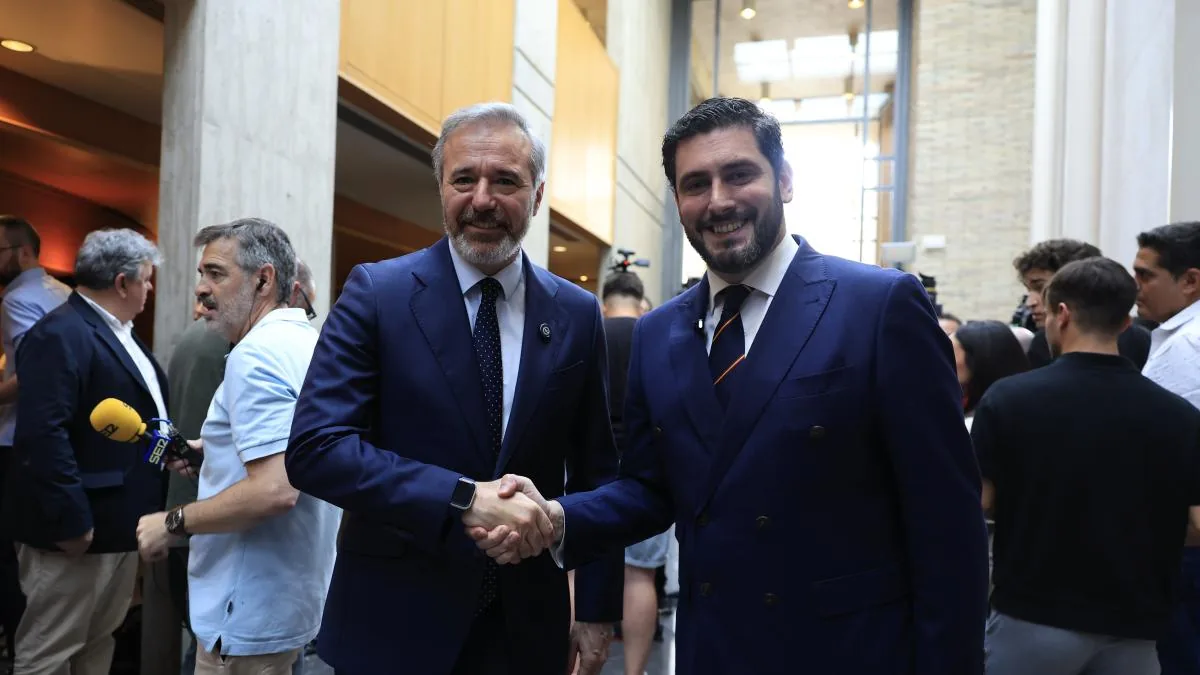
The Aragonese Institute of Catalan is a small body integrated into the Aragonese Language Academy. Created by decree in 2018, it was not effectively constituted until March 2022, and its very reduced cost is financed within Aragon’s own budgets. Even so, the new government emerging this week from the agreement between PP and Vox has set its sights on suppressing it, under the argument of “indoctrination.”
Read more Crucial turn for the accused: Aldama will acknowledge the corruption that Ábalos denies
The future coalition executive, chaired by Jorge Azcón, aims to free Aragon from what it calls “the imposition of Catalan,” and wants to do so quickly. The first results should be visible before the end of the year, and the process will culminate with a regulatory modification throughout the next year. From then on, Aragonese people —including those who speak Catalan— will be, as promised by the agreement signed with the far right, free from any linguistic imposition.
PP and Vox want to free Aragon from the “imposition” of Catalan
It is not the first time this has happened. In 2013 it was lapao , the euphemism for not calling Catalan “Catalan.” Now they want to call it fragatí . The form changes, but the substance is the same. What is clear is that this is not a measure of savings or administrative efficiency. It is a symbolic gesture of hostility towards a language and its speakers, which does not aim to suppress bureaucracy, but to eliminate its recognition.
The agreement between PP and Vox regarding a language spoken by nearly 30,000 people in La Franja exudes Catalanophobia. This strategy is used as an electoral weapon and seems to win votes for those who wield it. This Catalanophobia has a wide geography. It is in Aragon, but also in the Valencian Community, where they have changed the accent of the official name of the city –from València to Valéncia– against the criteria of the language academy. It is in the Balearic Islands, where Catalan is no longer mandatory to work in public administration. And it is, more subtly, in Brussels, where attempts are made to prevent co-official languages –Galician, Catalan, and Basque– from achieving European recognition.
Read more The investment consortium founders and further distances ERC and Junts
Ten million people speak Catalan. It has more speakers than Danish or Slovenian, but in a globalized world, it is seriously threatened. In two decades, its use has fallen by 15 points. This is noticeable in schools, in the workplace, in shops, and in leisure activities. The situation is worrying, and administrations should take decisive steps to protect it, not to corner it.
Defending an endangered language is not indoctrination. Denying it minimal institutional recognition is equivalent to deliberately abandoning the country’s linguistic richness because Catalan is not the problem. The political use made of the language is the problem, and for this reason, it would be good if the central government, beyond promoting its use in the European Parliament, reacted to protect it from the attack of other political forces.
Read more A no for nothing