A new front of tension between Brussels and the Venice Biennale. The European Commission has confirmed the withdrawal of the two-million-euro subsidy granted to the Venice Biennale Foundation, after the organization, one of Italy’s most emblematic cultural institutions, allowed the reopening of the Russian pavilion in its 61st edition, inaugurated this spring in a climate of maximum tension.
Read more The fat man and the wise monkeys
As the Community Executive justified in a brief statement, cultural events funded with European taxpayers’ money should safeguard democratic values, diversity, and freedom of expression, “values that are not respected in current Russia.” The controversy is brewing, and the foundation has already announced an appeal against the decision.
Brussels states that democratic values, diversity, and freedom of expression “are not respected in Russia”
It’s not a new dispute. After the Russian invasion of Ukraine in 2022, the Biennale condemned the aggression and prohibited entry to anyone linked to the Kremlin. Although it has never formally banned Russia’s participation, the country remained absent from the 2022 and 2024 editions. But this changed this year, to everyone’s surprise, when the participants for the major global contemporary art event were announced in March: Moscow was once again included, to the great indignation of Kyiv, which considered it a whitewashing of the aggressor and another blow from the Kremlin in its hybrid war against Europe. “It’s like inviting a serial killer to dinner with friends,” compared its Minister of Culture, Tetiana Berejna.
The organization then defended that the Biennale is an “open institution” in which any country recognized by the Italian Republic can participate and rejected “any form of exclusion or censorship of culture and art.” The letter sent by 22 European Ministers of Culture and Foreign Affairs to the President of the Biennale, Pietrangelo Butafuoco, urging him to reconsider the decision, was of no avail. The Biennale stood its ground and maintained the presence of the Israeli and Russian pavilions despite serious boycott threats.
“It was a victim of a fantasy of pacification; it wanted an art UN and ended up deceiving itself into believing it could influence foreign policy. But that is up to the government and Parliament,” justified the Italian Minister of Culture, Alessandro Giuli, who refused to attend the inauguration as a sign of protest. As political division is also fertile on the Italian right, the Secretary of State for Culture, Lucia Borgonzoni, instead denounced “the umpteenth shameful political and ideological attack” by the EU.
Read more Sánchez’s nougats
The discontent was so great that the jury, which was supposed to award the prizes, resigned en masse. It had previously excluded artists from countries whose leaders were accused of crimes against humanity, which led to the ceremony being postponed from May 9 to November 22, something that had only happened when the coronavirus pandemic shook Italy, making the country the first in Europe to suffer lockdowns.
Even the Russian feminist punk collective Pussy Riot and the Ukrainian group FEMEN landed in Venice, disrupting the Biennale in protest against Russia’s readmission.
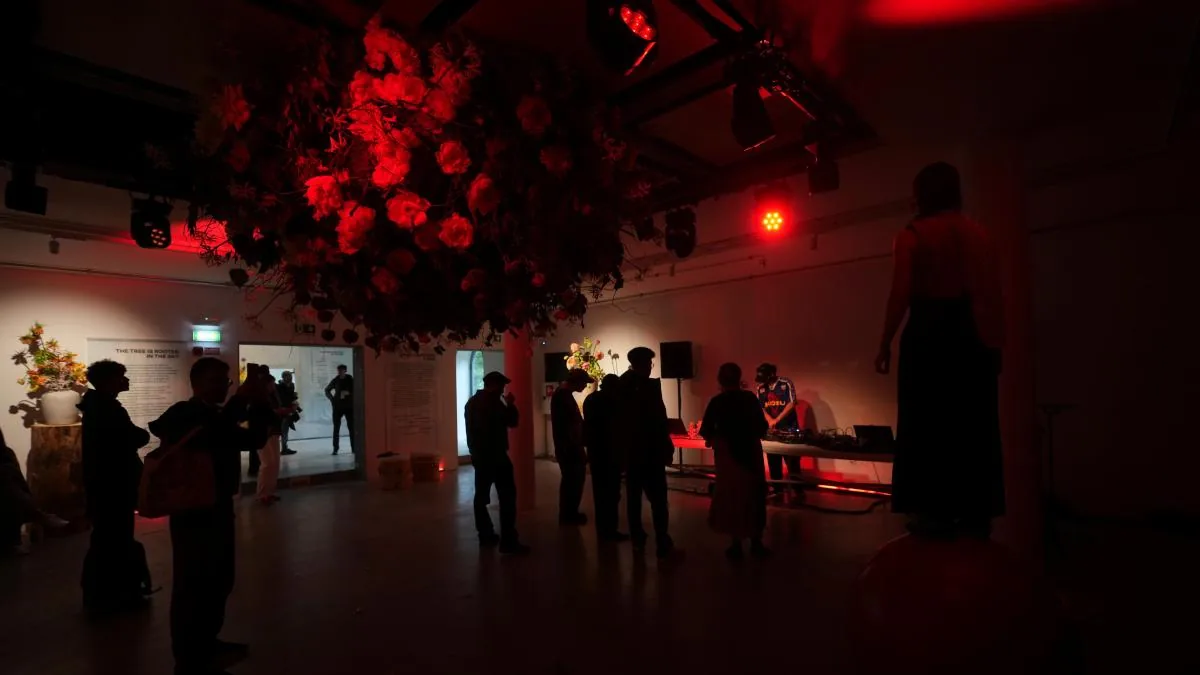
In the end, the Russian pavilion didn’t even open to the public: it was only accessible during the preview pass reserved for the press and authorities, with live performances and even a bar on the upper floor. Afterwards, it was closed to the general public and replaced by an audiovisual format, with a video projection (of a performance titled The tree is rooted in the sky ) that could be viewed from the outside, through a window, without access to the interior spaces.
Amidst all the noise, the European Commission made its move. The Executive Vice-President of the Commission for Technological Sovereignty, Security and Democracy, the Finn Henna Virkkunen, urged the European Education and Culture Executive Agency to cancel the subsidy. The problem is that in this war there are also collateral victims: the subsidy withdrawn by Brussels (the two million euros) does not affect art itself, but rather activities linked to cinema, the Biennale College and the Venice Production Bridge, which are programs linked to the Mostra, the foundation’s film section. In this way, although the conflict originated from the Russian pavilion at the Art Biennale, the economic blow partly falls on the cinematographic sector.
Read more The Government proposes Yolanda Díaz to lead the ILO