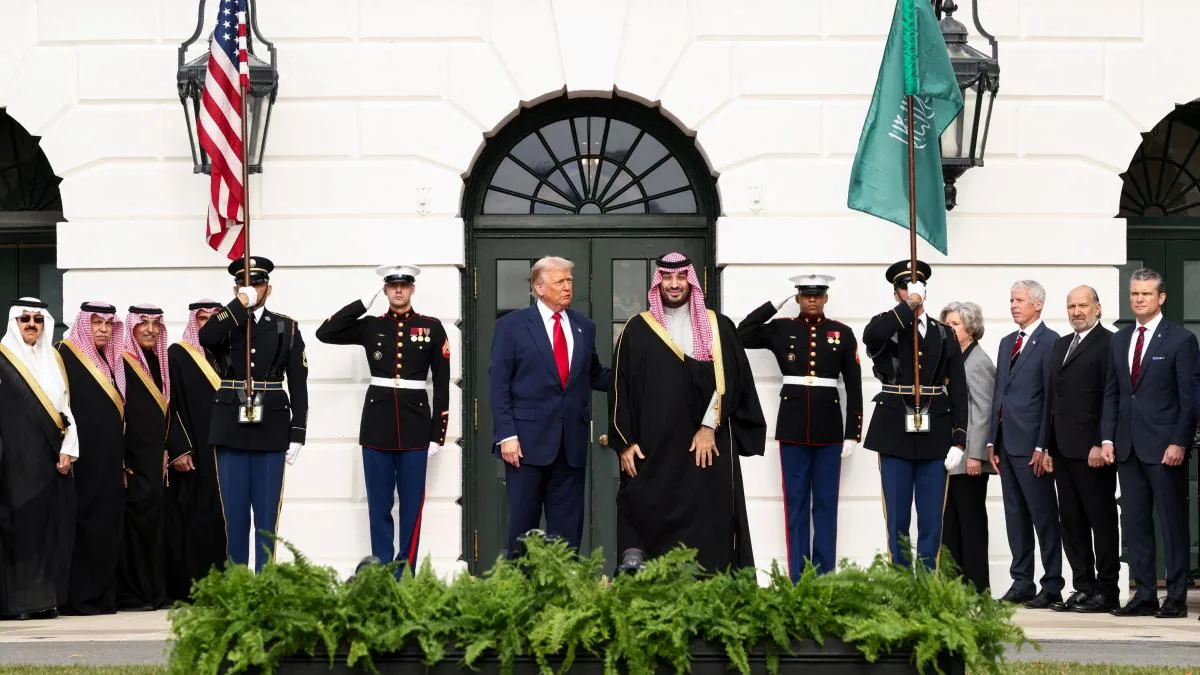
The White House plans to announce as early as this Wednesday an agreement that would allow Saudi Arabia to enrich its own fuel for civilian reactors without the need for international supervision, according to The Wall Street Journal and confirmed by multiple US media outlets. The controversial pact, which would last 30 years, must first be approved by Congress, a process that could face obstacles because many legislators view it with suspicion due to the possibility that the Arab kingdom could end up building a nuclear bomb in the future. It is also a setback for Israel, the US’s biggest ally in the Middle East, which has been warning for years about the risk of Riyadh enriching uranium.
Read more The five 1-O syndics finally benefit from the Amnesty Law
Read also
If the agreement is finally ratified, the US would grant Saudi Arabia access to military technology, as well as specialized knowledge, provided by American companies. Before uranium enrichment could begin, a joint team from both countries would study whether it is justified and economically viable. The idea is that the US would not transfer sensitive technology, although its companies would build the nuclear facility in the Persian Gulf country.
The agreement would prohibit Riyadh from developing its own enrichment technology or purchasing it from countries other than the US during the first decade of the three contemplated. Unlike the nuclear agreement with Iran, which allowed but restricted its uranium enrichment only for civilian purposes in 2015, in this case Saudi Arabia would not be obliged to allow inspectors from the International Atomic Energy Agency (IAEA) to review the nuclear program.
In 2009, the US already signed a similar agreement with the United Arab Emirates to cooperate in the development of nuclear energy. However, Dubai was obliged to sign the so-called IAEA Additional Protocol, which provides for program supervision. In the case of Saudi Arabia, it has resisted signing this protocol for fear that inspectors might enter the holy city of Mecca or the royal palaces. Thus, it is solely a bilateral pact, although the IAEA Board of Governors will have to ratify its terms.
Read more Rosalía apologizes to Argentine fans for the controversy after sharing a video of Mia Khalifa
Saudi Arabia would not be obliged to sign the IAEA Additional Protocol for the entry of nuclear inspectors into the country
The pact comes amid a new escalation in the Middle East, where the US and Iran have exchanged attacks for the eleventh consecutive day tonight. Trump’s justification for this war was that Tehran can never develop a nuclear bomb, although the Islamic republic has repeatedly said that its program only pursues civilian purposes. However, Saudi Crown Prince Mohammed bin Salman has said in the past that he will seek a nuclear bomb if Iran ever produces its own.
Both the Joe Biden and Trump Administrations have been seeking an agreement for years that would allow sharing US technology with Saudi Arabia to strengthen their alliance with the kingdom and advance towards the normalization of relations with Israel. However, the Hamas attacks in Israel, which led to Tel Aviv’s retaliation and its massacre in Gaza, put a halt to the negotiations. Energy Secretary Chris Wright traveled to Riyadh last year shortly before Trump visited the country as part of his first foreign tour of his term. At that time, the secretary already announced progress in the dialogue to expand the American nuclear industry. The Trump family’s closeness to the kingdom, with which it has closed numerous real estate and cryptocurrency deals in the last year, could have helped unblock the negotiations.
Read more Two urbanizations in Cervelló confined due to a forest fire