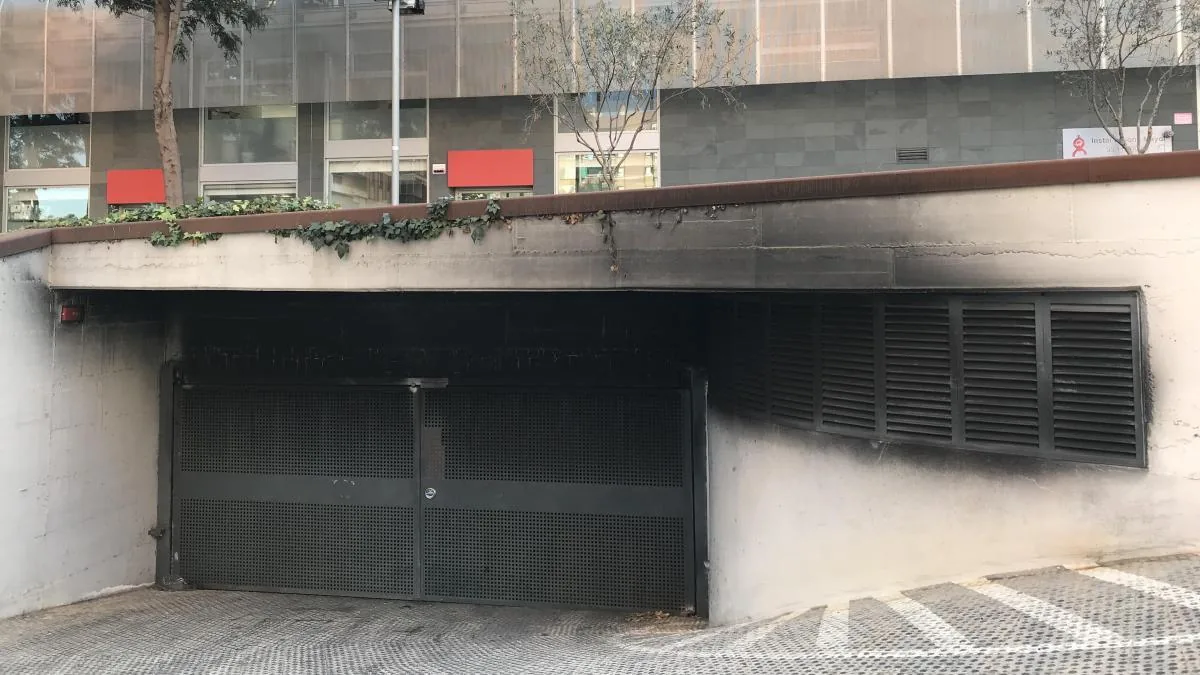
The couple took the elevator on the fourth floor, second apartment, and went down to the parking lot. Once there, the woman patted her pockets.
–I left my phone at home. You go ahead. I’ll be right back.
They had been living at number 6 Santiago Rusiñol Street in Viladecans for four months. He, Catalan, 45 years old; she, Colombian, 30. They had met during his continuous trips to Colombia and had been married for six years.
It was 12:30 PM on November 30, 2017. The man opened the door of the Volkswagen Polo. He sat behind the wheel. He inserted the key into the ignition. He turned it. The explosion made the entire parking lot tremble. The device attached to the underside of the vehicle exploded instantly. He died on the spot. His wife was saved by a matter of seconds.
A neighbor who was going up in the elevator was seriously injured. Firefighters evacuated the building while checking that the structure had not been damaged, and the Mossos d’Esquadra cordoned off the area for days. In Catalonia, there were almost no precedents of a car bomb. The method was more reminiscent of attacks by Colombian cartels or the Italian mafia than of score-settling by Catalan organized crime.
Upon entering the deceased’s name into the police database, investigators understood that he was not just any victim. His police record filled pages and pages. Drug trafficking. Extortion. Explosives. Contract killings. His name was Xavier Jaume Peña, and the Mossos no longer wondered why he had been killed, but which of his numerous enemies had done it.
Reconstructing his last years, a first episode led them to La Jonquera. A few days before his death, Xavier Jaume Peña had gone to pick up the indictment for a case that could cost him 26 years in prison. The Prosecutor’s Office accused him of having participated in the attacks against Paradise, the mega-brothel in La Jonquera.
On December 12, 2012, two years after its inauguration, Europe’s largest brothel had suffered a wave of explosive attacks. At six in the morning, two hooded men threw two homemade bombs from a motorcycle. The first exploded and damaged the facade; the second did not explode because the detonator failed. There were no injuries, but it was a warning.
The Mossos no longer wondered why he had been killed, but which of his enemies had done it
Eleven days later, they returned. Four hooded men stormed the brothel armed with automatic rifles. They left an Opel Corsa at the door and warned the doorman that there was a bomb inside. The assailants fled in a Porsche Cayenne which they burned shortly after in Capmany.
The Opel Corsa – loaded with dynamite, two butane gas cylinders, and a six-meter fuse – also failed to explode. The detonator failed again.
The Mossos named the investigation Operation Rockefeller, in allusion to one of José Luis Moreno’s puppets, because the owner of Paradise had an almost identical name: José Moreno. Although the Porsche was incinerated, investigators found fingerprints on a can of flammable liquid used for ignition. They belonged to Xavier Jaume Peña, who was arrested and imprisoned. A year later, he was released on bail of 10,000 euros.
Read more Manuel J. Castillo, longevity expert: “Our aging depends in part on our parents and grandparents”
The next name on the list was even more powerful. On September 3, 2012, a man was driving through the Los Pinares urbanization in Lloret de Mar with his wife and three-year-old son. At 7 PM, a high-displacement motorcycle approached them. The passenger pulled out a pistol and fired several times. The man received three bullets in the chest; the child, a shot to the head. Against all odds, both survived. The father was Gabrielle Biondo, a prominent member of the ‘Ndrangheta, the Calabrian mafia. When the police took a statement from the woman, she unhesitatingly identified the shooter: Xavier Jaume Peña. However, Biondo never wanted to report the incident. Who knows if he wanted to take justice into his own hands.
When he died, Xavier Jaume was already one of the drug trafficking bosses. That’s why it was not strange that so much trouble was taken to eliminate him. He had been linked to organized crime for years, where he had climbed positions. He started as a porter, unloading hashish offshore. In one of those operations, his name appeared in the press.
On January 16, 2000, Xavier Jaume had to be rescued after an offshore drug drop went wrong. The case kept the residents of Palamós on edge. At that time, everyone thought that a recreational boat with three young people on board had lost control and disappeared out to sea.
The story was not exactly like that. Peña left the port of Palamós with two companions in a zodiac to meet a narco-boat loaded with hashish from Morocco. While they were making the transfer, the sea became rough and the boat lost control. They drifted for five days until Maritime Rescue rescued them in the Menorca corridor.
What surprised the emergency services was that, when they located them, instead of three people, there were four. The surprise passenger was a Moroccan boy who did not speak the language and could not explain how he had ended up in that boat. When the rescued were in the hospital, the family said that the Moroccan was a friend of Xavier Jaume whom they had invited for a ride in the zodiac. Before the Civil Guard, however, those involved claimed that they found a dinghy and helped that poor boy.
What actually happened was that the Moroccan changed boats to help with the unloading when the two vessels accidentally separated. According to some sources, the three crew members even voted by a show of hands, in the middle of the sea, whether they should throw him overboard: Xavier Jaume voted in favor; the other two, against, and the boy was saved by a simple majority. They did get rid of the hashish bales, throwing them into the water. The four crew members had to be urgently admitted with symptoms of hypothermia and malnutrition. The worst off was Xavier Jaume, who took weeks to recover. The Civil Guard of Menorca opened an investigation which, despite suspicions, also ended up sinking.
The deceased was accused of having attacked a mega-brothel with explosive devices
When the Mossos closed the reconstruction of Xavier Jaume Peña’s criminal life, the list of enemies was endless. Drug traffickers, mafia members, people linked to the brothel business, and probably many other names that never appeared in the summary.
That November afternoon, however, someone wanted to make sure he ended up dead. While his car exploded, his wife was saved only because she had forgotten her phone at home. Nine years later, the car bomb investigation remains unsolved.