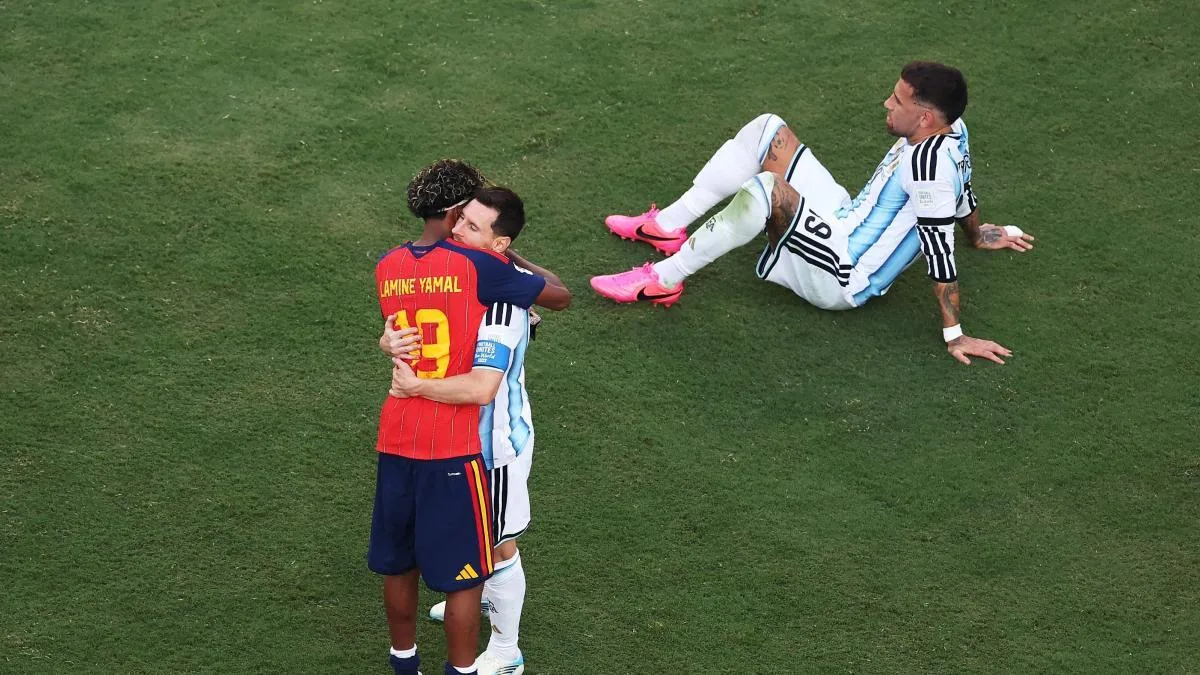
Justice, a highly elusive matter in football, answered the desperate call of the Spanish national team and granted them the second star late, in extra time, but with full merit. La Roja was overwhelmingly superior, dominating all aspects of the game as if the match were not a World Cup final but one from the preliminary phase of uneven forces. Spain only had two elements against them: providence dressed as Dibu Martínez and the refereeing, which snatched a goal from them as the pinnacle decision in a performance that allowed Argentina’s underground play (although it should be called something else because it was always visible). Paredes, who came onto the field electrified at halftime, should have been sent off half a dozen times. It is an illustrative example.
Read more Ferran Torres’ goal is worth a race and changes many lives
Spain links its new World Cup to that of 2010 by speaking the same language then and now, the best explanation to understand the reason for their success. While other countries seek exotic solutions that denature them in the face of failures (Brazil as the prime example), the Spanish national team has insisted on its own recipe despite the poor experiences of the 2014, 2018, and 2022 World Cups.
Also read
Spain links its new World Cup to that of 2010 by speaking the same language then and now
The Spanish victory was incontestable. Statistics, untimely when overused in football, spoke clearly this time. Spain shot on goal more than twenty times, and Argentina barely recorded one. In number of passes, the winning team doubled the loser, 800 to 400.
In the match that was logically summarized beforehand by the face-off between Lamine Yamal and Leo Messi, the hero was Ferran Torres. If justice is elusive in football, oddities are inherent to it. Ferran belongs to the category of footballers who look in the mirror and see themselves as better, a virtue in a sport where hustlers always end up finding a place. Spain is a team that is loved for its configuration. There are apparently no stars, but rather a representation of types who get along well with diverse sensitivities and backgrounds, moving in a direction different from the country’s presumed political destiny.
A Valencian scored, a Madrilenian was chosen best player of the tournament (Rodri), and a Catalan, the best young player (Cubarsí). All accompanied by Lamine Yamal and Nico Williams, whom we should not consider Spanish according to the Rajoy doctrine.
Let’s take care of football
The final was the culmination of a World Cup that leaves us a clear warning: only football will save football. Gianni Infantino, FIFA president, has paradoxically become the main saboteur of a sport attacked by those who insist on seeing it only as a cash register. Elitism is a fact due to the indecent price of tickets (either you are rich or a fool who goes into more debt); the fragmentation of the spectacle is an obsession to insert ads (hydration breaks and a half-hour Super Bowl-like show with Coldplay and a troupe of clowns), and the continuous submission under the regimes hosting the competition (Russia, Qatar, now the USA) has reached embarrassing levels with Donald Trump, which could not have been foreseen, so slicked by Infantino that both lifted the sanction of an American player as if it were normal, when it was a sneaky stab against all logic. In reality, Trump has entered football like a clumsy bison in a Lladró figurine shop. Let’s hope he leaves and closes the door behind him. And, while we’re at it, that he takes Infantino with him.