








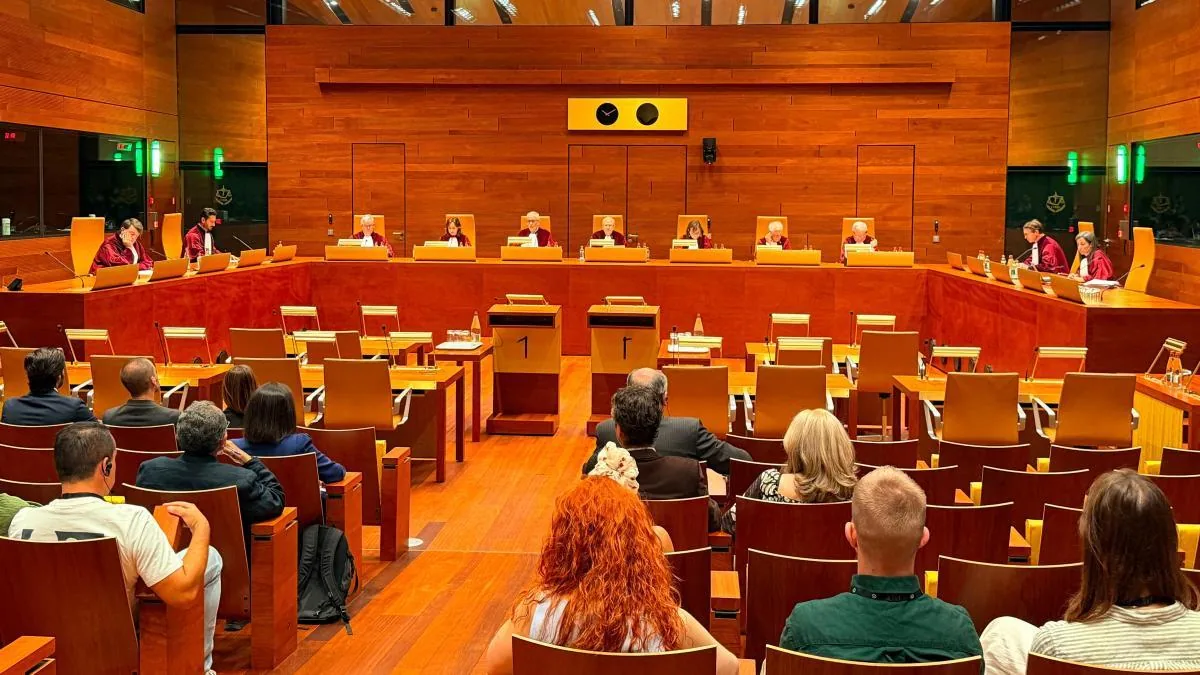
For almost two years, in the media, political talk shows, and even parliamentary debate, it has been repeated that the Court of Justice of the European Union (CJEU) held the future of the Amnesty law approved in 2024 by the General Courts for “institutional, political, and social normalization in Catalonia” in its hands. However, that premise was never entirely correct. This week, the Grand Chamber of the CJEU has issued two rulings on different aspects of that law, but this does not make the court an arbiter of Spanish politics nor does it resolve the debate about its timeliness or convenience.
Read more The points of a key sentence
Indeed, the highest EU court did not rule on whether the Amnesty law is – or is not – in accordance with the Spanish Constitution. Simply put, it does not do so because the Union treaties do not grant it that competence. That responsibility lies exclusively with the Spanish Constitutional Court. Nor does the CJEU turn the application of the Amnesty law into an automatic process. It will be the Spanish judicial bodies who must continue resolving each case.
This clarification helps better understand why both CJEU rulings do not automatically resolve the legal situation of the people potentially affected by the amnesty. What they do is establish a legal criterion that will guide the actions of Spanish judges while this matter continues to raise doubts about the interpretation of Union law. The CJEU reminds Spain that no national law can be applied in a way that deprives the preliminary ruling procedure of its effectiveness.
From this perspective, the CJEU rulings establish a legal criterion of enormous practical significance, especially relevant for procedures like the one currently handled by Supreme Court magistrate Pablo Llarena, although they do not prejudge its outcome nor anticipate whether the amnesty should be applied in that specific case. The reason is simple: if Llarena considers it necessary to refer a preliminary question to the CJEU in the future, he could maintain, while awaiting its response, the precautionary measures he deems necessary. Among them, the maintenance of the national arrest warrants against former President of the Generalitat, Carles Puigdemont, and former ministers Toni Comín and Lluís Puig.
Read more And after the amnesty sentence, what should happen?
Therefore, presenting these two CJEU rulings as the definitive resolution of the main pending procedures for the application of the Amnesty law is, at the very least, legally premature.
In short, they leave a lesson that goes far beyond the political debate in Spain. The CJEU has neither replaced the Spanish Constitutional Court nor acted as an arbiter of the political scene around the Amnesty law. It has limited itself to verifying its compatibility with Union law where it has effect and has reminded what limits no Member State can exceed when the Community legal order comes into play.
That is probably the main lesson left by this double ruling. The EU is not built on the idea that its institutions permanently replace national ones, but on a balance of competences and an institutional dialogue based on mutual respect, loyal cooperation, and the primacy of Union law.
Read more The Argentine lover