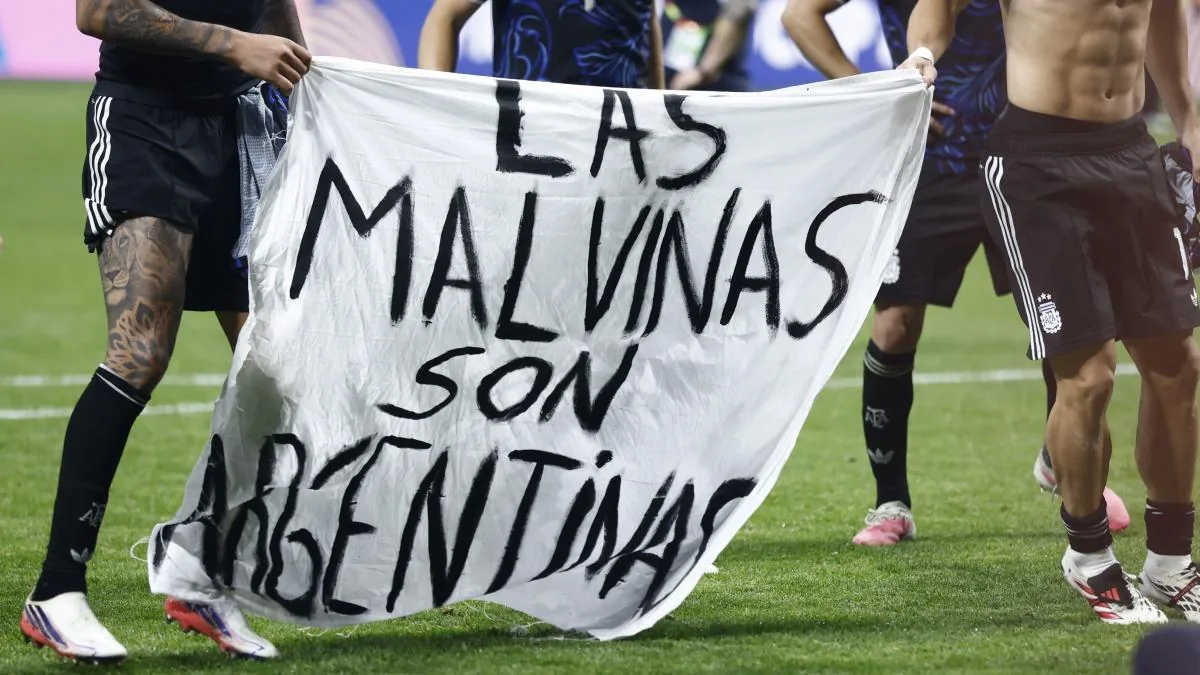
The unrestrained action of Nicolás Otamendi and Giovani Lo Celso displaying a banner with the slogan “The Malvinas are Argentine” after defeating England (1-2) in the 2026 World Cup semifinals has ignited the fuse of a tense diplomatic controversy between the two countries, which is on the path to flare up.
Read more Messi praises Spain and Barça before the final: “A club that I love and follow”
The latest episode, beyond the exchange of statements from the governmental representatives of the two states, has been the protest presented by the Casa Rosada against the British Embassy in Buenos Aires for what it considers “an illegal incursion” of a British warship in the waters of the disputed islands, an archipelago under British domination – administered since the 1982 war – and whose sovereignty Argentina claims.
The Argentine government has sent a note to the British Embassy to express “the strongest rejection of the movements of the HMS Medway ship – illegally deployed in the Malvinas Islands – which were not properly notified.” A maneuver, hours after the Atlanta match, “that constitutes a violation of the commitments assumed by both governments in 1991.”
The executive led by far-right Javier Milei reaffirms its “legitimate and imprescriptible sovereignty rights over the Malvinas, South Georgia and South Sandwich Islands and the surrounding maritime spaces,” and closes the note with the proclamation “by history, by law and by conviction, the Malvinas are Argentine.”
After the match, Argentine Vice President Victoria Villarruel also endorsed the display of the Malvinas flag by the albiceleste players. “The Malvinas are Argentine! They banned bringing them to the field and forgot that we carry them in our blood and heart,” expressed the second-in-command of Milei’s government on social media.
The Argentine players also openly expressed themselves when asked about the display of the banner and a flag with the silhouette of the islands. “And they will always be Argentine,” said Leandro Paredes. Fullback Nicolás Tagliafico attributed the banner action to the “emotion of victory, which leads you to do those things.” “It’s not good to show it publicly, but before the match we had that feeling it was going to be a special game,” he said. Lautaro Martínez assured that, although the Malvinas war “happened many years ago,” this was not “just another match.” “For us, it was not a match like the others. It was a special match,” he admitted.
Read more The amnesty has benefited 403 people since its approval two years ago
The players also sang the usual “he who doesn’t jump is an Englishman,” a chant that Argentine fans always sing at national team matches. It so happens that five of the 11 starters play in the Premier League.
British Rejection
“The World Cup may not be ours, but the Falkland Islands definitely are,” said the British Prime Minister’s spokesperson
For its part, the British government has requested FIFA to open an investigation into the display of the Malvinas banner. In an interview with the BBC, British Minister of Science, Innovation and Technology Peter Kyle stated that the footballers’ gesture “was totally inappropriate” and emphasized that “politics must be kept out of football.”
“I hope FIFA conducts a thorough investigation,” Kyle said, recalling that “one of the fundamental principles of the World Cup is that politics is separate from football.”
A Downing Street spokesperson added fuel to the fire by declaring: “The World Cup may not be ours, but the Falkland Islands definitely are.” “Our position has not changed. Self-determination belongs to the islanders. Our commitment to the Falkland Islands (the English name for the Malvinas) will never waver.”
Possible Economic Sanction
FIFA prohibits inside stadiums “banners, flags, flyers, clothing and other objects of a political, offensive or discriminatory nature”
The action of the albicelestes showing the politically charged banner violates FIFA’s code of conduct, which prohibits inside stadiums “banners, flags, flyers, clothing and other objects of a political, offensive or discriminatory nature.” Under pressure from the British government, it is expected that FIFA – opposed to political demonstrations in football – will open a file before deciding on a possible sanction, which could range from a warning to financial fines for the AFA, the Argentine Football Association, or only for the players involved. A sports suspension is less likely, as it is generally reserved for repeated or extraordinary cases due to their severity.