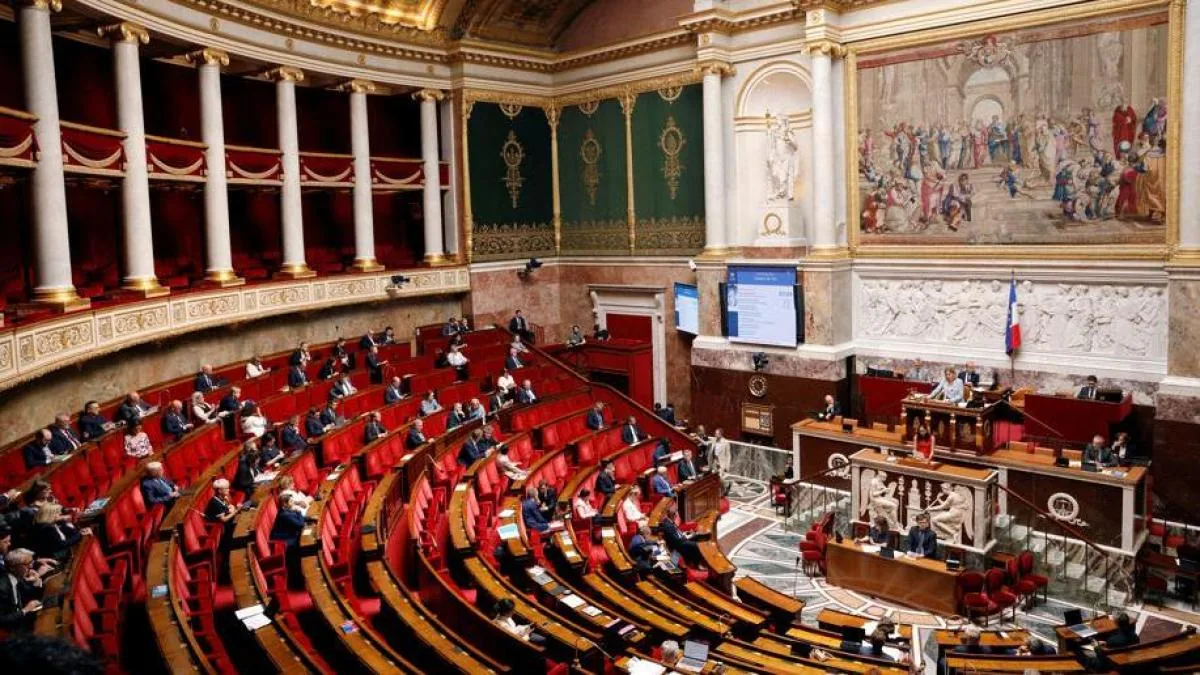
After two years of intense national debate, the deeply divided French National Assembly approved this Wednesday, by 291 votes in favor and 241 against, the bill on “the right to assisted dying.” The decriminalization, under strict conditions and protocols, of assisted suicide and euthanasia – words that the legislative text avoids naming – has had the support of President Emmanuel Macron, who has urged the Government to speed up the process.
Read more Ukrainian drones kill Russian recruits 30 minutes after arriving at the front, according to the CIA
Each deputy voted according to their conscience, without party discipline, and some political groups showed a total fracture.
Until now, in France there was the possibility of deep and continuous sedation for certain terminally ill patients. From now on, people who meet five requirements will be able to access “assisted dying”: being French or regular residents, suffering from a serious and incurable illness, being in an “advanced” and irreversible phase marked by a worsening that affects quality of life, and obviously making a written or oral declaration in full consciousness. Psychological suffering alone will not justify the right to die.
If possible, the patient themselves will self-administer the lethal substance. If that is not physically possible, a doctor or nurse will do it. People in a deep coma or suffering from Alzheimer’s are excluded from these procedures.
Lawmakers have introduced a series of criteria and safeguards to avoid abuses and pressures as much as possible. The intervention of a panel of physicians is foreseen in the decision and deadlines to make it and for the patient to back out. Doctors and nurses may invoke the conscience clause and refuse to intervene in these cases.
Read more The arrest warrant for Puigdemont will remain despite the CJEU ruling
This law has caused an unusual friction between the President of the Republic and his Prime Minister, Sébastien Lecornu, who has never looked too favorably on this initiative. The head of government wanted to delay approval until after the parliamentary summer break, and Macron forced him to bring the schedule forward. The president was determined that this law would be part of the legacy of his ten years at the Élysée and did not want delays. That is why he took badly Lecornu’s announcement that he will take the text to the Constitutional Council to determine if some points, such as the criteria on free will, the possibility of backing out, and the obligation of public medical centers to apply the law, respect the Constitution.
Several speakers who defended the law in the final debate highlighted the historic nature of the measure. The Macronist deputy Brigitte Liso admitted that all parliamentarians have the right to act according to their consciences, although she reproached some for wanting to “caricature” the supporters of the reform negatively. Liso emphasized that it is “a text of responsibility, freedom, and profound humanity.” In the same vein, the socialist Stéphane Delautrette spoke of “a text of fraternity that leaves no one in pain against their will” and of freedom for those who cannot go to Belgium or Switzerland to die.
The deputy of the National Rally (RN, far right) Christophe Bentz, opposed to the law, lamented “the abandonment of human life” and the creation of “a social death sentence.” The parliamentarian Justine Gruet, from the Republican Right, also opposed, criticized the rush to approve it and the mistake of legally authorizing taking a human being to death.
The bill has generated frontal resistance from the Catholic Church, under the impetus of Pope Leo XIV, who will make a pastoral visit of several days to France in September. In all parishes, there was a leaflet encouraging the faithful to a novena of prayer to ask for a last-minute change of vote. The leaflet recalled the Pope’s stance and his words in the Cortes, during his recent trip to Spain, such as the phrase that “the defense of human life is neither a partial issue nor a confessional interest; it is a goal of civilization,” or that “the moral greatness of a nation is manifested above all by its ability to accompany, protect, and love lives that go through the greatest fragility.”
Read more The Kings, Leonor and Sofía will be in New York on Sunday to cheer for Spain in the final