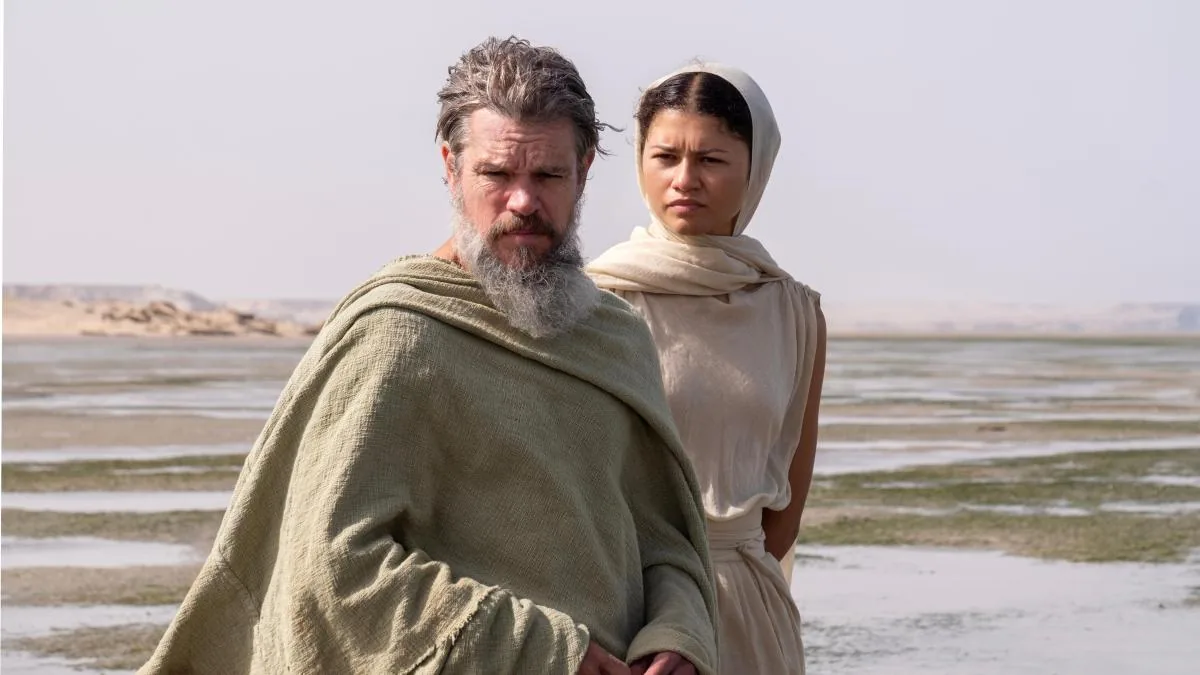
For almost three thousand years, the Odyssey has been understood as the great tale of return. A hero who, after playing a decisive role in the Greek victory over Troy —thanks to his cunning and the deception of the horse that allowed the city to be conquered— sets out on the journey back to Ithaca and crosses impossible seas to reclaim his kingdom and reunite with Penelope. But Christopher Nolan proposes a different reading of Homer’s poem: one in which Odysseus’s true journey does not end when he sets foot in his homeland, but when he understands the human cost of the war he won and the debt he owes to those who could not return.
Read more A fire in Sant Quirze Safaja forces the evacuation of a holiday home and a campsite
After the victory
The fundamental difference between the classic poem and the film is not only in the episodes Nolan keeps or removes, but in the question it raises. If Homer builds an epic about recovered identity, Nolan seems to ask what happens after the victory: what remains of a man who has survived when those who accompanied him in battle have been left behind and the order he fought for no longer exists.
In the Homeric poem, Odysseus’s return culminates with the restoration of the lost order. After twenty years of absence, the hero returns to Ithaca, defeats the suitors who have occupied his palace, regains his place as king, and reunites with Penelope. The final intervention of Athena and Zeus prevents violence from triggering a new civil war and allows the island to regain peace. The world fits together again.
Nolan radically changes that ending. After reclaiming Ithaca, his Odysseus understands that his reign has ended and hands power over to his son Telemachus. The hero does not claim the world he left behind: he accepts that it belongs to a new generation. The film thus turns the return into a farewell.
The Phaeacians disappear
This change is announced in the very structure of the story. One of the most significant elements Nolan removes compared to the poem is the presence of the Phaeacians, the people who in Homer welcome Odysseus and listen to the long songs narrating his adventures. Before them, the hero transforms his past into an epic: he recounts his encounters with Polyphemus, Circe, the sirens, or the descent to Hades, turning his sufferings into a story of survival.
With the disappearance of the Phaeacians, that public space of narration also disappears. Nolan transfers the confession to Penelope. The story ceases to be a display of feats and becomes an intimate revelation. Odysseus no longer speaks to be admired, but to be understood. Before the woman who has waited twenty years, he must face a truth he has tried to keep hidden: he has not only been a victim of the forces that shaped his destiny, but must also assume responsibility for the loss of the men who left with him for Troy and never returned.
Calypso and the weight of guilt
This transformation redefines one of the most enigmatic characters of the poem: Calypso. In Homer, the goddess is the figure who holds Odysseus on her island and offers him an immortal life away from the suffering of the human world. She represents a temptation: to abandon mortality and forget Ithaca.
In Nolan’s reading, however, Calypso takes on a completely different dimension. She is not simply the one who prevents the hero’s return, but the one who helps him understand why he himself is not ready to leave. His stay on the island is not only due to an external imposition: it is also an escape from memory. Odysseus remains there because he still cannot face the weight of his decisions.
The island thus becomes a space for physical and moral recovery. Calypso grants him the necessary time to heal, remember, and accept. Only when he stops fleeing from his past is he ready to return.
Read more This is how the new Sant Jordi Club will be: the future will be heard in Montjuïc
The debt to the dead
This awareness also transforms the hero’s final journey. In the film, after reclaiming his home, Odysseus and Penelope set sail westward to honor the dead who did not receive the proper rites. In Greek tradition, the West is associated with sunset, the territory where the sun disappears, and the symbolic boundary with the world of the dead. But Nolan turns that destination into more than a mythological reference: he transforms it into an act of reparation.
The journey no longer seeks glory, conquest, or recognition. It seeks to settle a debt. Odysseus must look toward those left behind before he can live the time he has left. The voyage to the dead is also the one that will allow him to free himself from them.
Penelope, beyond waiting
That is why Penelope takes on a new dimension. In Homer, she is the goal of the return: the woman who remains in Ithaca while the hero struggles to come back. In Nolan’s version, she is the companion of reconciliation. She not only waits for Odysseus: she shares with him the weight of what has been lived and accompanies him in the final stage of his journey, no longer as king and queen, but as two human beings seeking peace after loss.
The role of the gods also changes. While Homer relies on the intervention of Athena and Zeus to restore order, Nolan shifts that responsibility to the hero himself. Athena observes and acknowledges Odysseus’s transformation, but peace does not come from Olympus: it is born from human acceptance. True wisdom no longer consists in defeating the enemy, but in understanding when the time has come to step aside.
The shadow of ‘Oppenheimer’
This reading deeply connects with one of the central concerns of Nolan’s filmography. As in Oppenheimer, the protagonist is a man marked by the consequences of what he has created. The scientist who helped change the course of history and the king who led his men to war share the same wound: both must face the world that arises after their actions.
In Oppenheimer, the question was not only what the physicist had managed to create, but how he could live after opening a door that could no longer be closed. In Nolan’s Odyssey, the issue is not only how Odysseus survived, but what he must do with the memory of those who did not survive.
Telemachus inherits the world
That is why this adaptation ceases to be only the story of a hero’s return. It is the elegy of a world that disappears: that of warrior kings, great feats, and glory won on the battlefield. Nolan’s Odysseus does not triumph when he reclaims Ithaca, but when he accepts that it no longer belongs to him.
Only then can he embark on the final journey: the one that allows him to honor his dead, hand the future to his son, and finally find a peaceful life with Penelope.
Read more What is the judicial horizon for Puigdemont and the amnesty after the European justice ruling?