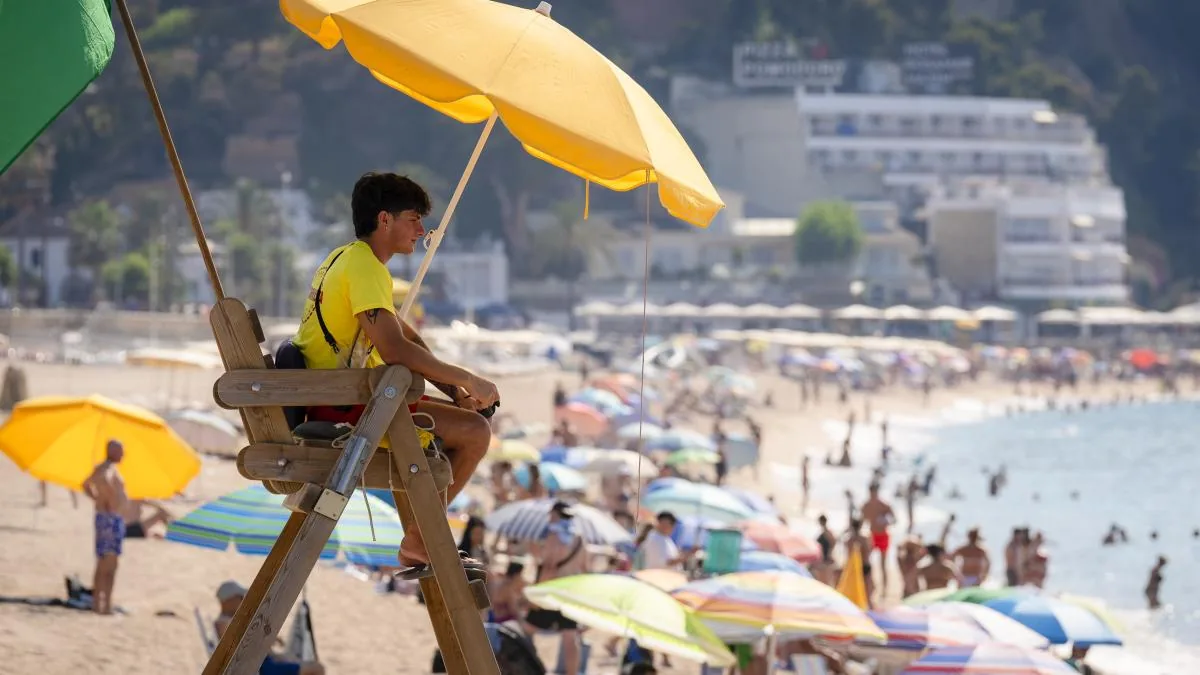
The employers’ association and the hotel sector criticize the possibility of increasing the tourism VAT to 21%. It is a position they have held for some time, but to which they have now added a new element. It is the report from the Institute of Economic Studies (IEE), published yesterday, which openly disagrees with this possibility recommended by the European Commission, the OECD, and also the group of Catalan economists who prepared the Fènix report.
Brussels defends the change due to the loss of revenue it entails, about 7 billion euros, and because of its very limited redistributive effect; and the economists of Fènix believe that this reduced VAT should be compensated with tourist taxes. The goal for these academics is for tourism to stop growing with companies that exploit sun and beach with low wages and move towards models with more added value.
The Fènix report believes that low productivity is due to the growth of sun and beach tourism
However, for the IEE, this think tank linked to the CEOE, raising the VAT on hotels and catering to the general rate would be “an economic policy mistake,” mainly due to the loss of competitiveness the sector would suffer compared to European competitors and the job destruction it would entail. They argue that tourism VAT effectively taxes an export, and increasing it would mean establishing a tariff on our sales abroad. Furthermore, they warn that tourist demand is very price sensitive, and an increase would mean shifting visitors to Spain’s main market competitors, such as Greece, Italy, Croatia, Turkey, or North Africa.
The thesis is that, in a sector with such narrow margins, the 11-point VAT increase (from the current 10% to the general 21%) would have to be passed on to prices, closing establishments or destroying employment. In this regard, the IEE refers to a historical precedent. The case of Portugal, which raised the VAT on catering from 12% to 23% in 2012, with such negative results that four years later it reversed the measure. According to the Portuguese sector employers’ association, during that period catering and beverage establishments closed and jobs were lost until reaching historic lows in sector employment. And, most significantly, the expected revenue increase was not achieved; instead, revenue decreased.
Moreover, it is observed that the Spanish case is not an exception, but that most neighboring countries apply a reduced rate of this tax, with Portugal setting 6% for accommodation and 12% for catering; and Italy and France, 10%. Meanwhile, Germany has taken the opposite path and since January has permanently set the reduced rate of 7% for catering. Thus, a VAT increase would leave Spain in a fiscally more burdensome situation than its competitors. This is what the report calls a “self-inflicted competitive disadvantage.”
Read more Spanish right blue card
In response to arguments that a very labor-intensive but low-productivity sector is being subsidized, which is the basis of the Fènix report, the IEE study reacts by denying that the reduced VAT is an unjustified tax privilege, but rather an instrument consistent with its “export nature, labor-intensive and highly subject to external competition.”
As a final argument, the IEE also disputes the Commission’s criticism that a reduced VAT rate has a limited redistributive effect, because high incomes consume more hospitality services and revenue. Here it points out that the negative effects on employment would especially harm medium- and low-skilled workers.
An opposition to the VAT increase that is endorsed by the CEOE. “The report provides economic arguments that any decision on tourism VAT must consider not only its revenue effect but also its impact on competitiveness, employment, and investment,” sources from the employers’ association state, adding that “the debate should not only be about how much can be raised, but what the economic cost would be.” Here comes the usual argument of tourism as a growth engine and not making decisions based on a short-term fiscal perspective.
What Brussels and the Fènix report say
It was the European Commission that last month issued the recommendation to raise the VAT on hotels and catering in its evaluation of the fiscal package. There it first points out, in general terms, that “economic efficiency could be improved by broadening the VAT base and limiting the application of reduced rates.” Then, it focuses on tourism. It states that “among the categories to which preferential VAT rates apply, catering and accommodation services stand out due to their high budgetary impact.” It is 0.4% of GDP. A large budgetary effect with “a very limited redistributive effect.” This corresponds to an indirect tax like VAT, and even more so when referring to a sector where high incomes are the main users.
For their part, the economists of the Fènix report describe tourism as a “subsidized” sector, since what companies pay the State for their workers, plus the personal income tax these employees pay, is not enough to compensate for the public services those citizens receive.
Read more Albares reproaches the PP for its confrontational policy with neighboring countries