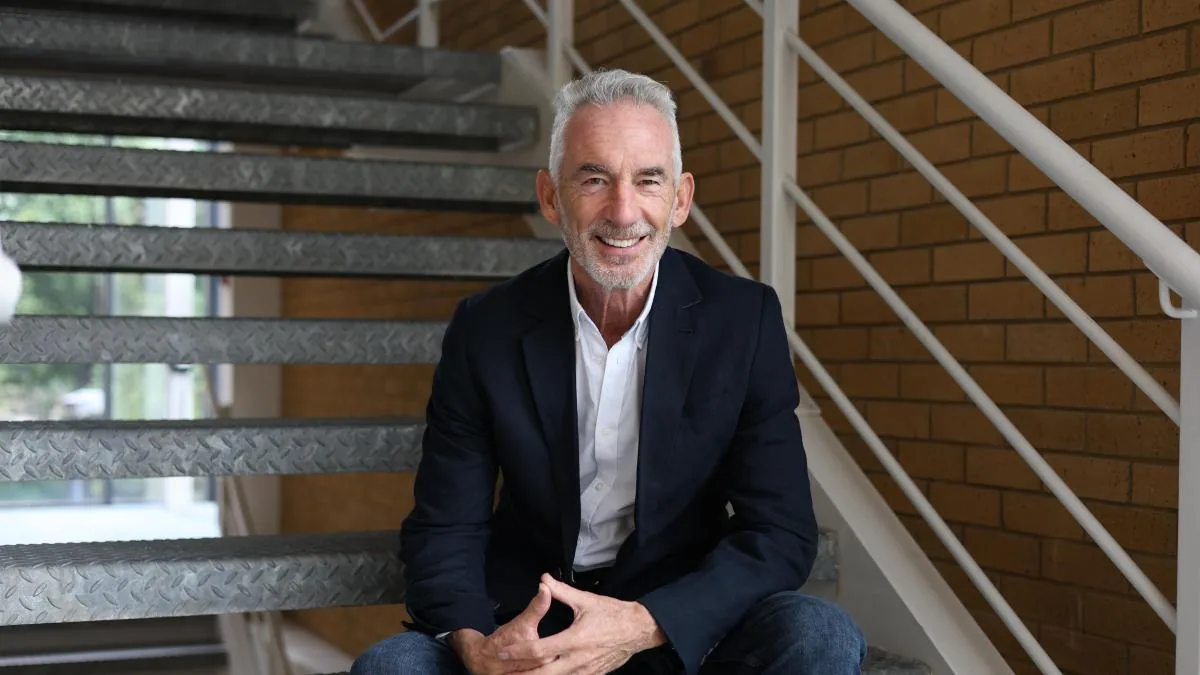
All societies, unpacks British economist Tim Jackson (1957), cling to a myth by which they live. Ours is the myth of growth. Eternal growth that one day will solve all our problems. It is useful, he admits, when you have little. But in excess, it begins to cause imbalances. “Human prosperity is mainly about health,” he points out. And he believes that the myth of growth, driven by male economists who have focused on productivity, efficiency, and the invisible hand of the market, and who have left aside the “invisible heart of society,” the poorly paid work of women, has failed. Jackson, author of Postgrowth and emeritus at the University of Surrey, thinks it is time to change it. He publishes L’economia de la cura (Arcàdia), which will appear in Spanish at Paidós in October.
Read more Anya Taylor-Joy returns to television in a big way
An Elusive Myth
The myth of continuous growth is stronger today, we don’t know how to live without it”
He states that the myth of growth reigns in our society. What does that mean?
It is even stronger than before. We see it in political speeches, military attitudes, territorial demands. Today we desperately cling to a creed; it is an idea without which we don’t know how to live. The growth we want remains elusive, but this is how we give meaning to our world and articulate power.
Are wars, the return of the far right, related to that?
Yes. Part of the responsibility lies with the neoliberal ideals of the powerful sectors of society, now called the Epstein class, a group of people who control power and wealth, including the government. And they use it to pursue their own power and wealth. The problem with the myth of growth is that it is legitimized by the idea that growth is the focus of our prosperity. And if you take that for granted, you can legitimize all this greed, this ambition for power and territory; that is what makes it seem respectable because it claims to be progress. Populism is the symptom of a thirst for power from another sector of society, an elite that has captured governance processes and economic institutions for its own benefit.
After the 2008 crisis and the pandemic, in the end, did anything change?
In the 2008 crisis, to some extent, yes. It was the beginning of the break with the neoliberal idea. First with the Occupy movement, the indignados: this system has destroyed the planet, impoverished people, and created its own financial instability, and now states bail out the banks. But opposition to the system was exhausted by austerity, by the withdrawal of welfare from the poorest, by rising youth unemployment, by distracting people. We had no bread, but we had circuses. Social networks, Netflix, series marathons, the endless celebrity paraphernalia. The irony is that this process of emptying opposition to neoliberalism generated populism. And now things that were hidden, as the MAGA movement shows, are explicit: the defense of territorial power and unbridled greed as the highest good.
You call for replacing the myth of growth with a care economy. What is that?
When I was writing about postgrowth and prosperity without growth, a question arose: What does prosperity really mean? The myth of growth conceives prosperity as wealth and accumulation. And if the North Star of our society is wealth, then accumulation, growth, progress, is the way to get there. But if you accumulate and accumulate, in the end you damage the planet, and that undermines everything. The idea that prosperity is only about accumulating wealth is wrong. In reality, the best model of prosperity is the idea of health. If you take that idea broadly, physical, mental, community, ecological health. Because health never operates simply through accumulation: its guide is balance. And once you have shifted from wealth to health, from growth to balance, what is the role of the economy? To help us achieve that balance. The key idea of the care economy is that our prosperity does not always mean having more and more. The idea of having more and more is dangerous. When we don’t have enough, having more is a good thing. But if we are obsessed with having more and more, we lose that point of balance. Of enough. The care economy is a way of saying that we have built institutions around a false myth. Health works through balance. And balance requires restoration. Care is that restorative force. The economy has to be a force of care. The force of care is so fundamental that it is an organizing principle of organic life. Sometimes it is the care of one organism for another, but very often the organism itself, inside, is constantly bringing us back to balance. And that, I believe, is what has been lost in our economy and needs to be reinstated.
He states that our neurolimbic systems were not designed for capitalism.
They were not, but capitalism has done a very good job exploiting them, because we seek pleasure and avoid pain. It is very easy to monetize that. The food industry deliberately created a science of desire, employed neuroscientists to find the pleasure factor in processed foods, which would activate our dopamine circuits and give us a feeling of pleasure. And it began to design our diets around that type of food. We have that dopamine circuit because we evolved in a time when sugar was very scarce. Every time you found a concentrated sugar source in a small fruit, you got a small dose of dopamine. And that encouraged you to look for the next one. But there was a great distance between one and the other. If you are bombarded with products from an industry designed to hack your reward circuits and those products turn out to be bad for you, you have the recipe for disaster. An epidemic of chronic diseases that goes beyond anything we have seen with products that generate profits for the industry and undermine public health. But we legitimize them because they promise to generate growth. Also, the overmedicalization of health was based on the idea that it was a source of profit.
He emphasizes that gender is the key division when talking about care.
More than 70% of paid care work worldwide and a higher percentage of unpaid care work is done by women. It has been relegated to a sector of society considered less important: women, minorities, immigrant workers. But care is so fundamental to our lives that we should always have rewarded it adequately. As men, we have lived in a society that has privileged masculine values over feminine ones. And that harms both us and women. Today, the forces of a masculinized, patriarchal society driven by growth and territoriality, the society of 21st-century capitalism, are leading us to disaster. We need policies that invest in care, that pay care workers adequately, that allow people to organize their lives in ways that do not stress them and undermine their health. A reform of the food industry because it makes us sick. A reform of the pharmaceutical industry because it profits from our illness. Health is our most important asset. We saw the rise of care as something with social value during the pandemic and then it disappeared and instead, like a pendulum, there is violence. The work as individuals, as societies, as governments, as politicians, is to provide that counterforce to the pendulum again, because the momentum toward violence is overwhelming at the moment. And terrifying.
Read more La Sagrada Família recovers Gaudí’s workshop burned in 1936