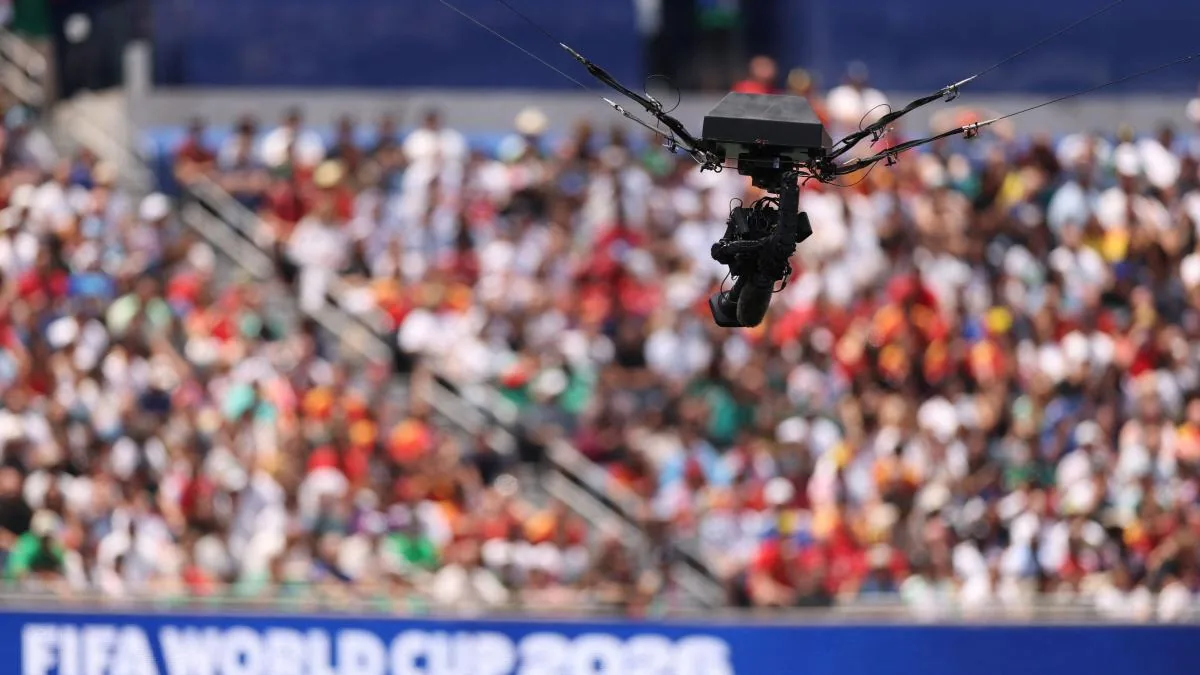
It all started after a long goal kick from the Norwegian goalkeeper Orjan Nyland. The Fox Sports cameras captured how the ball – as seen in the replay – seemed to hit one of the cables supporting the aerial camera at the Hard Rock Stadium in Miami. It would have been a mere anecdote if it weren’t for the fact that this was the play that led to England’s 1-1 draw against Norway and sparked the controversy dubbed cable-gate.
Also read
The sequence was as follows: after the supposed contact, Elliot Anderson took control of the ball, the action continued with a pass to Anthony Gordon, who assisted Jude Bellingham, who equalized the match at 1-1. The images caused immediate protest from the Norwegian players and bench, convinced that the ball had grazed the cable. But the play was not reviewed on the monitor because neither the French referee Clément Turpin nor the VAR team, led by his compatriot Jérôme Brisard, who was officiating his seventh World Cup match using the technology, saw a decisive incident during the play.
The rule requires stopping play if the ball touches an external agent, but FIFA maintains it did not happen
England ended up beating Norway and securing their place in the World Cup semifinals, but the Norwegians protested immediately and cable-gate has become one of the most talked-about issues of the tournament, opening a new debate about the limits of technology applied to refereeing.
On one hand, there is the IFAB regulation, the body responsible for creating and modifying the rules of the game. Rule 8.2 states that if the ball comes into contact with an external agent – such as the cable of an aerial camera – play must be stopped and restarted with a dropped ball. Therefore, if that contact had been confirmed, England’s goal would have had to be disallowed.
So why was the play not reviewed?
Fox Sports explained during the broadcast that FIFA had informed them that the ball had not touched the cable. Hours later, FIFA issued a statement. According to the organization, the sensor embedded in the ball did not detect any alteration consistent with an impact against the cable. “The ball sensor showed no spike in the ball’s ‘heartbeat’ while in the air and therefore there is no evidence that it touched the upper cable and altered its trajectory,” it explained.
Read more Bryan Johnson, the millionaire who wants to live forever, suffers from an autoimmune disease
The rule requires stopping play if the ball touches an external agent, but FIFA maintains it did not happen
Additionally, the statement was accompanied by a graph of the data recorded by the ball to demonstrate that no alteration in its trajectory occurred. The English coach, Thomas Tuchel, supported that explanation by recalling that the chip integrated into the ball is capable of detecting minimal contacts.
However, Norway does not believe that version. “Many on the bench saw it immediately. The ball fell right in front of us,” said coach Ståle Solbakken. Midfielder Sander Berge also called the situation “ridiculous” and lamented that such a small detail ended up being decisive. Even Alf-Inge Haaland, father of Erling Haaland, stated that Norway had been “robbed.”
The goal was added to the scoreboard, England moves forward, and cable-gate already has a reserved place in World Cup history.