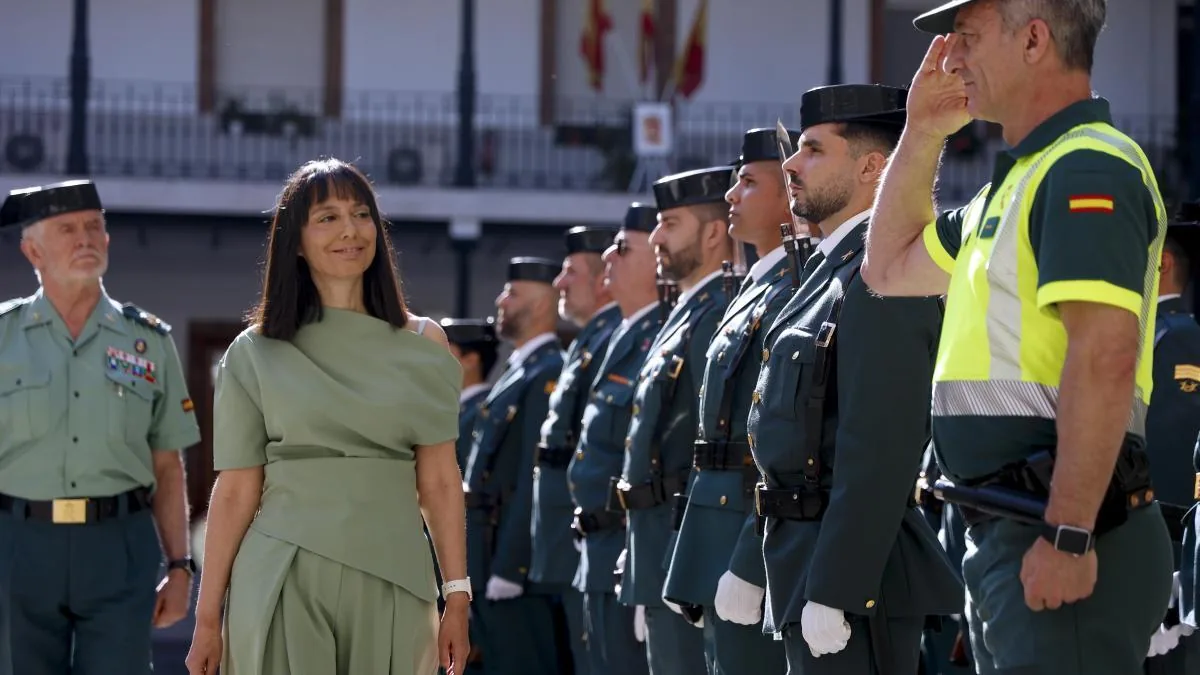
The director of the Civil Guard, Mercedes González, who until now had denied any meeting with former PSOE militant Leire Díez, now acknowledges at least two encounters with the so-called socialist ‘fixer’, although she places them outside the headquarters of the armed institution. Through a statement, the highest-ranking official of the force assures that she “has never interfered in any investigation carried out by the agents” of the body she directs. And that communications were cut off after Díez proposed that she reinstate Commander Rubén Villalaba, who was removed after being charged in the Koldo Case. Something González rejected.
Read more Lego launches its largest set with a Sagrada Familia of 12.060 pieces
González maintains that she met Díez during her time as Government Delegate in Madrid, when Díez was director of Institutional Relations for Correos. That relationship was limited to WhatsApp exchanges related to the labor mobilizations in which this company was immersed, which caused demonstrations and concentrations at its different headquarters. After her appointment as director of the Civil Guard, the former socialist militant contacted González to hold a first meeting in which she conveyed her new employment situation and merely told her that she was working as a freelance, thus resuming her work in the world of journalism, “without specifying where or for whom she worked,” only that she was commuting between Cantabria and Madrid.
Read also
That first meeting, for which González does not provide a date, took place in a cafeteria near the General Directorate of the Civil Guard. According to González, in that quick 15-minute appointment, she understood it was “a mere initial contact to ask for a job or establish a working relationship in the future,” given her recent appointment. The statement mentions “a possible second meeting” of the same characteristics, but does not confirm it.
Several months later, Díez contacted González again, proposing to see her, but that appointment was canceled due to a family illness. The meeting resumed “some time later,” developing, says the director general, into a conversation about her family situation, previously mentioned. But at a certain point, Díez asked her “if there would be any possibility” for Commander Rubén Villalba to return to his job. “A request that the director flatly rejected, reminding her that he was without assignment due to his alleged involvement in a judicial case, immediately ending the meeting,” the statement reads. That was the last meeting.
Read more Primavera Sound provisionally suspends its concerts due to rain
Santos Cerdán allegedly opened a priority channel within the Civil Guard leadership to torpedo cases inconvenient for the Government, according to the summary
González’s situation has been compromised after one of the police reports submitted by the Civil Guard’s Central Operative Unit (UCO) attested to at least three meetings with Leire Díez near the headquarters of the armed institution. González had always denied any encounter with the PSOE ‘fixer’, who, according to investigating judge Santiago Pedraz, was tasked with maneuvering to “destabilize” investigations affecting the socialist sphere. Díez, who in a meeting promised “protection” to an investigated former UCO captain in exchange for dirt on his former superiors, claimed to have González’s “trust”.
The case summary, to which La Vanguardia has had access, details how the alleged plot led by former PSOE organization secretary Santos Cerdán would have opened a priority channel within the Civil Guard leadership to torpedo cases inconvenient for the Government. Díez, according to the National Court, would have instilled suspicions in González about the UCO, which would have materialized in internal investigations for alleged leaks, but whose real objective was to intimidate the unit’s commanders. The investigating judge has not yet charged González, but the new revelations from the police reports complicate her situation. On May 27, Pedraz sent the UCO to the headquarters of the armed institution to request all information about those files opened by González.
Last week, the Minister of Interior, Fernando Grande-Marlaska, flatly denied that the director of the Civil Guard had had “any relationship” with Díez “of any kind.” This very morning, although he has refused to specify meetings, the head of Interior has again backed González, highlighting her “full honesty.” However, with the new revelations from the summary, this very afternoon government sources began to admit several meetings between Díez and González, albeit clarifying that they had always occurred outside the Civil Guard headquarters and that, above all, the director never acceded to the ‘fixer’s’ requests. A version that contradicts that presented by the UCO in its reports.