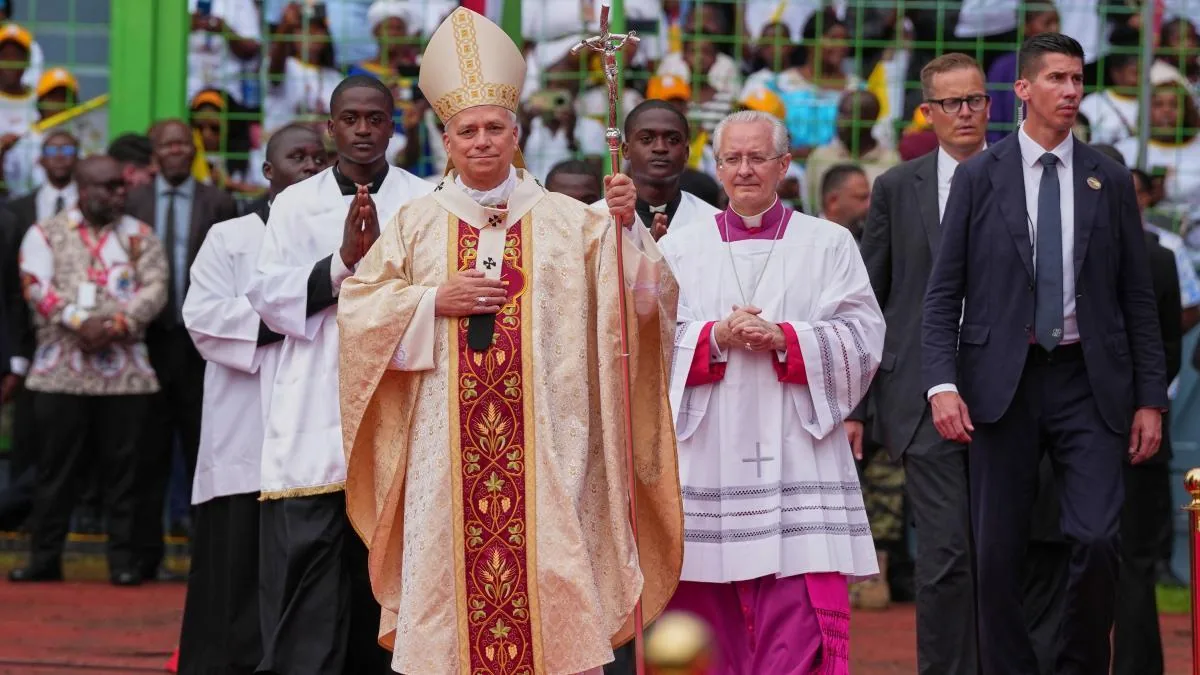
Leo XIV’s long journey has ended. An extensive 11-day tour, which touched four countries and had begun with the weight of the very serious accusations made by Donald Trump against the American Pope for his anti-war positions. A burden from which the Pontiff tried to free himself immediately, responding to the president: “I am not afraid of the Trump administration,” but making it clear that he did not want to “debate” with him. A request reiterated in the following days to journalists who had interpreted some of his speeches as messages directed at the White House.
Read more Tel Aviv and Beirut dialogue at the White House under fire in southern Lebanon
On the flight back to Rome, the Pontiff spoke, as usual, with journalists about current affairs, starting with the reopening of the Strait of Hormuz, a confusing situation in which “in negotiations one day the United States says no and Iran says yes, and then the opposite; we don’t know who created this chaotic situation, critical for the world economy, but there is also an entire population in Iran of innocent people suffering from this war.” “Rather,” he added, “I would like to encourage the continuation of dialogue for peace and for the parties involved to make every possible effort to promote it and for international law to be respected.”
Read also
Avoiding responding directly to Donald Trump, but asked about the repression carried out by the Iranian regime, which according to the president he did not criticize, the Pope affirmed that “I condemn all unjust actions. I condemn the killing of people. I condemn the death penalty.”
Continuing with the Middle East, the Pontiff confessed that he always carries with him “the photo of a Muslim child who, during the visit to Lebanon, was there waiting with a sign in his hand saying ‘Welcome Pope Leo,’ and who was later killed in this first phase of the war.” “There are many human situations,” Leo XIV emphasized, reiterating that “many innocent people have died.” For the Pope, it is necessary to encourage everyone to “strive to seek answers that arise from a culture of peace and not of hatred.”
“As a Church —I say it again—, as a pastor, I cannot be in favor of war. And I would like to encourage everyone to make efforts to seek answers that arise from a culture of peace and not of hatred and division.”
Responding to the issue of immigration, the Pope pointed out that it is a very complex issue affecting many countries, not only Spain, not only Europe, but also the United States: “it is a global phenomenon!” That is why —he added— his answer begins with a question: “What does the Global North do to help the Global South, those countries where today young people do not find a future and, therefore, live the dream of wanting to go North? Everyone wants to go North, but often the North has no answers on how to offer them opportunities.”
On repression in Iran, the Pope condemns “the killing of people and the death penalty”
The Pope added that “a State has the right to establish rules at its borders. I am not saying that everyone should enter without order, sometimes creating situations in the places they arrive that are more unjust than those they left behind.” But, he then raised a fundamental question: “What do we do in the richest countries to change the situation in the poorest countries? Why can’t we try, both with state aid and with investments from large companies, from multinationals, to change the situation in countries like those we have visited on this trip?”
Read more Arc de Triomf becomes the setting for comics and fantasy on Sant Jordi
And he warned: “Africa is considered by many people as a place where one can go to extract minerals, to take its riches for the prosperity of others, in other countries. There is a great challenge: a country can say it cannot welcome more people, but when they arrive, they are human beings and deserve the respect due to every human being for their dignity, not to treat them often worse than animals.”
To the question of whether these trips could end up whitewashing authoritarian leaders like Teodoro Obiang, in Equatorial Guinea, the Pope responded that the presence of a Pontiff alongside any head of State “can be interpreted in various ways.” “It can be understood —and some have interpreted it this way— as if the Pope or the Church were saying that it is okay to live that way. Others can say different things.”
Read also
The Pope then wanted to return to the meaning of his trips: “I would like to recall what I said at the beginning: the main objective is to visit people.” And he also emphasized “the great value that the Holy See continues to attach, sometimes with great sacrifices, to maintaining diplomatic relations with countries around the world.”
In that context, he explained that the Church maintains relations “also with countries that have authoritarian leaders,” which allows “speaking with them at a diplomatic level, at a formal level.” “We do not always make grand declarations of criticism, judgment, or condemnation,” he added.
However, he insisted that there is “a lot of work behind the scenes to promote justice, advance humanitarian causes” and address concrete situations, such as “political prisoners” or contexts of “hunger and disease,” seeking practical solutions.
Thus, he concluded, the Holy See, “maintaining neutrality and trying to sustain positive diplomatic relations with so many different countries, tries to apply the Gospel to concrete situations so that people’s lives can improve.”
Read more Readers make a pilgrimage for the hundred signatures of Nobel laureate Han Kang