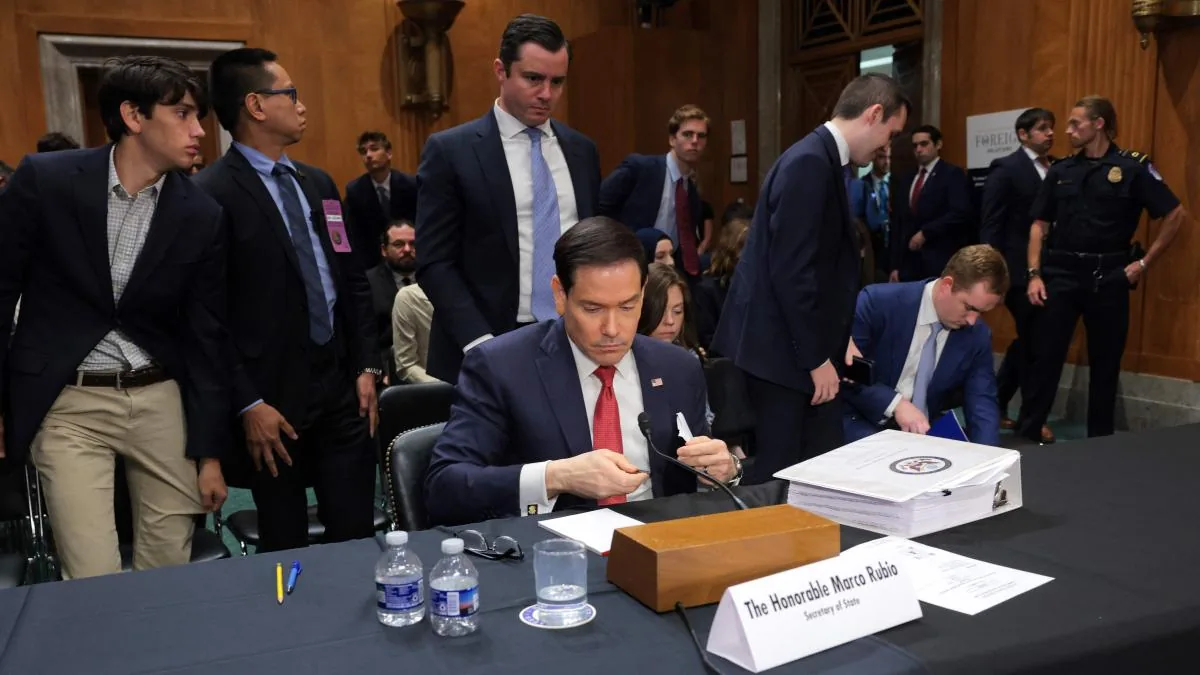
Although he was badly injured and disfigured in the bombings at the start of the war in Iran, the United States believes that the Iranian supreme leader, Mojtaba Jamenei, is alive and “increasingly involved” in the country’s leadership and negotiations, stated US Secretary of State Marco Rubio in the Senate this Tuesday, while talks to end the war remain uncertain.
Read more The Pope will also use Catalan in the blessing of the tower of Jesus
The Secretary of State explained that the war against Iran has complicated interactions with Tehran. But Ayatollah Mojtaba Jamenei “is increasingly participating at some level, although all his communications have been in writing and through intermediaries,” he indicated.
According to Rubio, this causes a slowdown in advancing agreements since Iranian officials may take between three and five days to relay an update on US proposals.
His statements about the current supreme leader seemed to clear up a doubt that has been in the air since talks began, as it was not known who the real interlocutor was or if there was more than one faction vying for power in the Islamic republic. That he is the son and heir of the late Ayatollah Ali Khamenei, one of the victims of this conflict among regime leaders and who is being prepared for a three-day funeral, clarifies the ground for maintaining contacts, according to the Secretary of State.
Rubio appeared for the first time in the Upper House since the government he is part of and Israel began bombings on Iran on January 28. In his speech, the former senator expressed confidence that contacts with Iran will resume to reopen the Strait of Hormuz and establish a 60-day ceasefire to reach a nuclear agreement.
He expressed this hope after Tehran announced on Monday a pause in negotiations due to the Israeli offensive in Lebanon. This Tuesday, talks continued despite President Donald Trump stating on Monday that he had agreed with Netanyahu and indirectly with Hezbollah (via the Lebanese government) that there would be no attacks. Despite this, the Israeli army advanced this Tuesday in southern Lebanon and requested the evacuation of Nabatiye, the large southern city and Shiite stronghold, located about 70 kilometers from the capital, Beirut.
The war in Lebanon has become complicated for Benjamin Netanyahu, who had counted on using the conflict to get rid of the Hezbollah militia. However, the Shiites have surprised the Israeli army with their drones, which, although they do not stop the Israeli advance on the front, cause casualties among the enemy and punish northern Israel.
While Republicans questioned him for their own benefit and to praise the Trump administration, Rubio faced Democrats during the hearing. “The war is over,” stated the Secretary of State about the conflict with Iran.
Read more Follow the podcast ‘The World of Yesterday’ about the figure of Johan Cruyff here
“The war is not over,” replied progressive Senator Cory Booker. The United States never formally declared war on Iran. Senior Trump administration officials have maintained since the first week of April that a ceasefire with Tehran is in effect, a term that usually implies a pause in hostilities to allow peace negotiations. However, US armed forces carried out several attacks against Iran late last week, with consequent Iranian responses.
Booker reproached Rubio that the main goal of the Trump administration is to reopen the Strait of Hormuz, which was open when they launched this war, and that everything points to the possible nuclear agreement not being better than the one vilified by Trump reached by President Barack Obama in 2015.
“The president’s priority is that Iran does not have the nuclear weapon,” Rubio replied. The Secretary of State assured that for the first time Iran has agreed to “negotiate aspects of its nuclear program,” something it refused a month ago, he emphasized.
“A provisional agreement could be reached today, could be reached tomorrow, or could be reached next week,” he said, although he warned there is no guarantee that this agreement will be “acceptable to the Senate or to the American people.”
But he stressed that under no circumstances will sanctions be lifted for reopening the Strait of Hormuz. “No, that has not been discussed, nor have we offered it,” he answered. Sanctions will only be eased or lifted if uranium enrichment ends, if Iran evacuates what they currently have, and for the nuclear weapons race, he specified.
“Sanctions are linked to the reason they were imposed. Iran is sanctioned because it has enriched uranium to high levels and for its nuclear activities. If they agree to give up those activities, there will be sanction relief associated with their commitment and compliance with that commitment,” he reiterated.
There were also questions about another collateral issue highlighted by this war. Rubio blamed European partners for the US distancing from NATO due to their initiative to cooperate. And he gave an example. “You only have to look at Spain boasting about not letting us have their bases.”
Read more Muniesa (Caixabank): “European regulation reduces market agility”