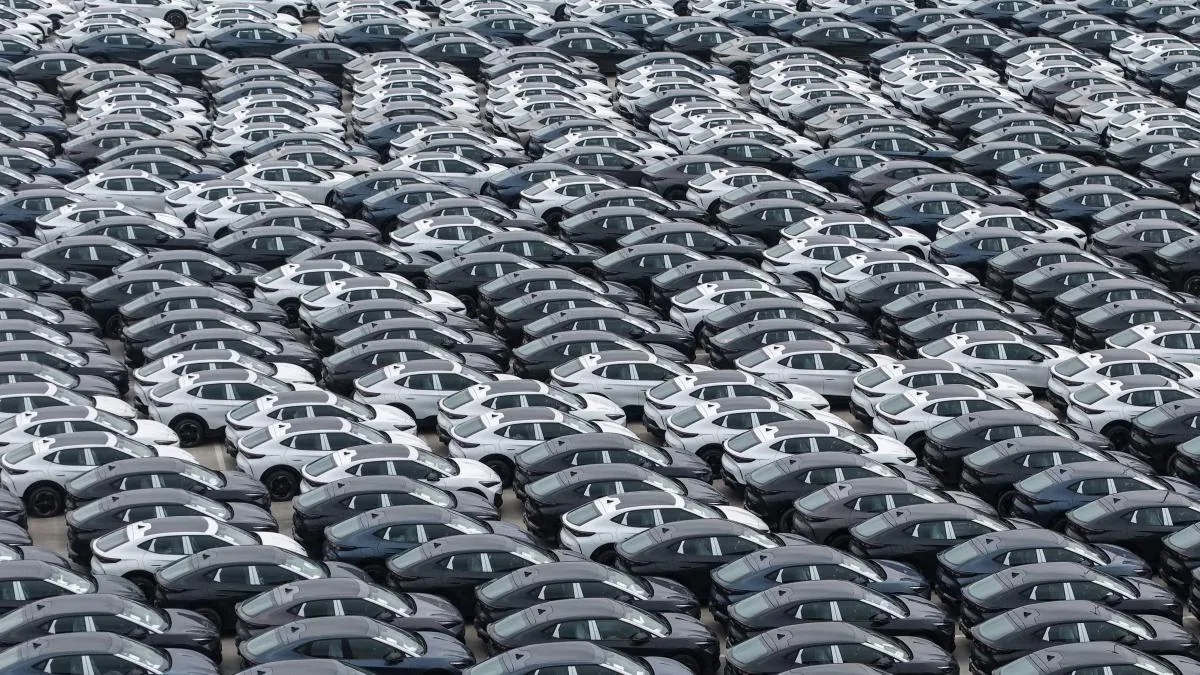
Electric car sales are soaring worldwide, but the one that truly benefits from this growth is China. Chinese producers supplied 60% of electric cars sold globally in 2025, while European and North American manufacturers were each responsible for approximately 15% of global sales, according to a report on the global electric vehicle market by the International Energy Agency (IEA). This market share distribution occurs as global electric car sales grew by 20%, reaching 22 million units. A quarter of all new cars sold worldwide last year were electric.
Read more A confidential report from Meloni’s party seeks to dismantle the «Sánchez model»
China produces almost three-quarters of all global manufacturing. “Since production exceeded domestic demand, Chinese exports of electric cars doubled, reaching a record of more than 2.5 million units,” notes the IEA. Outside the three main markets (China, Europe, and the United States), 55% of electric cars sold in the rest of the world were imported from China, compared to less than 5% five years ago. The Asian giant also maintains its dominance in supply chains and accounts for more than 80% of battery cell production in 2025.
And the market will continue to grow. The outlook is that this year will close with a sales growth – according to the report – of 10%, reaching 23 million vehicles. In Europe, sales increased by nearly 30% year-on-year in the first four months; in the Asia-Pacific region, excluding China, sales soared by 80%; and in Latin America, they rose by 75%.
“The growing popularity of electric vehicles is providing some relief amid the greatest oil supply crisis in history,” says IEA Executive Director Fatih Birol. “Looking ahead, falling battery prices and possible policy responses to the current global energy crisis will further boost electric vehicle markets,” Birol notes. By 2035, even without announcements of new incentive policies in countries like the United States and China, which are slowing sales, the global electric vehicle fleet is expected to reach 510 million, compared to nearly 80 million today, with strong momentum from emerging markets.
Read more The Trump supporter De la Espriella wins the first round of elections in Colombia
By 2035, the global electric vehicle fleet will reach 510 million compared to 80 million today
And yet, in this growth environment, European automakers are shifting their strategies. From focusing on electric vehicles, many have recently been turning towards maintaining production of hybrids and plug-in hybrids while the electric vehicle market grows enough, in their opinion, to amortize investments. This is the case with Stellantis, probably the most severe adjustment in the European sector. It closed 2025 with historic losses of 22.3 billion euros due to the accounting impact of canceling electric models, production restructurings, or the expectation of fewer electric sales, a demand it “overestimated,” especially in the U.S. The new strategy is explicit: demand-oriented focus, investment of about 60 billion euros in 60 models by 2030, but with mandatory technological mix (combustion, hybrids, and electric). But there are slowdown strategies at Volkswagen, Ford, and General Motors.
“The apparent plan changes of European manufacturers are not a renunciation of electric vehicles, but a strategic correction seeking to maintain their profitability and market realism,” says Ignacio Crespo, consulting partner at KPMG in Spain. In his opinion, European manufacturers are in an “uncomfortable position.” “They maintain market confidence, a strong industrial network, and favorable regulation, but they have lost speed compared to China,” he states. “Tariffs and protection measures must serve to buy time, but manufacturers need to increase their competitiveness,” he advises.
Stellantis gives up on 100% electric by 2030 and there are also slowdown strategies at VW, Ford, and General Motors
In this regard, manufacturers are pressuring European authorities to relax CO² emission reduction rules, which aim for zero emissions in 90% of new cars by 2035 and are the origin of 100% electrified strategies, so that they align with demand. But for Isabell Büschel, director of T&E Spain, the recent increase in electric vehicle sales in the EU has been driven precisely by the regulation. “This has forced European manufacturers to launch more affordable and attractive electric vehicles to the market. If Europe maintains ambitious CO² targets for 2030 and 2035, its manufacturers will have to offer even more attractive and competitive models, which will give the EU the opportunity to catch up with China in electric vehicle share” and reduce oil dependence.
Read more Immigration will impact the elections