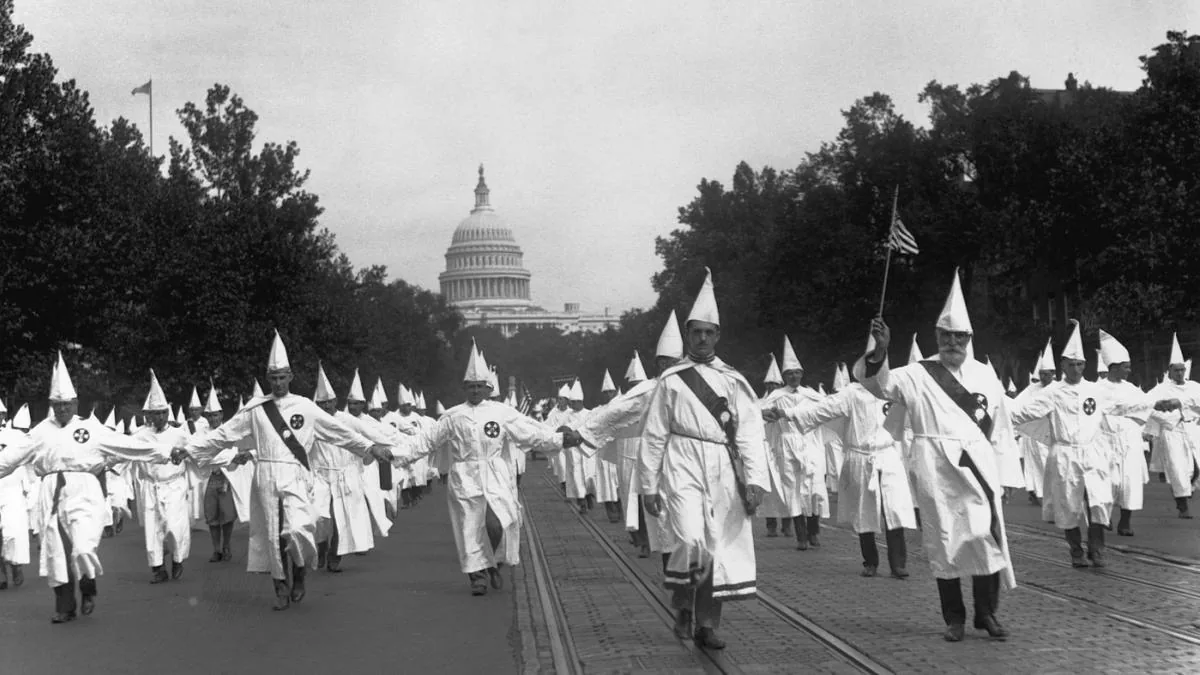
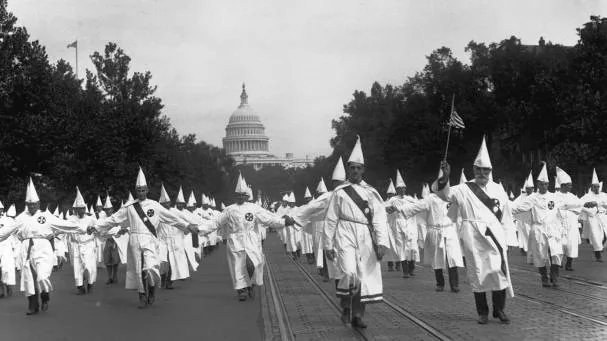
On August 8, 1925, a crowd of about 40,000 hooded Ku Klux Klan members – occasionally unmasked – paraded in their white robes, hoods, and crosses down Pennsylvania Avenue in Washington, the heart of the federal capital of the United States, to demonstrate their power. The white supremacist organization, which emerged in the Southern states from the ashes of the Civil War to combat – including with violence – the exercise of civil rights by newly freed Black slaves, then had between three and four million members and used its influence to sway the election of senators and governors.
Read more Iceland looks to the EU again
The Klan lost strength from then on, but resurged violently in the mid-1960s. The organization and some of its more violent factions, such as the White Knights, again resorted to terrorism and murders to fight the growing Black population movement, led by Martin Luther King, in defense of their rights.
Taking advantage of a Supreme Court ruling, the southern U.S. states have launched efforts to eliminate majority-Black electoral districts
Among their crimes, the murder of three civil rights activists – James Chaney, Andrew Goodman, and Michael Schwerner – on the night of June 21-22, 1964, in Neshoba County (Mississippi), where they had gone to encourage African Americans to register to vote, gained prominence. The case, which years later inspired the famous film Mississippi Burning (Alan Parker, 1988), caused a deep shock. It ultimately convinced President Lyndon B. Johnson of the need to pass a Voting Rights Act to guarantee its effective exercise. It was approved by Congress in August 1965.
Black people had been granted the right to vote since 1870 (Fifteenth Amendment to the Constitution). However, beyond the violence of the Ku Klux Klan and other racist groups, Southern states still kept the Black population subjugated with racial segregation laws and practically obstructed their electoral participation with all sorts of legal tricks: payment of poll taxes, literacy test requirements… The 1965 law changed all that.
A century after the Ku Klux Klan march through Washington, its supremacist and far-right ideas are once again in vogue in the United States, and many of the safeguards achieved through years of struggle and effort are being dismantled one by one. The Supreme Court, controlled by an ultra-conservative majority – consisting of six of the nine justices, three of whom were personally appointed by Donald Trump – dealt the final blow to the Voting Rights Act in a controversial ruling at the end of April, stating that the “enormous social change” experienced by the U.S. no longer justifies maintaining certain measures in defense of minorities. With this ruling, from now on, legal protection can only be invoked if authorities deliberately seek to restrict their political representation.
It goes without saying that the Supreme Court’s progressive minority dissents from the ruling. According to Justice Elena Kagan, the decision is “the final chapter in the demolition, now complete, of the Voting Rights Act.” In her opinion, it is not up to the Court but to the legislative branch to decide whether the law remains necessary.
Read more A generation without a home
The origin of the ruling lies in a dispute over electoral districts in the state of Louisiana. Based on the 1965 law, and supported by the Supreme Court’s historical jurisprudence, many states had drawn districts where the Black minority was the majority to ensure their representation. In Louisiana, where one-third of the population is African American, the state sought to create a new majority-Black district (so that there would be two out of six total). The initiative was challenged and has now been overturned by the Supreme Court, arguing that defining a district based on race is unconstitutional. Accordingly, Louisiana’s legislature approved on Friday the elimination of that second district.
Also read
Taking advantage of the precedent, other southern states are preparing to eliminate Black districts as well. The Tennessee Congress approved on the 7th the removal of a majority-Black district in the city of Memphis, and the governor of Alabama has urged the reinstatement of a 2023 electoral map – annulled by state justice – with the same goal. In Georgia, the governor has called a special assembly to redesign electoral districts, and similar plans are underway in South Carolina and Mississippi. “We are witnessing, in real time, the creation of a one-party state in the southern U.S.,” journalist G. Elliot Morris (Strength in Numbers), an expert in electoral analysis, has denounced.
The underlying motive is partisan: Black voters predominantly support the Democratic Party, and what is sought is to dilute their vote in predominantly Republican and white districts. This type of maneuver, consisting of redrawing the electoral map to gain representatives at the expense of the rival, has long been practiced in the U.S. It was inaugurated in the 19th century by Vice President Elbridge Gerry, who drew an electoral district vaguely shaped like a salamander (salamander), hence this practice is known as gerrymandering.
Republicans, fearing losing the majority in Congress in the upcoming November midterm elections, are carrying out such tricks wherever they can. Ruthlessly. If this trend already represented a serious democratic problem by itself, it has now also become a racial problem.
Read more From Echevarría to Andic, the video of a previous fall