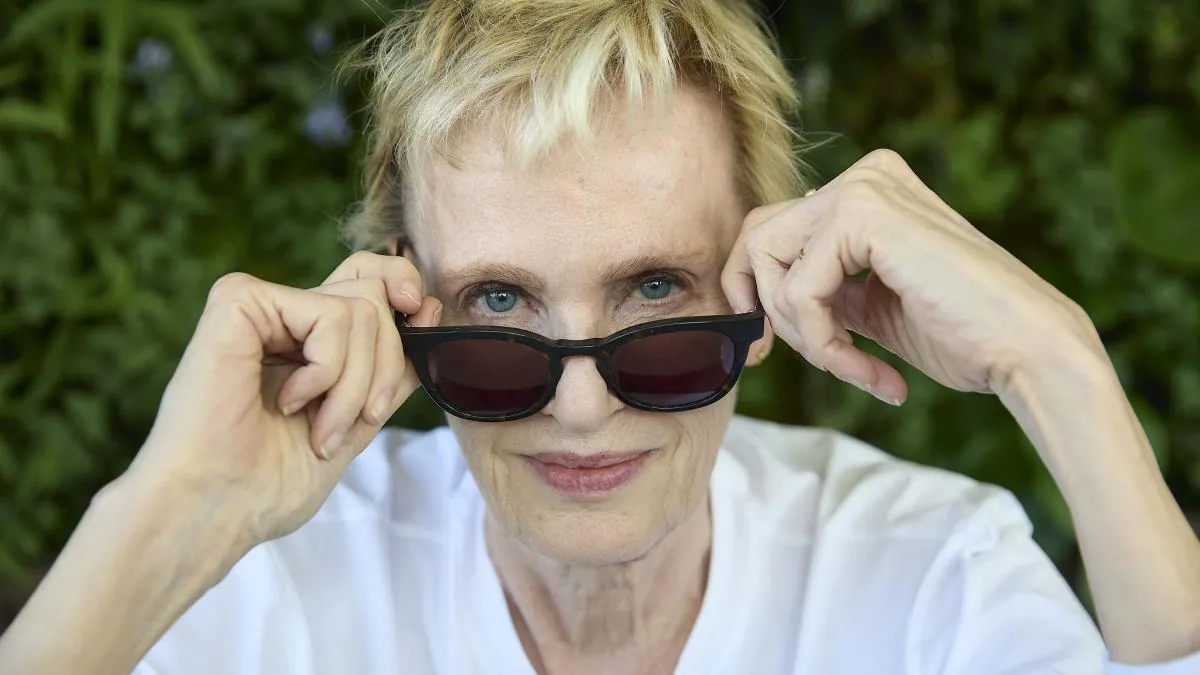
When her husband died two years ago, Siri Hustvedt (Minnesota, 1955) began writing Ghost Stories (Seix Barral/Edicions 62), a book that helped her face the abyss of “vanished time,” start the grieving process, and adjust to life alone after 43 years of marriage. If the one who left, a victim of cancer that the author describes with harshness but without losing her sense of humor, had not been Paul Auster, it would be the same, she admits, because this work is not a biography of the novelist, but a lost love song. “The most painful reality in this world is not loving someone and losing them to death, but the inability to love,” she argues.
Read more Enrique Riquelme: “Florentino’s Super League was a fairy tale, a joke”
The Mind and the Body
The process of completing is part of the presences: I knew it was Paul”
The first notes of the book are from just a few days after the burial, did you rewrite much later?
No. I started in mid-May. Paul passed away on the last day of April. And I had a clear idea. I knew what I was going to include. Some things never changed, like the first paragraphs. I simply wrote them. Then there were other parts of the book, some of the more reflective ones, where I rewrote and often deleted text to prevent the balance from sinking. Especially scientific reflections on presences and grief, to make sure the overall rhythm was right.
The presence, or appearance, of Paul Auster occurred on the same day as his burial and for you it was a very happy experience. Do you long for his return?
You can’t control that. I tried to make it very clear, because it has a long history in neurological literature. And I had read a lot about presences before having mine. I also mentioned that, when I was a teenager, in puberty, I experienced a very negative presence at the foot of the stairs. It was not something unknown to me. The interesting thing about this occasion was that it never returned. Some people have them repeatedly. After writing this book, many people have told me about their presences. But I think what happens is that one’s subjective perceptual reality is radically altered by death.
Even to the supernatural?
The nervous system is very sensitive to deprivation. At night we dream, create images, and if you put someone in a sensory deprivation tank, after ten minutes they start to hallucinate spontaneously. We all have a blind spot in both eyes. We never see it. And we should see it. From a scientific point of view, there is no reason why we don’t see it. We mentally complete it, and I think that process of completing is part of the presences. Some people have full hallucinations with the dead. In my case, I knew it was Paul. I knew he was there looking at me, checking that I was okay. And it was wonderful. In extreme situations it is more likely. This sensation of presence is a very well-known phenomenon in neurology, and that is why I quote William James, who has absolute certainty that this “something” is part of the experience. A combination of philosophical, phenomenological, and neurological work can partly explain this. Does it explain everything? No.
Grief and Absence
“The beats of my existence were completely altered”
You state that the grief was not only for Paul, but also for seeing yourself alone, without your partner.
Read more The teachers’ strike affects traffic again: closures on the C-32 and delays in both directions
The moment immediately after death is a shock to subjective phenomenology, our sensory and intellectual reality of life. And when you lose your partner or someone you have lived with for years, you lose that rhythm of everyday life, of daily reality. I knew Paul had died. I held him while he died. So no one had to tell me. I didn’t expect him to come through the door. I didn’t expect to wake up next to him. None of that. But the rhythm of my life, the beats of existence, were completely altered by his absence. Two years have passed since his death and that reality is slowly beginning to adapt to that lack.
The Limits of Physics
“My stance is that of embodied neuroscience: there is no consciousness without a body”
Based on your scientific inquiries, you question the separation between body and mind in Western culture. You argue that physics cannot explain consciousness…
Yes. I have been studying the mind-body problem for many years and physics is only part of it. My stance, in fact, largely coincides with what is now known as the new generation of neuroscientists, who have adopted an embodied perspective on consciousness. In other words, there is no consciousness without a body. Unlike Descartes, who had a dualist stance: here is the mind, it has no extension, so it is a different substance from the body.
And now artificial intelligence has arrived…
The oldest stance goes back to Turing. It’s interesting, because when he talks about machine consciousness, he says that maybe we can replicate forms of intelligence in a machine, but there are many things a machine will not be able to do, and he mentions food, sex, and sports. And that is completely true. These kinds of human pleasures are not really possible in a machine. And then there is Hobbes, who had a completely mechanistic view of both thought and movement and everything else. That is why there are people in the AI field who say they will upload their consciousness into a machine and that way it will be preserved forever. It’s a version of Descartes. I don’t believe in that. I believe we are embodied creatures and that our consciousness cannot be reduced to the brain.
Why not?
Well, it’s not that hard to understand. We can’t do it because we are constantly in a loop. With what is outside of us and with others. And that means you can’t say that memory is the hippocampus, or that balance is the cerebellum, or that our executive functions are in the prefrontal cortex. That’s where my criticism lies. Many scientists agree with me. So it’s not unscientific or even anti-physical. Physicists tend to be Platonists, because they deal with really mysterious things, right? Quantum physics is mysterious.
Very much so, certainly…
I met Carlo Rovelli on the jury of a philosophy prize. I had already read his books. He talks about relationship, about the between, about what I discuss with Siri and Paul. It’s a fundamental aspect of the universe, that’s how he interprets entanglement and those kinds of complicated things. I don’t know how to do the calculations, but I do know that the idea of relationship and what I call the between can be approached from multiple points of view, including physics and biology. There is an example I love, something called intrinsically disordered proteins. Scientists have known about them for a long time, but they thought they were exceptions and set them aside. Now they know that the higher the level or the more complex the organism, the more of these proteins are present. They are wild, untamable, and what they end up doing depends entirely on the protein they associate with.
Read more Trump’s Peace Board sinks in Gaza