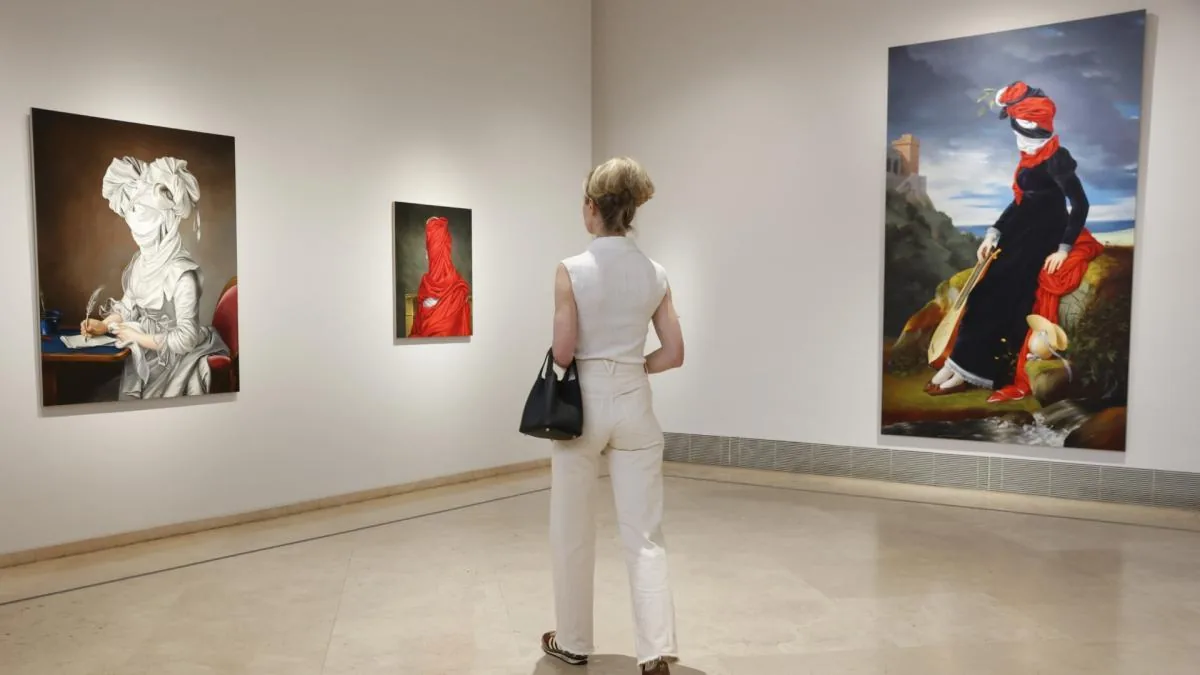
Faceless women… or rather with their faces hidden by hair, veiled by dresses, or even covered by a still life. The Polish painter Ewa Juszkiewicz presents about twenty unsettling portraits at the Thyssen-Bornemisza National Museum, from May 26 to September 6, which will not leave visitors indifferent.
Read more Madrid quantifies the medical strike: 10,470 surgeries and 215,344 consultations suspended
Born in 1984 in Gdansk, where she trained at the classical academy of fine arts, Juszkiewicz deconstructs the tradition of the female portrait to denounce the stereotyped image that patriarchal society has offered of the woman’s face. “I question the representation of femininity,” the artist said about the intention of her work during the presentation of the exhibition, the first solo show she has held in a museum.
And indeed she questions it, because this series of 24 portraits on which Juszkiewicz has been working from 2013 until 2026 is as unsettling as even “sinister” for the viewer, according to the definition of the Thyssen’s artistic director, Guillermo Solana, who is also the curator of the exhibition.
The “radical transformation” of historical portraits, especially from the 18th and 19th centuries that inspire the artist, fits for Solana into the tradition of appropriation art, the same that led to the creation of collage in the 1920s or pop art in the 1960s, but Juszkiewicz takes a twist on the appropriationism of the neo-conceptual artists of the 1980s, whose work was mainly based on photography, and adopts the pictorial language for her proposal.
And it is this mix of classical craftsmanship, one might say virtuoso, and contemporary features such as the large format of the oils and the saturation of color that gives Juszkiewicz’s work that disconcerting air, who had always been interested in masks, Solana has recounted. Even to the point of completely disfiguring them to nullify the human face in a “cancellation” that deconstructs the entire genre of the portrait.
Read more Madrid suffers major closures on the La Castellana axis due to the Pope’s visit
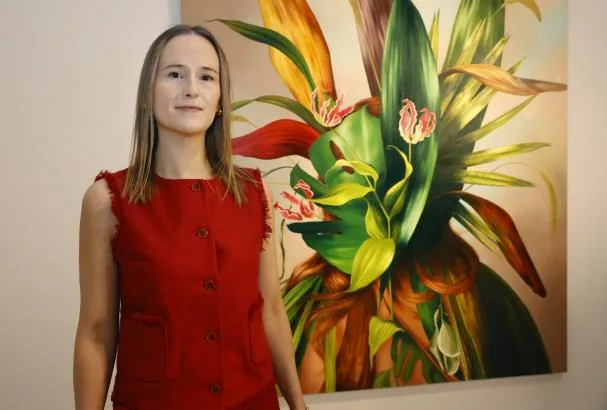
“The result is terribly attractive, even decorative, and at the same time unsettling, in the tradition of surrealism,” said the Thyssen’s artistic director, for whom Juszkiewicz’s work represents a “projectile” that “intimidates” the viewer to the point of “shock,” as it attacks the conventions of the male and patriarchal gaze on the female figure and questions the norms of decorum and beauty.
However, Solana pointed out, this apparent “cruelty” exercised on the female face, the only refuge of authenticity, of individuality, that women preserved in times when they had been reduced to a “gigantic decorative trinket,” is not an attack on their personality, but a denunciation of the absurd conventionalisms of power.
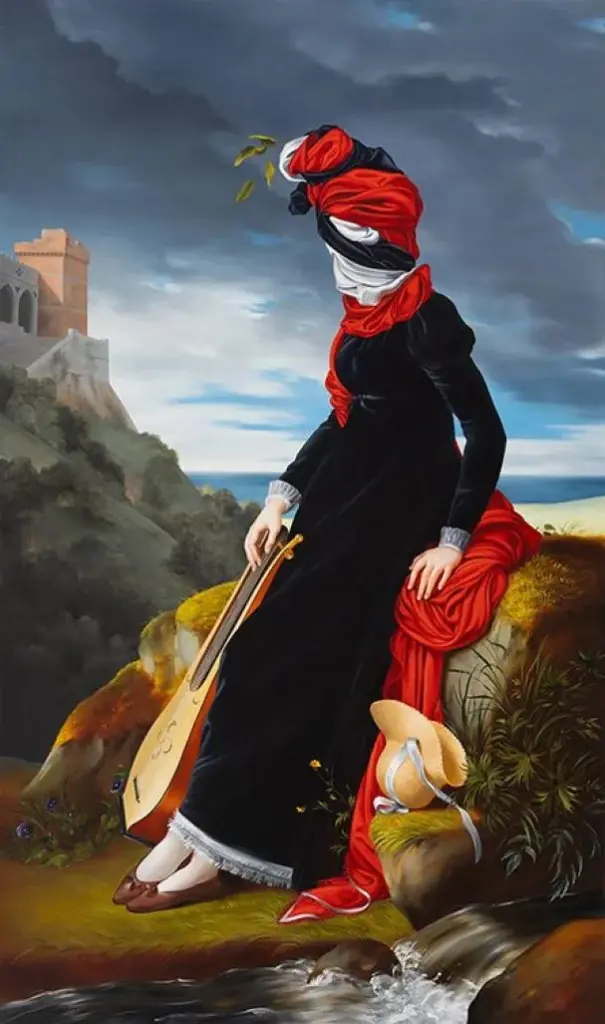
And the artist herself has expanded on this thesis, who, after acknowledging the influence of surrealist painters like Dalí or Magritte, but also of designer Elsa Schiaparelli and other artists like Oppenheim, explained her working method: “I challenge and deform the works I base myself on to question tradition and seek a space for reflection, a new conversation with art,” Juszkiewicz said.
Read more Alicante cannot find a site for the La Albufereta Bonfire less than a month before the festival