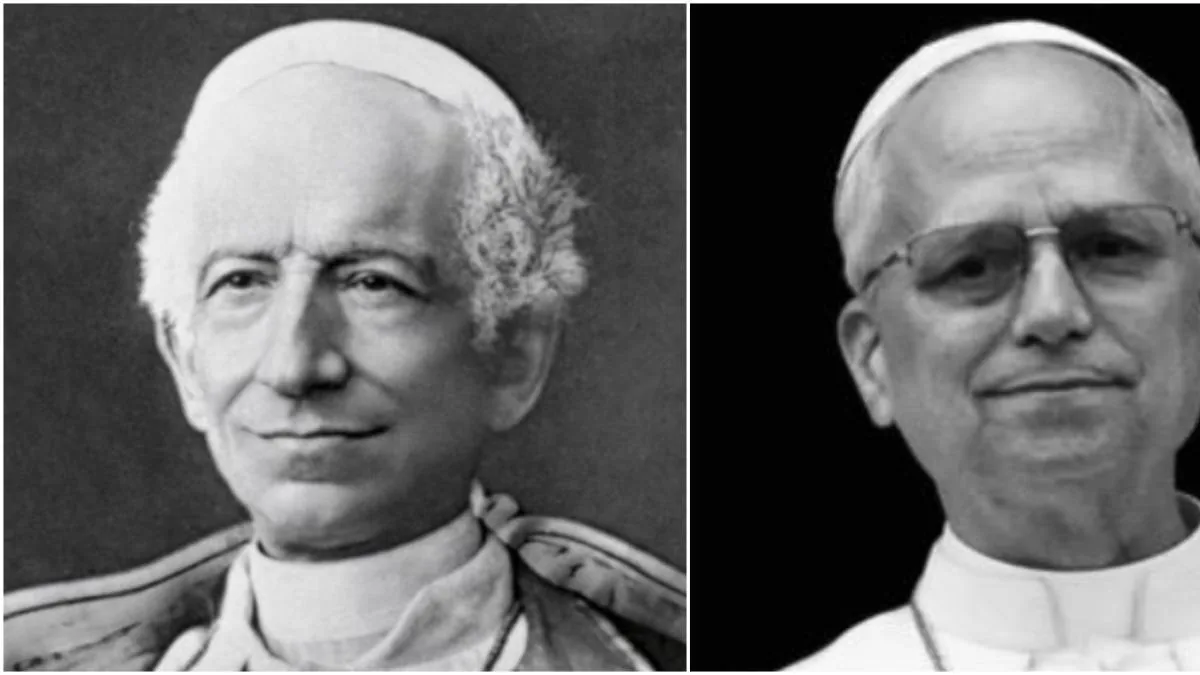
‘Rerum novarum’. Encyclical promulgated on May 15, 1891, by Pope Leo XIII, in which the foundations of the social doctrine of the Catholic Church are laid.
Read more ‘Magnifica humanitas’ by Leo XIV, a social encyclical
Awakened by the revolutionary itch that has been stirring peoples for some time, it was to be expected that the eagerness to change everything would one day spill over from the field of politics to the adjacent field of economics. Indeed, the advances in industry and the arts, which are moving along new paths; the change in mutual relations between employers and workers; the accumulation of wealth in the hands of a few and the poverty of the vast majority; the greater confidence of workers in themselves and their closer cohesion, together with the relaxation of morals, have determined the setting of the conflict. How great and important the matters involved are is seen by the sharp anxiety in which all minds live; this same thing activates the ingenuity of the learned, informs the meetings of the wise, the assemblies of the people, the judgment of legislators, the decisions of rulers, to the point that there seems to be no other topic that can more deeply occupy the hopes of men.
(…)
The matter is difficult to handle and not without dangers. It is truly difficult to determine the rights and duties within which the rich and the proletarians, those who provide capital and those who provide labor, must remain. It is a dangerous discussion, because it is often used by turbulent and cunning men to twist the judgment of truth and to seditiously incite the mobs. Be that as it may, we clearly see, something on which all agree, that it is urgent to timely provide for the welfare of humble people, since the majority struggle indecorously in a miserable and calamitous situation, as the old guilds of artisans dissolved in the past century, without any support to fill their void, public institutions and the laws of the religion of our ancestors neglected, time has insensibly delivered workers, isolated and defenseless, to the inhumanity of employers and the unrestrained greed of competitors. The evil was worsened by voracious usury, which, repeatedly condemned by the authority of the Church, is nevertheless practiced by greedy and avaricious men under a different appearance. Add to this that not only labor contracts but also commercial relations of all kinds are subject to the power of a few, to the point that a very small number of wealthy and rich people have imposed little less than the yoke of slavery on an infinite multitude of proletarians (…)
To solve this evil, socialists, fanning the hatred of the poor against the rich, try to abolish private property of goods, considering it better that, instead, all goods be common and managed by the people who govern the municipality or the nation. They believe that with this transfer of private goods to the community, distributing wealth and well-being equally among all citizens, the present evil could be cured. But this measure is so inadequate to resolve the conflict that it even harms the working classes themselves; and it is, moreover, extremely unjust, as it exerts violence against legitimate owners, alters the mission of the republic, and fundamentally agitates nations.
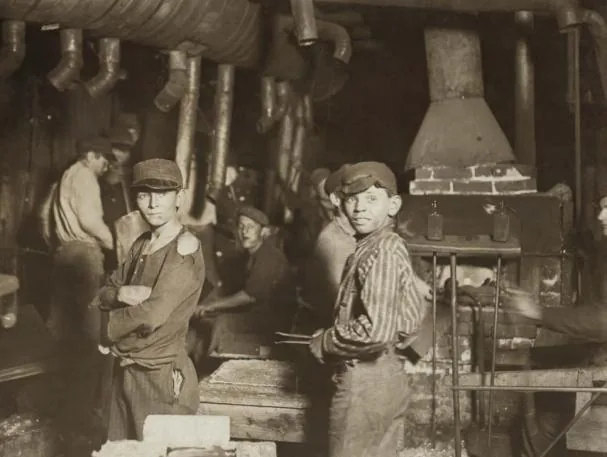
Undoubtedly, as is easy to see, the very reason for the work provided by those engaged in some lucrative trade and the primary goal sought by the worker is to provide something for himself and to own something as his own by right. If, therefore, he lends his strength or skill to another, he will do so for this reason: to obtain what is necessary for food and clothing; and for this, by means of the work provided, he acquires a true and perfect right not only to demand wages but also to use them as he wishes. Then if, by reducing his expenses, he saves something and invests the fruit of his savings in a property, with which he can better secure his maintenance, this property is really nothing other than the same wages dressed in another appearance, and hence the property acquired by the worker in this way must be as much under his control as the wages earned with his work. Now: this is precisely what constitutes, as can be easily inferred, the ownership of things, both movable and immovable. Then socialists worsen the situation of all workers insofar as they try to transfer private goods to the community, since by depriving them of the freedom to place their profits, they thereby rob them of hope and the ability to increase family assets and obtain benefits.
What most contributes to the prosperity of nations is the probity of customs, the right and orderly constitution of families, the observance of religion and justice, moderate public burdens and their equitable distribution, the progress of industry and commerce, flourishing agriculture, and other factors of this kind, if they remain, which, the more eagerly they are promoted, the better and more happily citizens will be able to live. Through these things, it is within the reach of rulers to benefit other social orders and greatly alleviate the situation of proletarians, and this by the best right and without the slightest suspicion of interference, since the State must watch over the common good as its own mission.
(…)
The first thing to do is to free poor workers from the cruelty of the ambitious, who abuse people without moderation, as if they were things for their personal gain. That is, neither justice nor humanity tolerates the demand for such performance that the spirit is dulled by excessive work and at the same time the body succumbs to fatigue. As with everything in human nature, its efficiency is circumscribed within certain limits, beyond which one cannot go. Certainly, it sharpens with exercise and practice, but always on the condition that work is interrupted from time to time and rest is allowed.
(…)
It must be ensured, therefore, that the daily working hours do not extend beyond what the strength allows. Now: how long the rest interval should be will be determined by the type of work, the circumstances of time and place, and the very condition of the workers. The hardness of the work of those engaged in quarrying stones or in iron, copper, and other similar mines must be compensated by the brevity of its duration, as it requires much more effort. If the worker receives a sufficiently large wage to support himself, his wife, and his children, given that he is prudent, he will easily incline to saving and will do what nature itself seems to advise: reduce expenses so that there is something left to gradually build a small patrimony. For we have already seen that the issue we are dealing with cannot have an effective solution unless it is assumed and accepted that the right of property must be considered inviolable. Therefore, laws must favor this right and provide, as far as possible, that the majority of the working mass owns something.
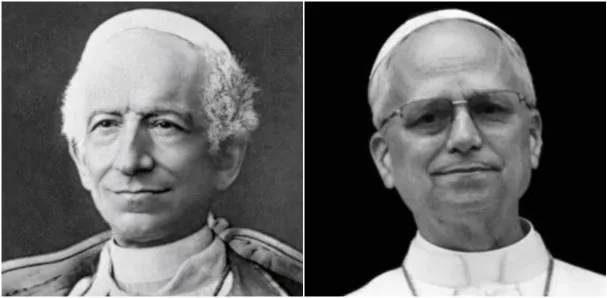
‘Magnifica humanitas’. Encyclical promulgated on May 21, 2026, by Pope Leo XIV on human nature and the new artificial intelligence. A document that will open a great worldwide discussion.
The MAGNIFICENT HUMANITY that God has created today faces a decisive choice: to build a new Tower of Babel or to build the city where God and humanity dwell together. Each generation receives as an inheritance the task of shaping its own time: to mature history as a place where the dignity of each person is protected, justice is promoted, and fraternity is made possible. But in every era, there is the risk of building an inhuman and more unjust world. Where humanity risks losing its face, we Christians raise our eyes to the God who became flesh, knowing that “the mystery of man is only clarified in the mystery of the Incarnate Word.”1 In Jesus Christ, this magnificent humanity finds the way, the truth, and the life, opening to each of us the path to grow toward fullness.
Read more The Pope, against the technooligarchs
Observing our time, we cannot ignore that the protection of human rights today is exposed to two particularly serious risks. The first is that of a purely formal declaration, while, along with technological progress, violations of human dignity advance in a disguised or evident manner. The second, which is actually the basis of the first, is the inability to recognize the foundation of its universality, because the ‘search for the most solid foundations behind our choices and also our laws’ has been abandoned.
Pope Francis urged not to underestimate this latter problem. He recalled that when reason is seriously questioned about human nature, it is capable of discovering values applicable to all because they derive from it. If this search work were abandoned, it could happen that rights today considered untouchable would in the future end up being questioned or denied by those in power, perhaps after having obtained only apparent consensus from terrified or manipulated populations.
(…)
This paradigm has spread rapidly in recent years, also as an effect of the diffusion of AI, cognitive sciences, nanotechnology, robotics, and biotechnology. In themselves, these innovations can be a great help for integral human development and care of the common home. But precisely because of their power, they can act as an accelerator of the technocratic paradigm and, therefore, need a new spiritual, ethical, and political framework. More powerful does not necessarily mean better. In this sense, the words of Romano Guardini remain current: “Modern man is not prepared to use power wisely.”
(…)

For AI to respect human dignity and truly serve the common good, it is essential that responsibilities be clear at all stages: from those who design and program the systems to those who use them and those who decide to entrust them with concrete decisions. In many cases, however, the internal processes leading to a result may be opaque, making it more difficult to assign responsibilities and correct errors. This is where what we call responsibility becomes decisive: the possibility of identifying who must be accountable for decisions, justify them, control them, and, when necessary, question them and remedy the damages arising from them.
(…)
Entrusting in practice to an algorithm the power to select who is worthy and who is not, without anyone assuming the weight of the decision, means entrusting it with the task of redefining the limits of human possibilities. What diminishes in this process is not only empathy toward the excluded, which can be artificially imitated, but political responsibility, because the discarding of the weak is cloaked in neutrality and objectivity before which it is impossible to protest. And thus, injustice is silently realized and compassion, mercy, and forgiveness, not as mere appearance but as political gestures, disappear from the horizon.
(…)
We cannot limit ourselves to invoking the moralization of the machine, the so-called “alignment” of AI with human values, without having the courage to impose a further condition: the possibility of discussing the ethical code to be used, subjecting it to criteria of shared social justice. Otherwise, whoever controls AI will impose their own moral vision, which will become the invisible infrastructure of the systems. A more moral AI would be useless if this morality is decided by a few. A more present politics is needed, capable of slowing down where everything accelerates and protecting spaces where communities can continue participating and questioning (…)
Indeed, as with every great technological advance, AI tends to increase above all the power of those who already have economic resources, skills, and access to data. In light of the common good and the universal destination of goods, this phenomenon raises serious concern: small very influential groups can steer information and consumption, condition democratic processes, and influence economic dynamics for their own benefit, contradicting social justice and solidarity among peoples. Therefore, it is essential that the use of AI—especially when it involves public goods and fundamental rights—is accompanied by clear criteria and effective controls, inspired by participation and subsidiarity; communities and intermediate bodies cannot be reduced to recipients of decisions made elsewhere but must be able to contribute to discernment and oversight. (…)
Disarming AI means removing it from the logic of the arms race, which today is no longer only military but economic and cognitive. It is the race for the most effective algorithm and the largest database, to consolidate a geopolitical or commercial advantage over all others. Disarming means breaking this equivalence between technological power and the right to govern. Disarming does not mean renouncing technology but preventing it from dominating the human. It means removing it from monopolies, making it debatable, refutable, and therefore inhabitable, restoring in it the plurality of human cultures and ways of life. The task today is not only ethical or technical; it is ecological in the most radical sense, because it calls into question a new dimension of our common home. AI is already an environment in which we are immersed and a power we must face. Therefore, it is not enough to regulate it; it is necessary to disarm it and make it welcoming.
Read more The defense of Jonathan Andic will file the appeal against the detention order before Thursday