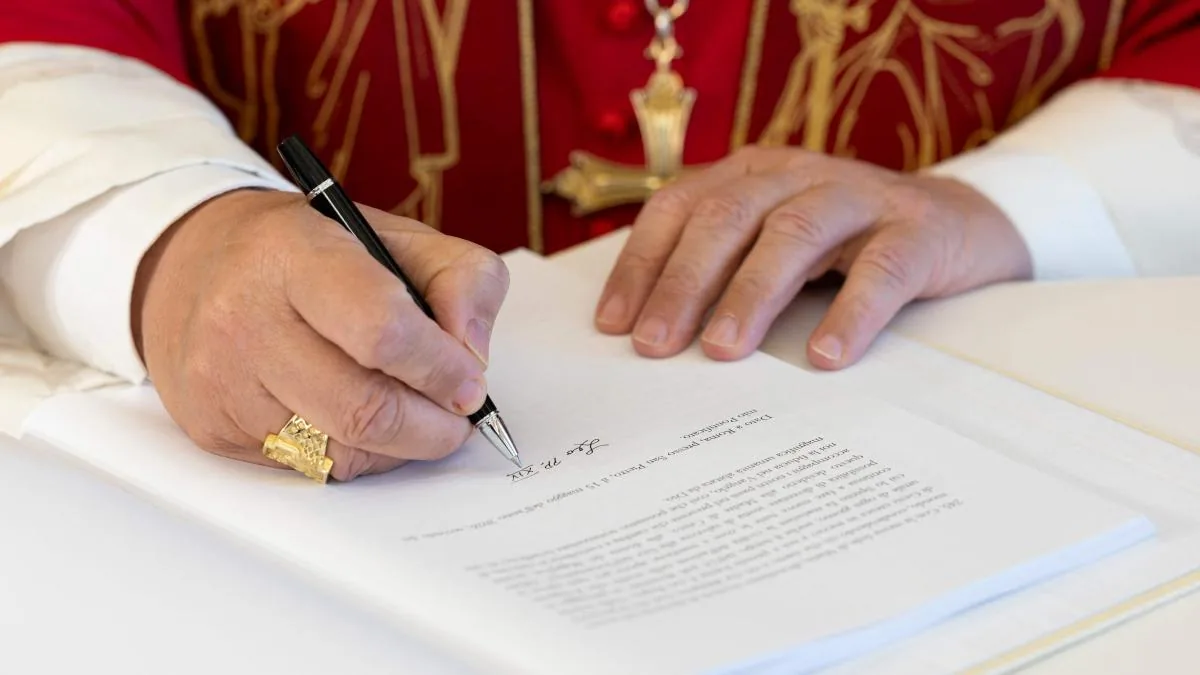
Artificial intelligence (AI) fascinates and repels, frightens and seduces, and is, above all, fundamentally mysterious, the ultimate reason for the fear it inspires in a broad majority. It has landed in our lives, and everything points to its impact being decisive in the world that awaits us, a world so imminent that we already feel its ripples. Leo XIV has therefore demonstrated clear and agile reflexes by dedicating his first encyclical, Magnifica humanitas, subtitled “On the custody of the human person in the time of artificial intelligence,” a letter to Catholics that secular society should also read carefully.
Read more The Pope, against the technooligarchs
When just over a year ago, Robert Francis Prevost, the first American in history to be elected pope, decided to call himself Leo XIV, he declared with the chosen name that the social doctrine of the Church would be at the center of his message. The Italian Pope Leo XIII published in 1891 the first social encyclical, Rerum novarum (Of New Things), dedicated to the terrible working conditions of workers during the Industrial Revolution.
Prevost believes that the social doctrine of the Church must now face this new industrial revolution, that of AI, which is beginning to transform the world, and possibly for the worse. In the distant times of Leo XIII, the steam engine and the mechanical loom were visible tools, assembled and with specific functions in the production chain in the factory. In the present times of Leo XIV, the machine causing the transformations has changed nature: artificial intelligence grows, learns, improves, and its applications in the most diverse fields are announced as infinite.
That is why, Prevost warns, AI, digitalization, and robotics cannot be left in the hands of a handful of billionaire technooligarchs. “In many cases, in the digital context, control of platforms, infrastructures, data, and computing power is not the prerogative of states, but of large economic and technological actors who, in fact, determine the conditions of access, the rules of visibility, and the very possibilities of participation – writes the Pontiff -. When such a power is concentrated in few hands, it tends to become opaque and evade public control, and the risk of distorted development that causes new dependencies, exclusions, manipulations, and inequalities grows.”
The spirit of the letter
Robert Francis Prevost’s first encyclical is a vindication of the principles of the social doctrine of the Catholic Church in the face of the most dizzying digital leap of the 21st century: artificial intelligence (AI)
Faced with this scenario, it reclaims the great principles of the social doctrine of the Church: the inalienable dignity of the person, the common good, the universal destination of goods, subsidiarity, solidarity, and social justice. Magnifica humanitas is not just an encyclical about technology; it is a vindication of the social doctrine of the Catholic Church in the face of the most dizzying digital leap of the 21st century. As a social encyclical related to AI, it addresses job destruction and the necessary protection of workers, and warns of the risk that the development of less favored peoples will become even more stalled.
It is also an encyclical about peace, another key of Leo XIV’s pontificate, which he also expressed on the very day of his election from the balcony of St. Peter’s Basilica: “The peace of Christ, an unarmed peace and a disarming peace, humble and persevering.”
Read more The defense of Jonathan Andic will file the appeal against the detention order before Thursday
One year later, he applies the word ‘disarm’ to artificial intelligence: “Disarming AI means removing it from the logic of the arms race, which today is no longer only military but economic and cognitive. It is the race for the most effective algorithm and the largest database, to consolidate a geopolitical or commercial advantage over all others. Disarming means breaking this equivalence between technological power and the right to govern. Disarming does not mean renouncing technology, but preventing it from dominating the human.”
And against the worrying rehabilitation in public discourse of war as just another instrument of international politics, and the consequent growth of a war industry that increasingly includes AI instruments, the Pope warns: “There is no algorithm that can make war morally acceptable.”
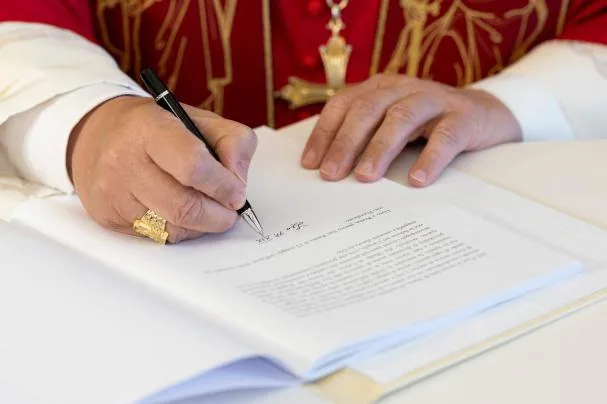
It is no coincidence that Leo XIV’s encyclical, presented on Pentecost Monday, is signed and dated May 15, 2026, the day marking 135 years since the signing of Rerum novarum by his predecessor in name. Magnifica humanitas is a social encyclical.
And it is no coincidence that the solution Robert Francis Prevost proposes to the AI crossroads is precisely the one practiced by Nehemiah in the biblical story of the reconstruction of the walls of Jerusalem, consisting of “building the city where God and humanity dwell together,” a metaphor for the need that all those involved in the sources of artificial intelligence do not forget the dignity of the human being. The other feasible path at this historical moment would be to raise AI as a new Tower of Babel, a colossal project with pride and without ethics. Against that model, the Pope warns with all his strength.
Read more The UDEF accuses Zapatero’s daughters of hiding bribes with fake invoices