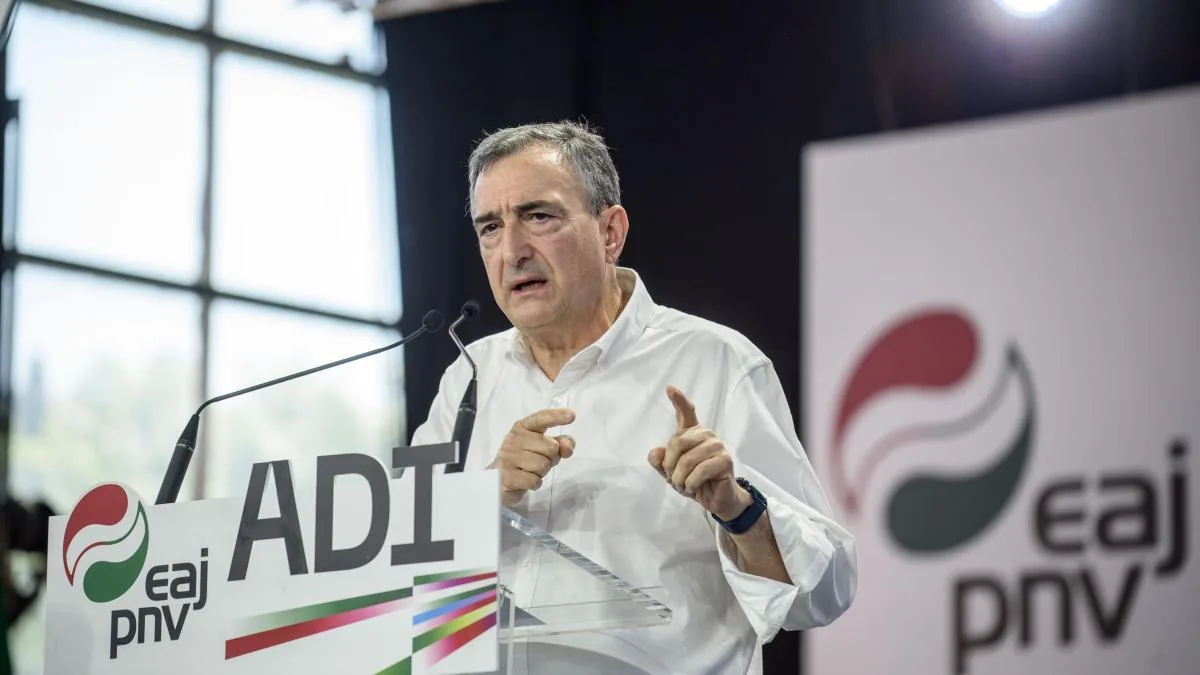
The warning has been measured, without fireworks or grand gestures, but it could hardly be more serious. The Basque Nationalist Party lit an amber light this Sunday amid the political fog surrounding Pedro Sánchez following the indictment of former president José Luis Rodríguez Zapatero. “It would be irresponsible” for the Government to continue “beyond 2026,” warned the PNV president, Aitor Esteban, in a message as restrained in form as it was severe in substance.
Read more Pep and the Clock That Changed Football
“This scenario makes it very difficult for Sánchez to complete the legislature. I would rather say it would be irresponsible to continue beyond 2026 without direction, without a budget, without a stable majority, and with an uncontrolled and judicialized agenda,” the PNV leader clarified from Durango (Bizkaia).
In Madrid, where politics usually unfolds at breakneck speed, the PNV’s message gains added value precisely because the Basque nationalists tend to operate with a different logic. They are not given to ultimatums or dramatic moves. They usually weigh every word with a mix of institutional prudence and strategic calculation. That is why, when Ajuria Enea lets slip a warning of this magnitude, the PSOE interprets it more as a sign of exhaustion than as a momentary outburst.
The context also multiplies the political reach of the move. The PNV governs in Euskadi thanks to the support of the Basque socialists. After the last regional elections, the nationalists managed to retain the lehendakaritza by a narrow margin against EH Bildu – a tie in seats and just a handful of votes difference. It was the PSOE’s support that allowed Imanol Pradales to remain at the head of the Basque Government. In that delicate balance, any message towards La Moncloa is always measured with its internal consequences in mind.
And precisely for that reason, the hardening of the tone is significant. Until now, the PNV had chosen to protect the investiture block even in the most complicated moments of the so-called Koldo case. The nationalists then understood that the investigations into José Luis Ábalos or Santos Cerdán affected specific leaders but did not necessarily erode the PSOE’s legitimacy as a government partner. However, that thesis begins to crack with the development affecting Zapatero.
Read more Cult of ‘gloss’: porcelain face and radiant lips
Because the former president represents another symbolic and political dimension. Not only because of the historical weight he retains within Spanish socialism but also because of the Venezuelan connection that appears in the background of the judicial investigation. And there arises an old discomfort in Basque nationalism. The PNV has never looked favorably on the relationship that certain sectors of the PSOE maintained for years with Chavismo. Venezuela is not a minor issue for the jeltzales.
That is why Esteban has wanted to explicitly distance himself. “Not everything goes here,” warned the PNV leader, who described Zapatero’s indictment as “very serious” and demanded “many explanations.” The Basque leader went even further by stating that the current scenario makes it “very difficult” for Sánchez to complete the legislature.
Even so, the PNV has also made its red lines clear. In Bilbao, they do not consider a motion of no confidence that depends on Vox. The Basque nationalists do not want to appear in any photo linking their initials with the Spanish far-right. And that greatly limits parliamentary alternatives. The message they convey is not so much that of an immediate replacement as that of an orderly exit. An early election before wear and tear ends up dragging the entire investiture block down.
Read more Perfumes, formulas and millions: Spain, a world power in beauty (although few people know it)