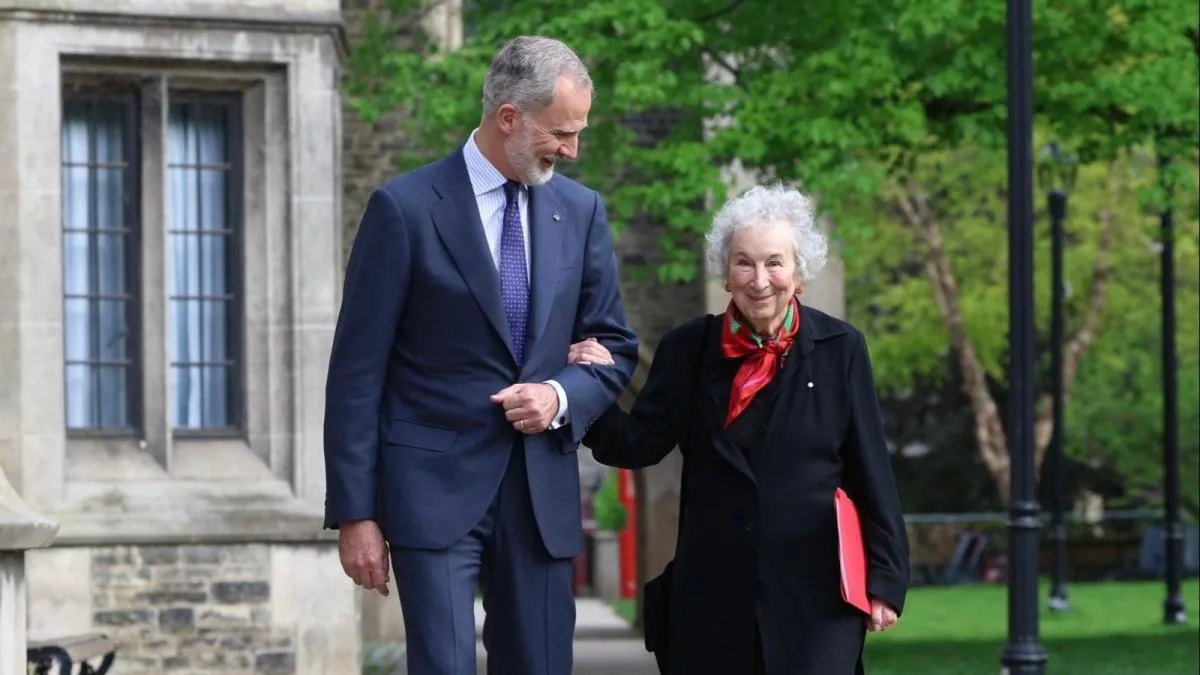
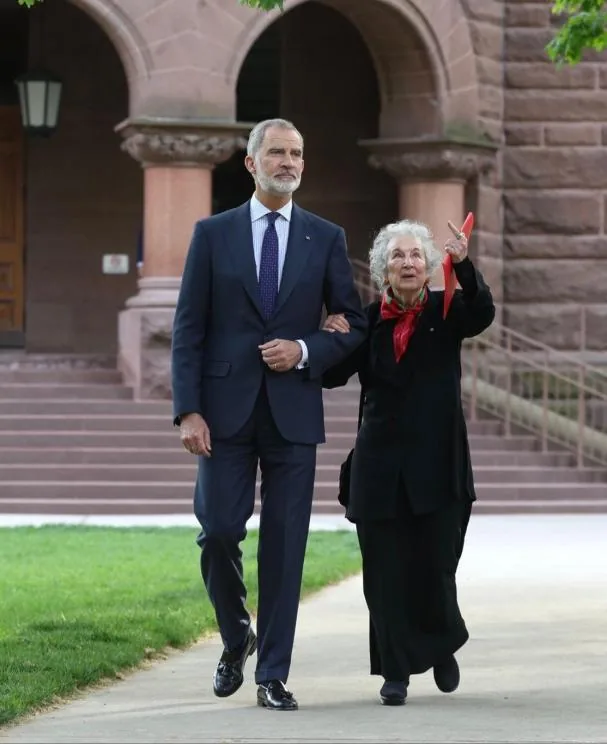
Every poem is an act of hope on the part of the poet, and so proclaimed Margaret Atwood, much more than the author of The Handmaid’s Tale. The 86-year-old Canadian writer received the Joan Margarit poetry award this Wednesday from the hands of the King, in an event held at Victoria College of the University of Toronto, where a king and a poet were seen walking across the campus.
Eighteen years after receiving the Prince of Asturias Award for Literature in Oviedo, Margaret Atwood met again with Felipe de Borbón and both recalled that moment while walking arm in arm, before entering the room where the Joan Margarit Poetry Award ceremony was held. Promoted by the Instituto Cervantes, the publisher La Cama Sol, and the family of the late Catalan poet, previous editions awarded the American poet Sharon Olds and the Asturian Antonio Gamoneda.
Margaret Atwood, fragile in appearance but strong in her convictions, received a loud and prolonged applause after the King handed her the award in the form of an art book, enclosed in a methacrylate case. It was the moment to deliver a thank-you speech that the Canadian writer titled Poetry in Hard Times, in which she began by denouncing that “when political regimes have violently changed, poets have been among the first to be silenced, because they could say the forbidden, and say it convincingly, and that is threatening to autocrats.” She emotionally recalled “the sad fate” of poets such as Federico García Lorca, Pablo Neruda, Víctor Jara, or Osip Mandelstam and, at the same time, warned that “such stories continue again and again, tracing back to the mythical pattern of murdered poets: Orpheus, the magical singer torn apart in Greek legend.”
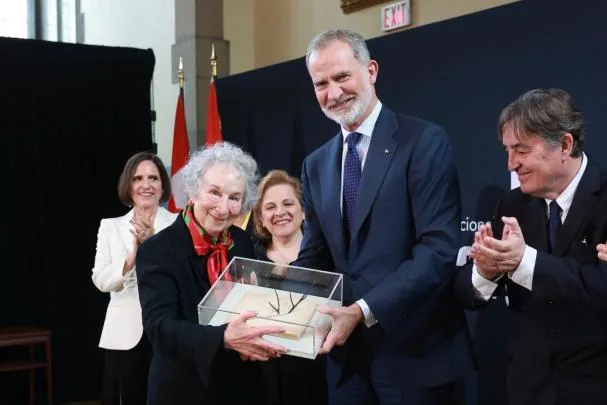
It was not an optimistic speech, although Atwood, like Gabriel Celaya, spoke of poetry as a weapon loaded with hope and freedom. “We need poetry,” said the awardee, “precisely when it seems most impossible: in the darkest hours, in times of turmoil, uncertainty, and fear, in times of wavering faith.”
“Every poem,” Atwood continued, “is an act of hope on the part of the poet, whatever its content. I hope to finish this poem. I hope it is good. I hope it goes out into the world and reaches those who need it. I hope it is received as a gift. And, in dark times, I hope it represents what we need most then:
Atwood wondered what value poetry has in these times when “after a long period of relative stability, we find ourselves again in turmoil.” She continued: “The doomsday clock keeps ticking and the future is uncertain, to put it mildly.” What will come next? Extreme weather events, terrorism, plagues, more wars, social collapses? Instability caused by massive job losses due to artificial intelligence? Democracies undermined and hollowed out from within? Police states with brutality, violence, corruption, and new intense forms of surveillance? Popular uprisings? The war of all against all?.
Atwood, who regretted not having met Margarit in life, of whom she said she felt connected by age and having grown up in post-war times, thanked the presence at the ceremony of the daughter and grandson of the late Catalan poet; of Luis García Montero, director of the Instituto Cervantes, and especially the King. “It is very kind of him,” said Atwood, “to come to Canada at this time, a time when international ties and friendships are increasingly important for those of us fortunate enough to still live in democracies.
The King closed the ceremony with a praise of the awardee to whom he expressed his gratitude for “teaching society to read better, to read our time, to read our societies, and to read ourselves.” Felipe VI described Atwood as “a brilliant novelist, committed intellectual, lover and teacher of nature, pastry artist, reader of cards and hands, astrologer and —of course— poet… A soul that reflects that of an entire country. Because only Canada could have produced such a multifaceted personality.”
The King also referred to Margaret Atwood’s sharp sense of humor, who has witnessed “the best and the worst,” hinting at “some dangers of dystopian futures,” situations that the speaker himself hoped would not materialize.
Felipe VI acknowledged that for him, as for many Spanish readers, the first encounter with this immense country that is Canada came through literature and, in particular, through the work — novels, poems, stories, and essays — of Margaret Atwood.
The King also recalled in his words the figure of Joan Margarit, not only for his status as a “great poet,” both in Catalan and Spanish, awarded the Cervantes Literature Prize in 2019, but also as an architect and professor. Mónica Margarit and her grandson Pol Lezcano, daughter and grandson of the late Catalan poet, participated in the ceremony, reading some of his poems.
The director of the Instituto Cervantes, Luis García Montero, recalled the figure of Joan Margarit and explained how the Canadian writer, with her perspective and defense of human rights, “delves into the intimacy of life experience and identity, celebrating political commitment, joy, and activism of the heart.”
Read more A man dies trapped between his car and a column in a garage in Madrid