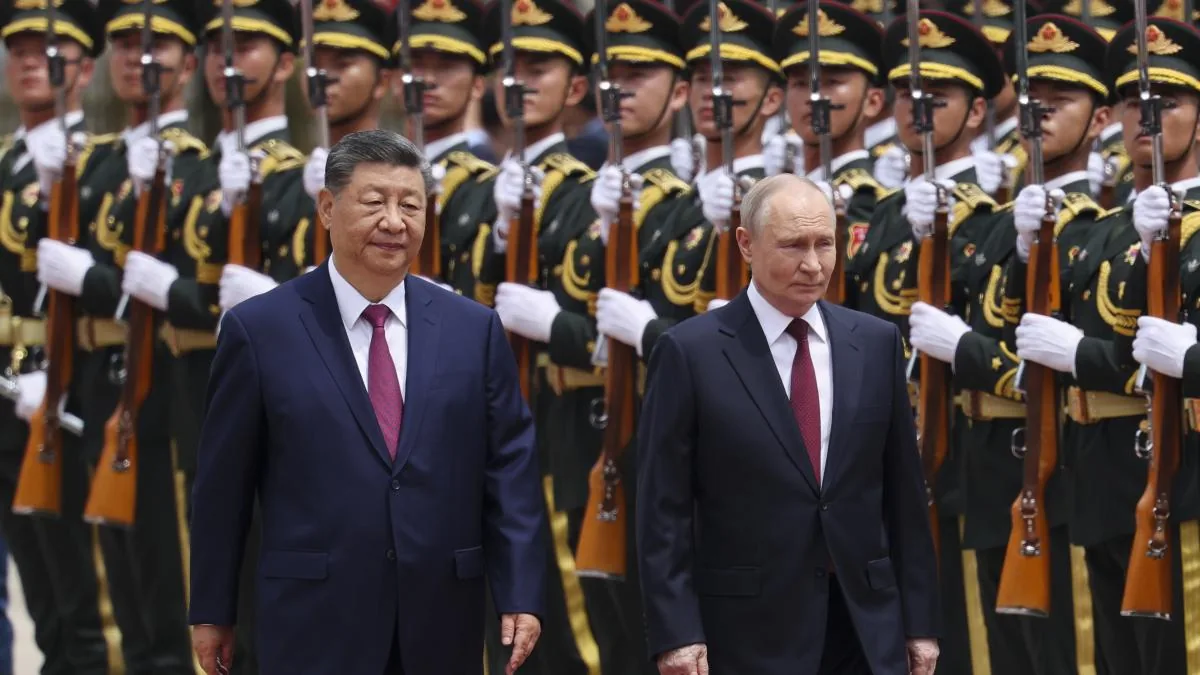
Chinese President Xi Jinping may have been formal in his welcome to his Russian counterpart, Vladimir Putin, this Wednesday at the Great Hall of the People in Beijing. However, he chose to call for “an immediate cessation of all hostilities in the Middle East,” noting that their resurgence would be “even more serious.” At the end of their meeting, both leaders signed a joint declaration in favor of “a multipolar world.” Otherwise, according to them, the current “disregard for international legality” and global institutions leads us to “the law of the jungle.”
Read more United States charges Raúl Castro for the death of four Americans in 1996
It is obvious that the unnamed recipient of these and other criticisms is Donald Trump. The same U.S. president who, between last Thursday and Friday, sat at the same endless table and had tea in the same Zhongnanghai gardens.
See, for example, the explicit condemnation, in the same statement, “of any foreign interference in Latin America, under any pretext.” Including “human rights.” After the fall of his Venezuelan ally, Xi and Putin do not take lightly Trump’s threats to also take over the island of Cuba, deprived of oil.
The presidents of Russia and China also condemn the “bloc politics,” which includes “the isolation of North Korea.” Instead of sanctions, they propose “a negotiated resolution of the Korean issue.” They also criticize “the militarization of the Arctic.” However, there is silence regarding the invasion of Ukraine, beyond the call to go “to the roots of the problem.” In this regard, Putin thanked “China’s neutrality.”
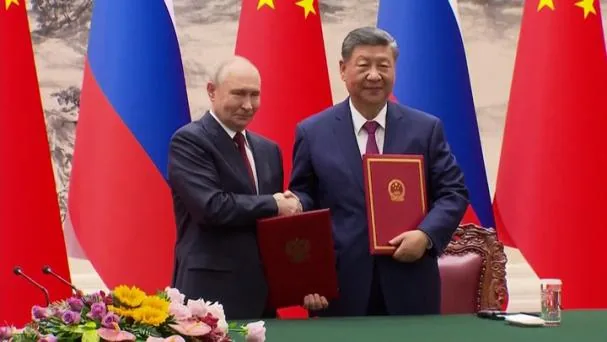
Xi, for his part, called to take the “strategic coordination” between Russia and China “to an even higher level.” As part of this, the Power of Siberia 2 gas pipeline project receives a new boost.
No matter how much they broaden the focus, it is reasonable to think that the “critical” situation in Iran has captured their attention. Both governments share an interest in preventing Washington from overthrowing the current Iranian regime to replace it with another aligned one, as was the case with the Shah. Iran is a key piece in their respective geopolitical puzzles. Both for the New Silk Roads to reach the Mediterranean and for the North-South Transport Corridor to connect the Russian Baltic with the Arabian Sea. Although the Guardians of the Revolution have shown they can defend themselves alone, their accuracy would not have been the same without Russian and Chinese satellites and positioning systems.
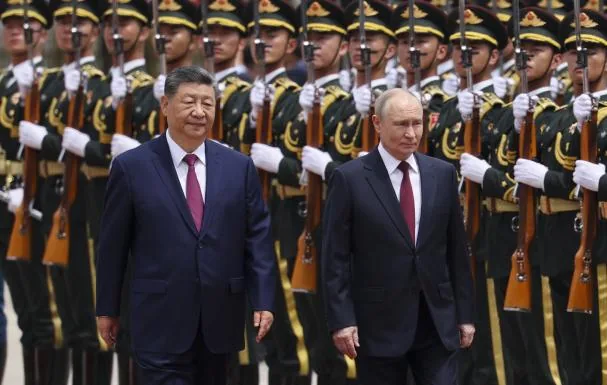
Putin was accompanied by no fewer than eight ministers, as well as the top officials of Gazprom, Rosatom, and Roscosmos. Before them, Xi repeated the same phrase he articulated before Trump last Thursday: “The international situation is fluid and turbulent.” This time with an addendum: “And unilateral and hegemonic ambitions are resurging. But peace, development, and cooperation among peoples will prevail.”
It is known, in any case, that among the more than twenty agreements later signed, 25 years after the Treaty of Friendship and Good Neighborliness, those of an energy, space, educational, or scientific nature stand out.
Read more Mango tries to reassure its workers: “The collaboration has been and will be maximum”
Geography and oil
Iran is a key piece for the trade corridors of Russia and Iran
A Kremlin spokesperson assures that the Russian president’s visit is not a reaction to Trump’s visit, but was planned since the phone call Putin and Xi had last March. The upheaval in the global hydrocarbon supply, in any case, is benefiting not only U.S. exporters but also the Russians.
It is hard to imagine a better context to try to close the details of the Power of Siberia 2 gas pipeline project, already included in the new Chinese five-year plan.
This one, 6,700 kilometers long (compared to the very distant 4,000 of Power of Siberia 1, completed in December 2019) draws from the same field, in the Arctic Yamal Peninsula, as the sabotaged Nordstream. Until recently, Beijing hesitated. Now the reliability of the land supply by Russia—in this case, via Mongolia—with long-term contracts, gains strength with the double blockade in force over the Strait of Hormuz.
It is worth remembering that both countries secure their payments. China pays for Russian oil in yuan and for Russian gas in yuan and rubles. But Beijing is in less of a hurry than Russia to finalize the price and the fine print of the supply. It might be better to do so at the end of 2027, when the EU has committed to reducing its imports of Russian gas to zero.
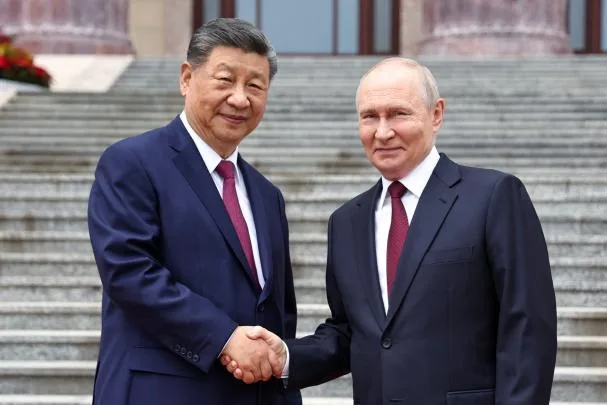
Despite the obvious political harmony with Russia, China does not neglect its commercial relationship with the U.S., which remains its primary market and a vastly more important investor. The Chinese Ministry of Commerce announced today that the purchase of 200 Boeing airplanes announced by Donald Trump will become a reality and that it is working hard to extend the one-year tariff truce agreed last fall in Korea.
Pressure on the petrodollar
China pays for Russian oil in yuan and for Russian gas in yuan and rubles, 50% each
China and Russia strive to strengthen relations and have decided to extend the mutual visa exemption until the end of 2027. But reality is stubborn. The U.S. continues to attract twice as many Chinese tourists and five times as many Chinese students. Although China has been Russia’s top trading partner for 16 years, Russia is only the eighth for China. Siberia is vast and not far from them, but strength and energy are not everything.
Late Wednesday, Putin flew back to Russia after a stay of less than 24 hours. Even so, the Chinese official press has reasons to boast about Beijing’s rapid consolidation, in the last six months, as the “epicenter of world diplomacy.” Xi Jinping will hardly have a break before the next visit, this very Sunday, of the President of Serbia, Aleksandar Vucic.
Read more The charitable foundation of discord between Jonathan and Isak Andic